Helmholtz-Institute for Biomedical Engineering, Stem Cell Biology and Cellular Engineering, RWTH Aachen Faculty of Medicine, Aachen, Germany.
Institute of Human Genetics, RWTH Aachen Faculty of Medicine, Aachen, Germany.
Sci Rep. 2018 Aug 3;8(1):11676. doi: 10.1038/s41598-018-30069-6.
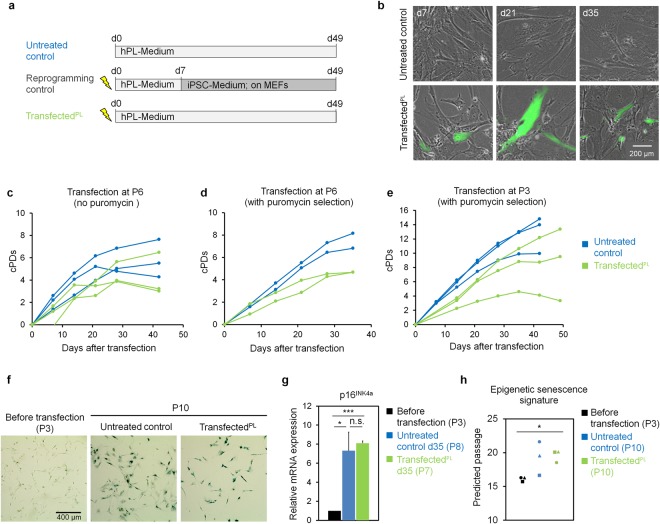
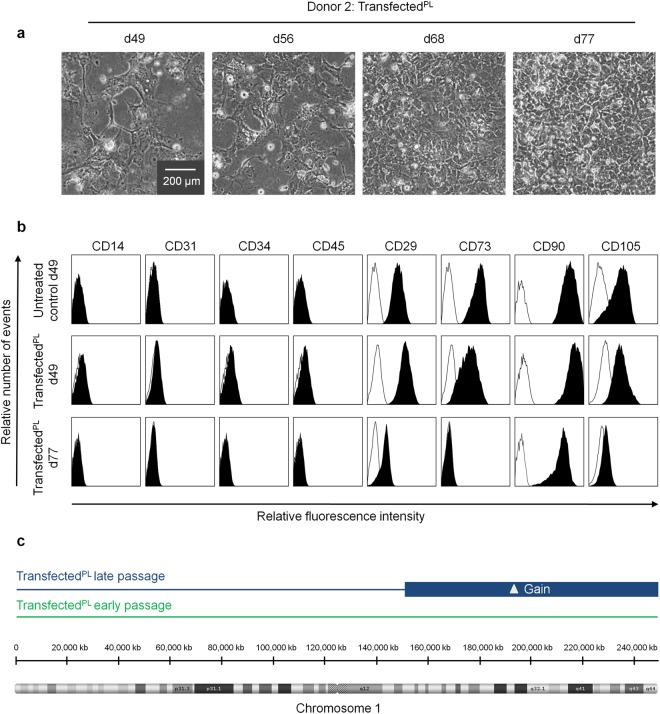
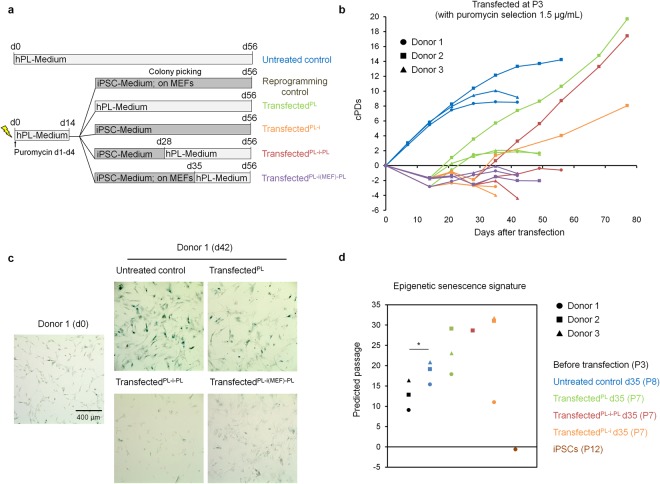
Replicative senescence hampers application of mesenchymal stromal cells (MSCs) because it limits culture expansion, impairs differentiation potential, and hinders reliable standardization of cell products. MSCs can be rejuvenated by reprogramming into induced pluripotent stem cells (iPSCs), which is associated with complete erasure of age- and senescence-associated DNA methylation (DNAm) patterns. However, this process is also associated with erasure of cell-type and tissue-specific epigenetic characteristics that are not recapitulated upon re-differentiation towards MSCs. In this study, we therefore followed the hypothesis that overexpression of pluripotency factors under culture conditions that do not allow full reprogramming might reset senescence-associated changes without entering a pluripotent state. MSCs were transfected with episomal plasmids and either successfully reprogrammed into iPSCs or cultured in different media with continuous passaging every week. Overexpression of pluripotency factors without reprogramming did neither prolong culture expansion nor ameliorate molecular and epigenetic hallmarks of senescence. Notably, transfection resulted in immortalization of one cell preparation with gain of large parts of the long arm of chromosome 1. Taken together, premature termination of reprogramming does not result in rejuvenation of MSCs and harbours the risk of transformation. This approach is therefore not suitable to rejuvenate cells for cellular therapy.
复制性衰老会阻碍间充质基质细胞 (MSCs) 的应用,因为它限制了培养扩增、损害了分化潜能,并阻碍了细胞产品的可靠标准化。MSCs 可以通过重编程为诱导多能干细胞 (iPSCs) 来恢复活力,这与年龄和衰老相关的 DNA 甲基化 (DNAm) 模式的完全擦除有关。然而,这个过程也伴随着细胞类型和组织特异性表观遗传特征的擦除,这些特征在重新分化为 MSCs 时不会被重新表达。在这项研究中,我们因此遵循了这样一个假设,即在不允许完全重编程的培养条件下过表达多能性因子可能会重置衰老相关的变化,而不会进入多能状态。MSCs 用附加体质粒转染,要么成功地重编程为 iPSCs,要么在不同的培养基中连续传代培养每周一次。过表达多能性因子而不进行重编程既不能延长培养扩增,也不能改善衰老的分子和表观遗传特征。值得注意的是,转染导致一个细胞制剂的永生化,获得了 1 号染色体长臂的大部分。总之,过早终止重编程不会导致 MSCs 的年轻化,并存在转化的风险。因此,这种方法不适合用于细胞治疗的细胞年轻化。