Seager R J, Hajal Cynthia, Spill Fabian, Kamm Roger D, Zaman Muhammad H
Department of Biomedical Engineering, Boston University, 44 Cummington Mall, Boston MA 02215.
Department of Mechanical Engineering, Massachusetts Institute of Technology, 77 Massachusetts Avenue, Cambridge, MA 02139.
Converg Sci Phys Oncol. 2017;3. doi: 10.1088/2057-1739/aa7e86. Epub 2017 Jul 28.
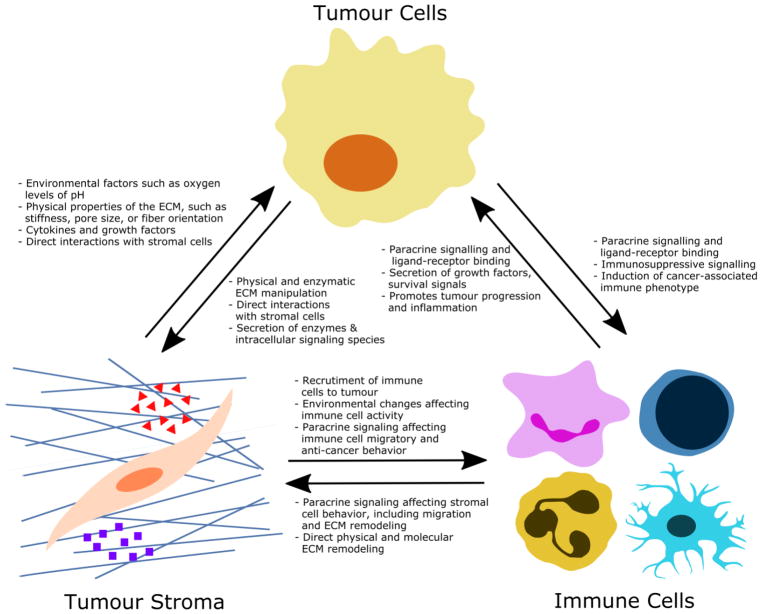
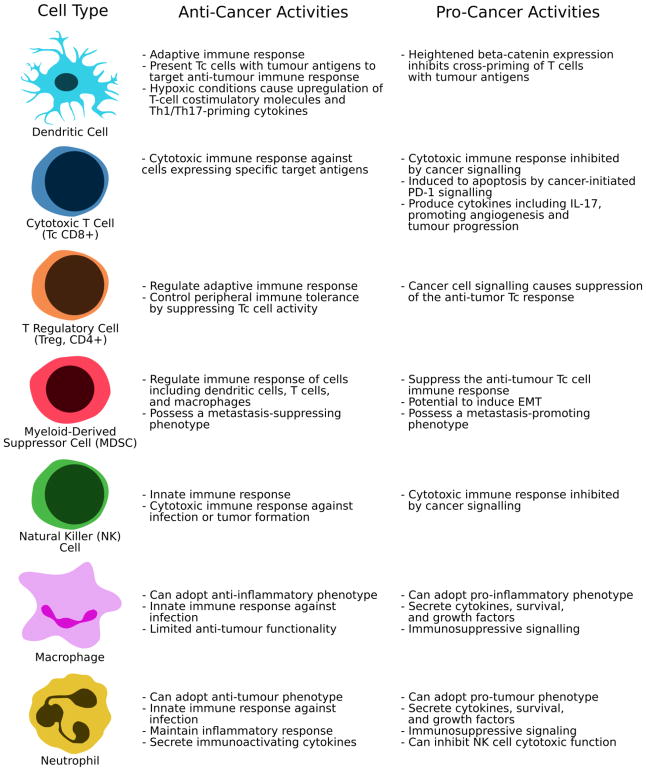
In the tumour microenvironment, cancer cells directly interact with both the immune system and the stroma. It is firmly established that the immune system, historically believed to be a major part of the body's defence against tumour progression, can be reprogrammed by tumour cells to be ineffective, inactivated, or even acquire tumour promoting phenotypes. Likewise, stromal cells and extracellular matrix can also have pro-and anti-tumour properties. However, there is strong evidence that the stroma and immune system also directly interact, therefore creating a tripartite interaction that exists between cancer cells, immune cells and tumour stroma. This interaction contributes to the maintenance of a chronically inflamed tumour microenvironment with pro-tumorigenic immune phenotypes and facilitated metastatic dissemination. A comprehensive understanding of cancer in the context of dynamical interactions of the immune system and the tumour stroma is therefore required to truly understand the progression toward and past malignancy.
在肿瘤微环境中,癌细胞直接与免疫系统和基质相互作用。人们已经确切了解到,免疫系统在历史上被认为是机体抵御肿瘤进展的主要部分,但肿瘤细胞可对其进行重编程,使其失效、失活,甚至获得促肿瘤表型。同样,基质细胞和细胞外基质也具有促肿瘤和抗肿瘤特性。然而,有强有力的证据表明,基质与免疫系统也会直接相互作用,从而在癌细胞、免疫细胞和肿瘤基质之间形成三方相互作用。这种相互作用有助于维持具有促肿瘤免疫表型并促进转移扩散的慢性炎症性肿瘤微环境。因此,要真正理解肿瘤向恶性发展及之后的进程,就需要在免疫系统与肿瘤基质动态相互作用的背景下全面了解癌症。