Department of Nutritional Sciences, School of Allied Health Sciences, University for Development Studies, P O Box 1883, Tamale, Ghana.
Nutr J. 2018 Aug 11;17(1):75. doi: 10.1186/s12937-018-0386-2.
Ramadan is a monthlong fast for healthy adolescents and adult Muslims. The quality of foods eaten and eating patterns in Ramadan may be different from other months of the year. Food intake of adolescents is a concern as energy and nutrient requirements are higher and needed to support the growth spurt of this stage. The objective of the present study was to describe the food patterns, dietary diversity and body weight changes among adolescents during Ramadan.
A prospective cohort study design with four measurement points (baseline, midline, endline and post endline) was conducted among 366 adolescents in Junior High Schools. Food pattern was assessed with a food frequency questionnaire, a 24-h dietary recall was used to assess dietary diversity and body weight was measured using an electronic scale. A repeated measures ANOVA was used to compare changes in dietary diversity scores (DDS) and weight of pupils.
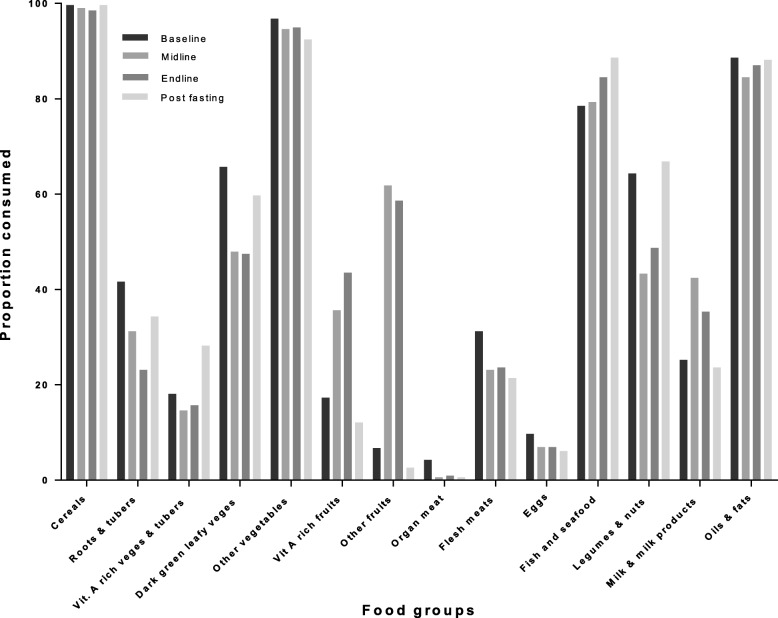
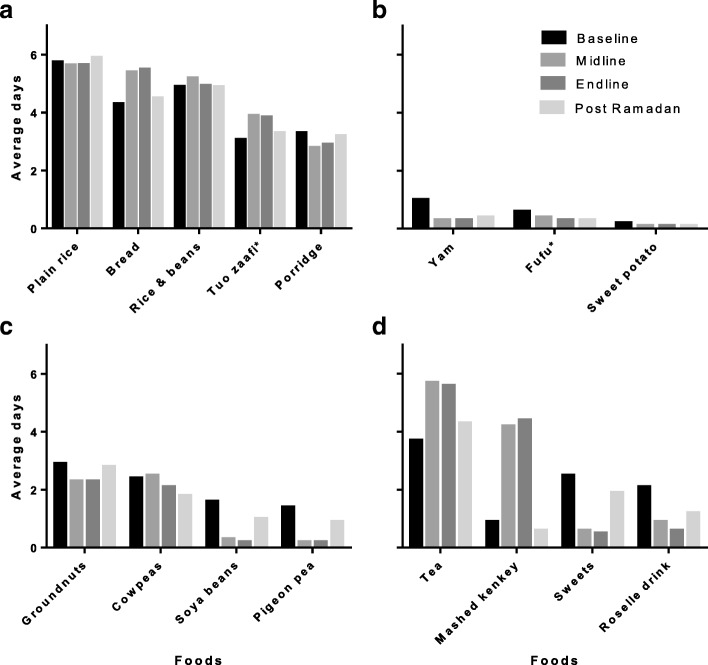
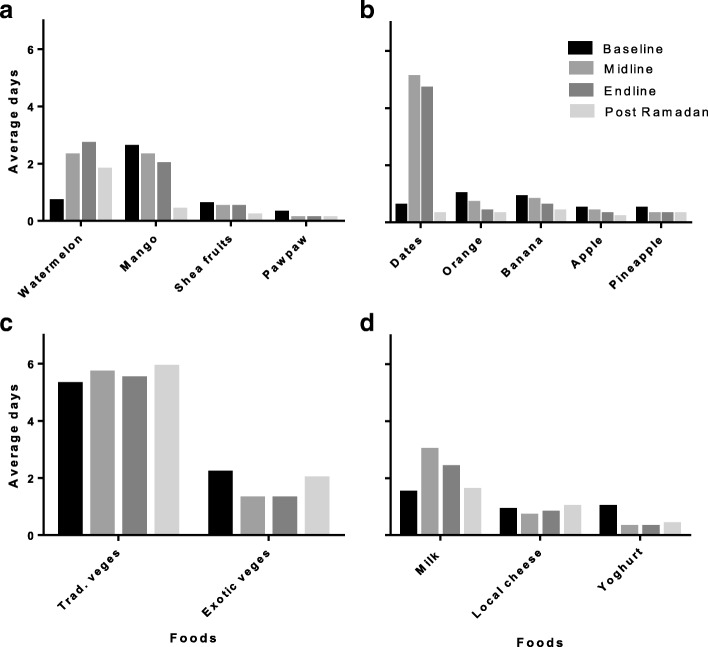
Half of the pupils (50.3%) were female and average age was 15.9 ± 1.8 years. Pupils fasted for an average of 28.3 ± 4.0 days and 14.3 ± 0.5 h a day (dawn to dusk) during Ramadan. The number and types of dishes taken at meal times differed substantially between Ramadan periods and outside Ramadan. Consumption of vitamin A-rich fruits, other fruits, and milk and milk products increased markedly during Ramadan. However, fasting came with a reduction in consumption of foods from roots and tubers, legumes and nuts, and dark green leafy vegetables while other food groups remained unchanged. Mean DDS increased significantly during Ramadan (F (2.933, 1070.573) = 7.152, p < 0.001) while mean daily meal frequency decreased (F (2.936, 1071.623) = 51.653, p < 0.001). There was significant body weight loss (-1.5 kg (95% CI: -1.1 kg to -1.6 kg)) among adolescents (F (2.656, 958.95) = 304.90, p < 0.001). Weight loss was short-lived; regained one month after Ramadan.
In this prospective cohort study among schooling Ghanaian adolescents who fast during Ramadan, fasting was characterised by marked changes in usual food patterns, increased dietary diversity and significant body weight loss.
斋月是健康的青少年和成年穆斯林进行的一个月禁食。在斋月期间,所食用食物的质量和饮食习惯可能与一年中的其他月份有所不同。青少年的食物摄入量是一个值得关注的问题,因为他们的能量和营养需求较高,需要支持这个阶段的生长突增。本研究的目的是描述青少年在斋月期间的食物模式、饮食多样性和体重变化。
在初中的 366 名青少年中进行了一项前瞻性队列研究设计,有四个测量点(基线、中线、终线和终线后)。使用食物频率问卷评估食物模式,使用 24 小时膳食回忆评估饮食多样性,使用电子秤测量体重。使用重复测量方差分析比较学生的饮食多样性评分(DDS)和体重变化。
一半的学生(50.3%)是女性,平均年龄为 15.9±1.8 岁。学生平均斋戒 28.3±4.0 天,每天斋戒 14.3±0.5 小时(从黎明到黄昏)。在斋月期间和斋月之外,用餐时间所吃的菜肴数量和类型有很大差异。在斋月期间,富含维生素 A 的水果、其他水果以及牛奶和奶制品的消费量显著增加。然而,禁食导致根茎类蔬菜、豆类和坚果以及深绿色叶菜类食物的消费量减少,而其他食物组保持不变。在斋月期间,平均 DDS 显著增加(F(2.933,1070.573)=7.152,p<0.001),而每日用餐频率降低(F(2.936,1071.623)=51.653,p<0.001)。青少年体重显著下降(-1.5 公斤(95%CI:-1.1 公斤至-1.6 公斤))(F(2.656,958.95)=304.90,p<0.001)。体重减轻是短暂的,在斋月结束一个月后恢复。
在这项对在斋月期间禁食的加纳在校青少年进行的前瞻性队列研究中,禁食的特点是通常的食物模式发生显著变化、饮食多样性增加和体重显著下降。