Babaliari Eleftheria, Petekidis George, Chatzinikolaidou Maria
Department of Materials Science and Technology, University of Crete, Crete 70013, Greece.
Foundation for Research and Technology-Hellas (FORTH), Institute of Electronic Structure and Laser (IESL), Crete 70013, Greece.
Bioengineering (Basel). 2018 Aug 12;5(3):66. doi: 10.3390/bioengineering5030066.
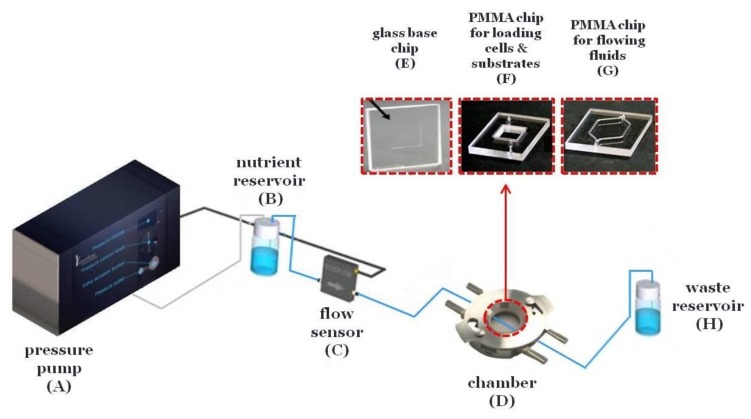
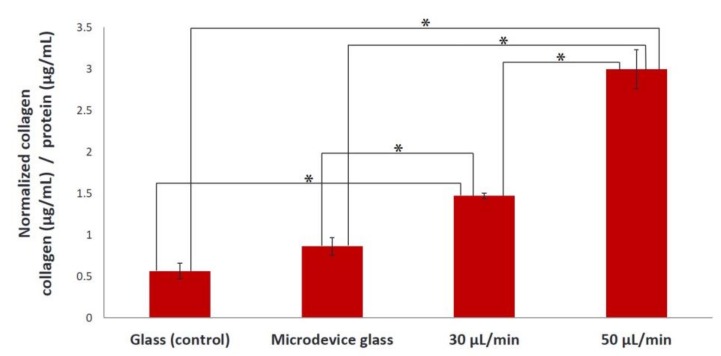
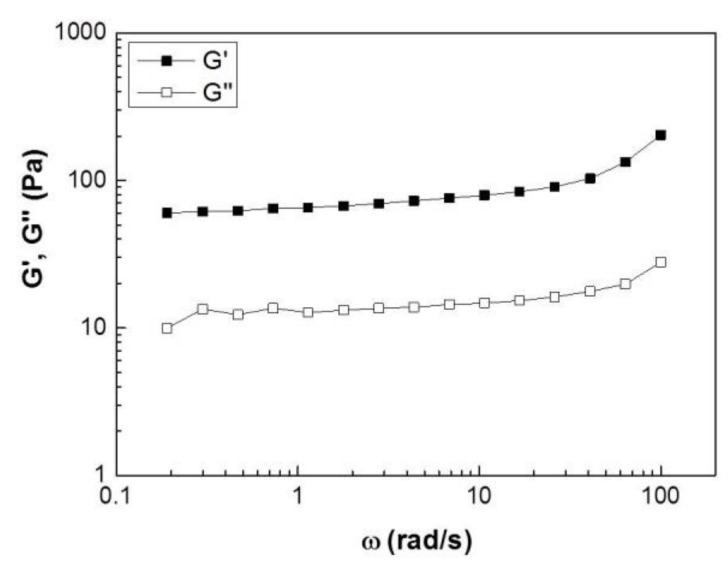
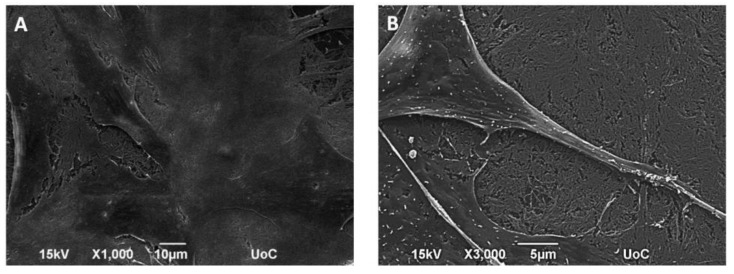
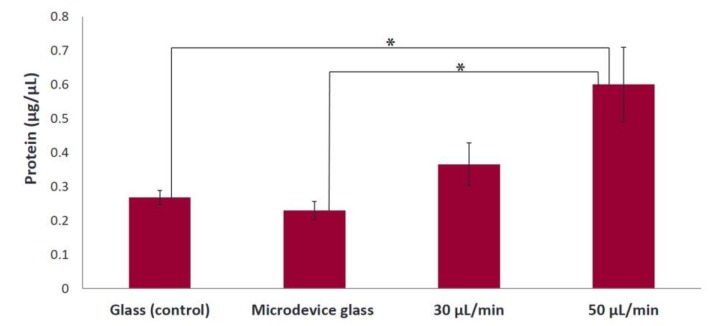
Bone tissue engineering provides advanced solutions to overcome the limitations of currently used therapies for bone reconstruction. Dynamic culturing of cell-biomaterial constructs positively affects the cell proliferation and differentiation. In this study, we present a precisely flow-controlled microfluidic system employed for the investigation of bone-forming cell responses cultured on fibrous collagen matrices by applying two flow rates, 30 and 50 μL/min. We characterized the collagen substrates morphologically by means of scanning electron microscopy, investigated their viscoelastic properties, and evaluated the orientation, proliferation and osteogenic differentiation capacity of pre-osteoblastic cells cultured on them. The cells are oriented along the direction of the flow at both rates, in contrast to a random orientation observed under static culture conditions. The proliferation of cells after 7 days in culture was increased at both flow rates, with the flow rate of 50 μL/min indicating a significant increase compared to the static culture. The alkaline phosphatase activity after 7 days increased at both flow rates, with the rate of 30 μL/min indicating a significant enhancement compared to static conditions. Our results demonstrate that precisely flow-controlled microfluidic cell culture provides tunable control of the cell microenvironment that directs cellular activities involved in bone regeneration.
骨组织工程为克服目前用于骨重建的治疗方法的局限性提供了先进的解决方案。细胞-生物材料构建体的动态培养对细胞增殖和分化有积极影响。在本研究中,我们展示了一种精确流量控制的微流控系统,该系统通过应用30和50 μL/min两种流速来研究在纤维状胶原基质上培养的成骨细胞反应。我们通过扫描电子显微镜对胶原基质进行形态学表征,研究其粘弹性特性,并评估在其上培养的前成骨细胞的取向、增殖和成骨分化能力。与静态培养条件下观察到的随机取向相反,细胞在两种流速下均沿流动方向取向。培养7天后,两种流速下细胞的增殖均增加,其中50 μL/min的流速与静态培养相比有显著增加。7天后,两种流速下碱性磷酸酶活性均增加,其中30 μL/min的流速与静态条件相比有显著增强。我们的结果表明,精确流量控制的微流控细胞培养提供了对细胞微环境的可调控制,可指导参与骨再生的细胞活动。