Ma Xiaoping, Shi Wentian, Peng Lina, Qin Xuying, Hui Yuzuo
Department of Gynecology and Obstetrics, The Affiliated Liaocheng People's Hospital of Shandong University, Liaocheng 252000, Shandong Province, PR China.
Department of Neurosurgery, The Affiliated Liaocheng People's Hospital of Shandong University, Liaocheng 252000, Shandong Province, PR China.
Saudi J Biol Sci. 2018 Jul;25(5):863-867. doi: 10.1016/j.sjbs.2017.10.020. Epub 2018 Feb 7.
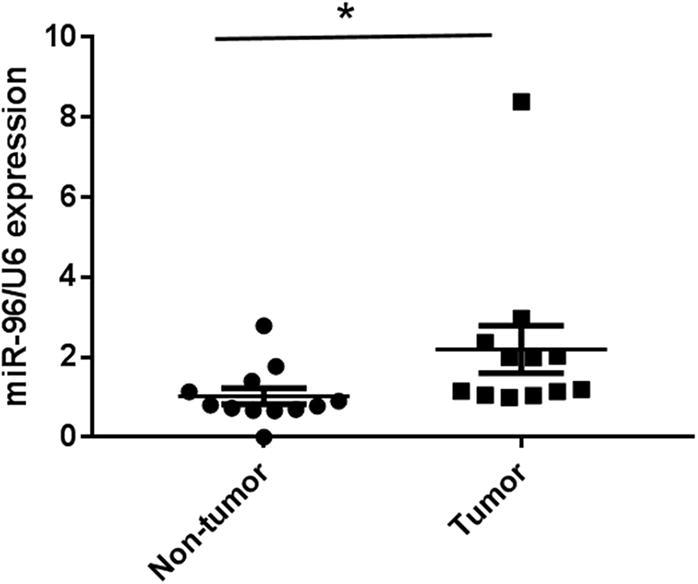
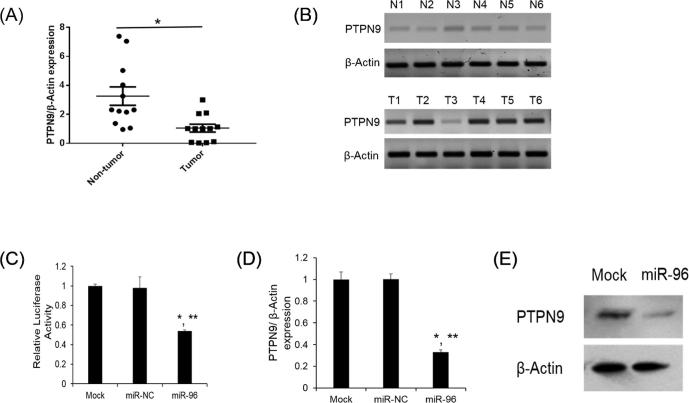
Up to date, the cervical cancer remains to be one of the leading gynecological malignancies worldwide. MicroRNAs (miRNAs) play critical roles in the process of tumor initiation and progression. However, miR-96 has rarely been investigated in human cervical carcinoma. We aimed to investigate the biological function and underlying molecular mechanism of miR-96 in human cervical carcinoma. MiR-96 levels were determined by qRT-PCR. Protein tyrosine phosphatase, non-receptor type 9 (PTPN9) mRNA and protein levels were investigated by qRT-PCR and western blotting. The cellular proliferation in cervical cells was monitored by CyQuant assay. Soft agar assay was employed to determine the tumorigenicity. 3' UTR luciferase assay was used to validate the target gene of miR-96. SPSS was used to analyze statistical significance in different treatment. MiR-96 was dramatically upregulated in human cervical tumor tissues. Overexpression of miR-96 was found to significantly promote the cellular proliferation and tumorigenicity of cervical cells. Furthermore, we showed that PTPN9 was a direct target gene of miR-96 and had opposite effect to those of miR-96 on cervical cells. MiR-96 may promote the cellular proliferation and tumorigenicity of cervical cells by silencing PTPN9. Our study highlights an importantly regulatory role of miR-96 and suggests that an appropriate manipulation of miR-96 may be a new treatment of human cervical carcinoma in the future.
迄今为止,宫颈癌仍是全球主要的妇科恶性肿瘤之一。微小RNA(miRNA)在肿瘤发生和发展过程中发挥着关键作用。然而,miR-96在人类宫颈癌中的研究却很少。我们旨在研究miR-96在人类宫颈癌中的生物学功能及潜在分子机制。通过qRT-PCR检测miR-96水平。采用qRT-PCR和蛋白质印迹法研究蛋白酪氨酸磷酸酶非受体9型(PTPN9)的mRNA和蛋白水平。通过CyQuant检测法监测宫颈细胞的增殖情况。采用软琼脂检测法确定致瘤性。运用3'UTR荧光素酶检测法验证miR-96的靶基因。使用SPSS分析不同处理中的统计学意义。miR-96在人类宫颈肿瘤组织中显著上调。发现miR-96过表达可显著促进宫颈细胞的增殖和致瘤性。此外,我们表明PTPN9是miR-96的直接靶基因,其对宫颈细胞的作用与miR-96相反。miR-96可能通过沉默PTPN9促进宫颈细胞的增殖和致瘤性。我们的研究突出了miR-96的重要调控作用,并表明对miR-96进行适当调控可能是未来治疗人类宫颈癌的一种新方法。