School of Agricultural and Veterinarian Sciences, São Paulo State University (Unesp), Via de Acesso Prof. Paulo Donato Castelane, S/N, Vila Industrial, FCAV/UNESP, Jaboticabal, São Paulo, 14884-900, Brazil.
Wageningen University & Research Animal Breeding and Genomics, P.O. Box 338, 6700 AH, Wageningen, The Netherlands.
BMC Genomics. 2018 Aug 16;19(1):619. doi: 10.1186/s12864-018-5003-4.
In livestock, residual variance has been studied because of the interest to improve uniformity of production. Several studies have provided evidence that residual variance is partially under genetic control; however, few investigations have elucidated genes that control it. The aim of this study was to identify genomic regions associated with within-family residual variance of yearling weight (YW; N = 423) in Nellore bulls with high density SNP data, using different response variables. For this, solutions from double hierarchical generalized linear models (DHGLM) were used to provide the response variables, as follows: a DGHLM assuming non-null genetic correlation between mean and residual variance (r ≠ 0) to obtain deregressed EBV for mean (dEBV) and residual variance (dEBV); and a DHGLM assuming r = 0 to obtain two alternative response variables for residual variance, dEBV and log-transformed variance of estimated residuals (ln_[Formula: see text]).
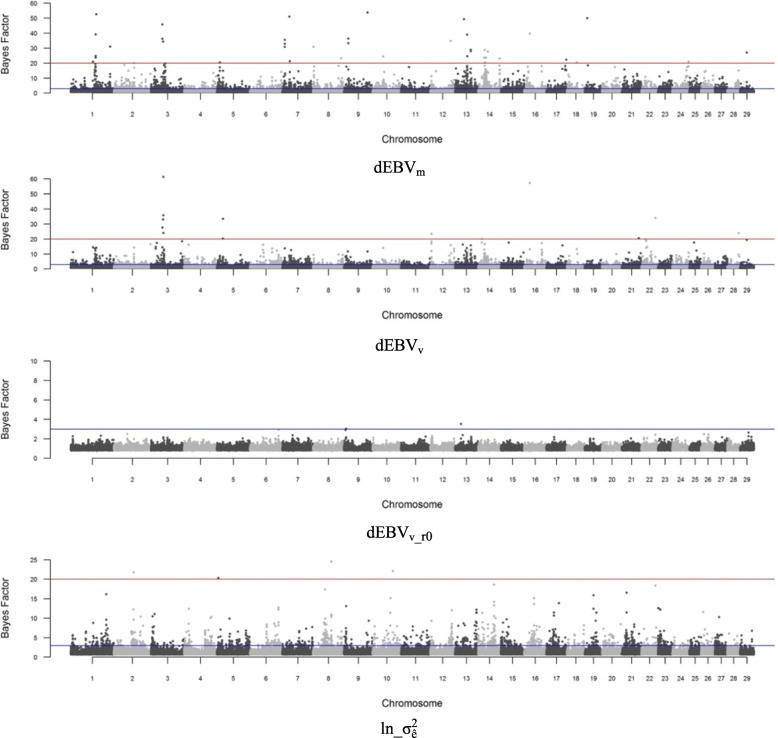
The dEBV and dEBV were highly correlated, resulting in common regions associated with mean and residual variance of YW. However, higher effects on variance than the mean showed that these regions had effects on the variance beyond scale effects. More independent association results between mean and residual variance were obtained when null r was assumed. While 13 and 4 single nucleotide polymorphisms (SNPs) showed a strong association (Bayes Factor > 20) with dEBV and ln_[Formula: see text], respectively, only suggestive signals were found for dEBV. All overlapping 1-Mb windows among top 20 between dEBV and dEBV were previously associated with growth traits. The potential candidate genes for uniformity are involved in metabolism, stress, inflammatory and immune responses, mineralization, neuronal activity and bone formation.
It is necessary to use a strategy like assuming null r to obtain genomic regions associated with uniformity that are not associated with the mean. Genes involved not only in metabolism, but also stress, inflammatory and immune responses, mineralization, neuronal activity and bone formation were the most promising biological candidates for uniformity of YW. Although no clear evidence of using a specific response variable was found, we recommend consider different response variables to study uniformity to increase evidence on candidate regions and biological mechanisms behind it.
在畜牧业中,由于提高生产一致性的兴趣,研究了残差方差。几项研究提供了证据表明,残差方差部分受遗传控制;然而,很少有研究阐明控制它的基因。本研究旨在使用不同的响应变量,利用高密度 SNP 数据,鉴定与内群年体重(YW)残差方差相关的基因组区域,在Nellore 公牛中。为此,使用双层次广义线性模型(DHGLM)的解来提供响应变量,如下所示:一个假设均值和残差方差之间存在非零遗传相关(r≠0)的 DHGLM 来获得均值(dEBV)和残差方差(dEBV)的去回归 EBV;以及一个假设 r=0 的 DHGLM 来获得两个用于残差方差的替代响应变量,dEBV 和估计残差的对数方差(ln_[Formula: see text])。
dEBV 和 dEBV 高度相关,导致与 YW 的均值和残差方差相关的共同区域。然而,方差的较高效应表明,这些区域对方差的影响超出了尺度效应。当假设 r 为零时,获得了与均值和残差方差之间更多的独立关联结果。当假设 r 为零时,13 个和 4 个单核苷酸多态性(SNP)分别与 dEBV 和 ln_[Formula: see text] 显示出强烈的关联(贝叶斯因子>20),而仅对 dEBV 发现了提示信号。dEBV 和 dEBV 之间前 20 个重叠的 1-Mb 窗口之前与生长性状相关。均匀性的潜在候选基因参与代谢、应激、炎症和免疫反应、矿化、神经元活动和骨形成。
有必要使用类似假设 r 为零的策略来获得与均值无关的与均匀性相关的基因组区域。参与均匀性的基因不仅涉及代谢,还涉及应激、炎症和免疫反应、矿化、神经元活动和骨形成,是 YW 均匀性最有前途的生物学候选基因。虽然没有发现使用特定响应变量的明确证据,但我们建议考虑不同的响应变量来研究均匀性,以增加候选区域和潜在机制的证据。