Yoshida Naohisa, Inada Yutaka, Yasuda Ritsu, Murakami Takaaki, Hirose Ryohei, Inoue Ken, Dohi Osamu, Naito Yuji, Ogiso Kiyoshi, Morinaga Yukiko, Kishimoto Mitsuo, Konishi Eiichi, Itoh Yoshito
Department of Molecular Gastroenterology and Hepatology, Kyoto Prefectural University of Medicine, Graduate School of Medical Science, Kyoto, Japan.
Department of Gastroenterology, Fukuchiyama City Hospital, Kyoto, Japan.
Gastroenterol Res Pract. 2018 Jul 8;2018:5059834. doi: 10.1155/2018/5059834. eCollection 2018.
Missed polyps are a pitfall of colonoscopy. In this study, we analyzed the efficacy of an additional 30 seconds observation using linked color imaging (LCI) for detecting adenoma and sessile serrated adenoma/polyp (SSA/P).
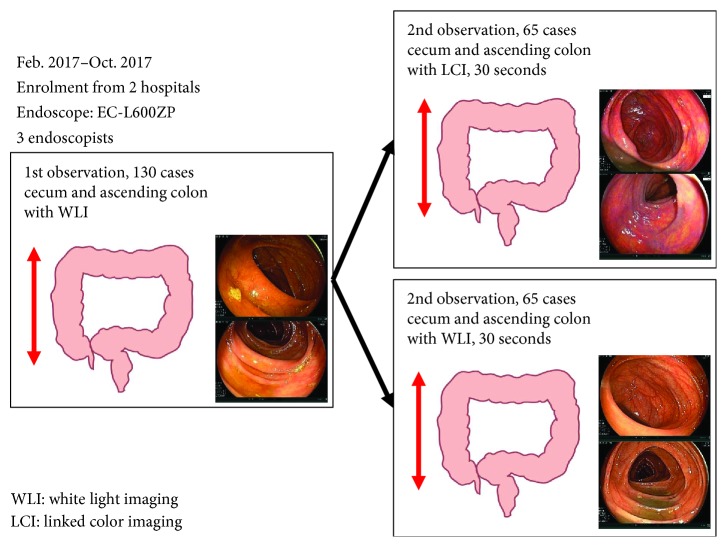
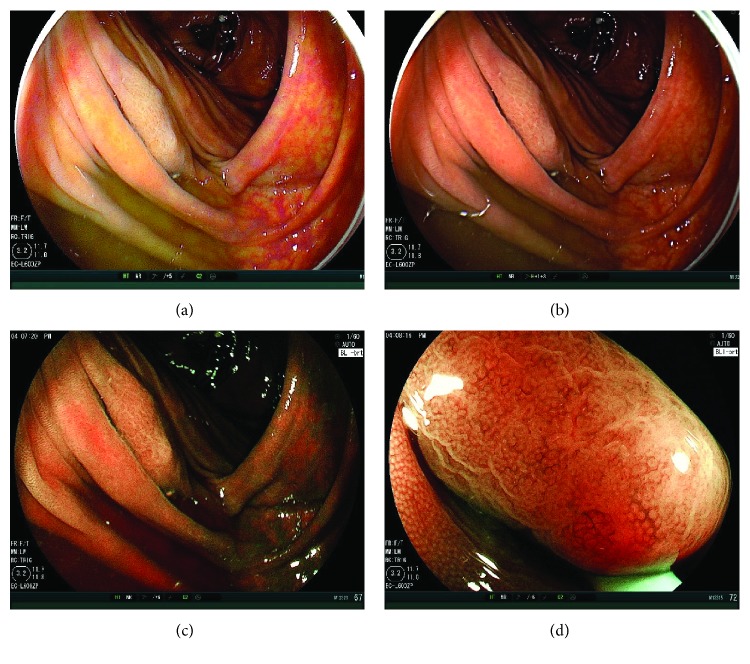
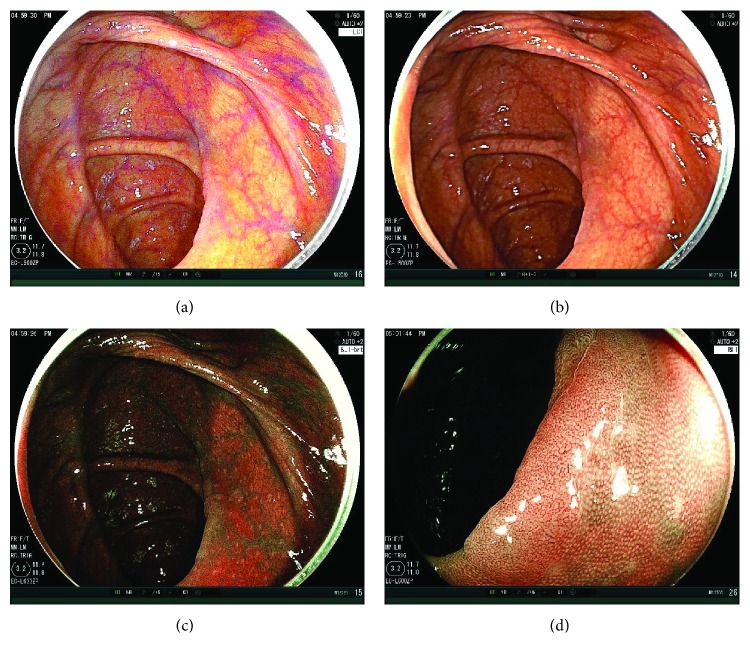
We enrolled patients undergoing colonoscopy from February to October 2017 in two institutions. In all patients, the cecum and ascending colon were observed with white light imaging (WLI) first. The colonoscope was inserted again, and the cecum and ascending colon were observed for an additional 30 seconds using either LCI or WLI. The method for the 30 sec observation was to insufflate the cecum and ascending colon sufficiently and observe them in a distant view, because the length of the second observation was determined to be precisely 30 sec. For the second observation, LCI was performed for the first 65 patients and WLI for the next 65. Adenoma and SSA/P detection rate (ASDR) in the second observation were examined in both groups. According to a pilot study, the sample size was estimated 65.
In the first observation, ASDR were 30.7% in the LCI group and 32.2% in the WLI group ( = 0.85). For the second observation, 13 polyps were detected in the LCI group and 5 polyps in the WLI group ( = 0.04). Additionally, ASDR for the second observation were 18.5% and 6.1%, respectively ( = 0.03). There were no significant differences between the LCI and WLI groups with respect to morphology (ratio of polypoid) (38.5% versus 60.0%, = 0.52) and histology (ratio of adenoma) (92.3% versus 100.0%, = 0.91). Total adenoma and SSA/P number were 48 in the LCI group and 36 in the WLI group ( = 0.02).
The 30 seconds additional observation with LCI improved the detection of adenoma and SSA/P in the right-sided colon.
漏诊息肉是结肠镜检查的一个隐患。在本研究中,我们分析了使用联动成像(LCI)额外观察30秒对检测腺瘤和无蒂锯齿状腺瘤/息肉(SSA/P)的有效性。
我们纳入了2017年2月至10月在两家机构接受结肠镜检查的患者。所有患者首先用白光成像(WLI)观察盲肠和升结肠。再次插入结肠镜,使用LCI或WLI对盲肠和升结肠额外观察30秒。30秒观察的方法是充分向盲肠和升结肠充气并在远距离观察,因为第二次观察的时长确定为精确的30秒。对于第二次观察,前65例患者采用LCI,后65例采用WLI。两组均检查第二次观察中的腺瘤和SSA/P检出率(ASDR)。根据一项初步研究,样本量估计为65例。
在第一次观察中,LCI组的ASDR为30.7%,WLI组为32.2%(P = 0.85)。对于第二次观察,LCI组检测到13个息肉,WLI组检测到5个息肉(P = 0.04)。此外,第二次观察的ASDR分别为18.5%和6.1%(P = 0.03)。LCI组和WLI组在形态学(息肉样比例)(38.5%对60.0%,P = 0.52)和组织学(腺瘤比例)(92.3%对100.0%,P = 0.91)方面无显著差异。LCI组腺瘤和SSA/P总数为48个,WLI组为36个(P = 0.02)。
使用LCI额外观察30秒可提高右侧结肠腺瘤和SSA/P的检出率。