Department of Physics, Case Western Reserve University, Cleveland, Ohio, United States of America.
PLoS Comput Biol. 2018 Aug 17;14(8):e1006399. doi: 10.1371/journal.pcbi.1006399. eCollection 2018 Aug.
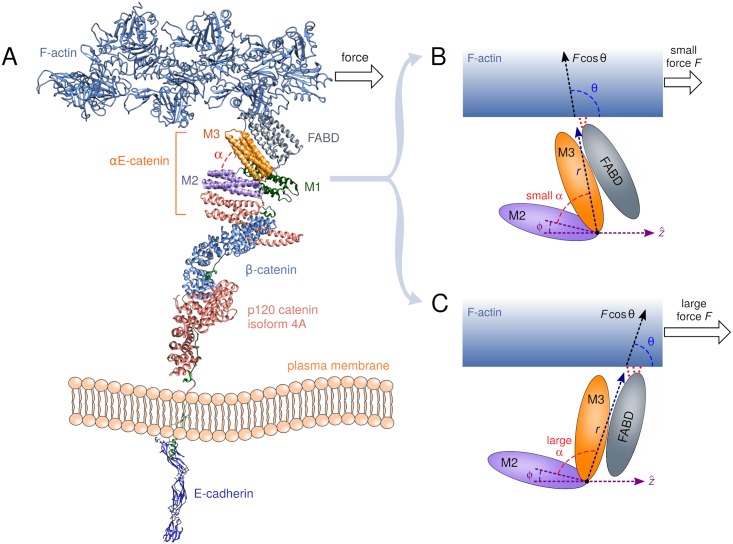
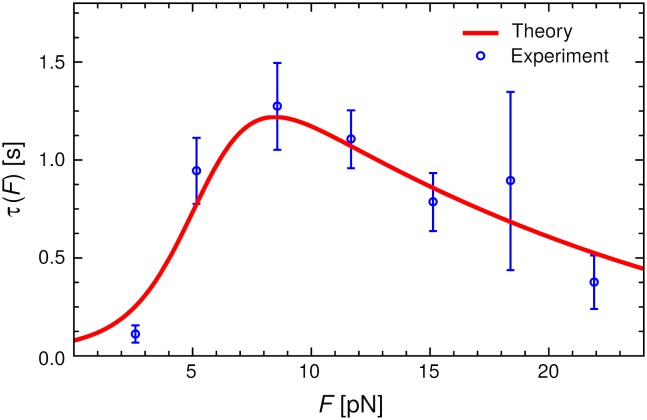
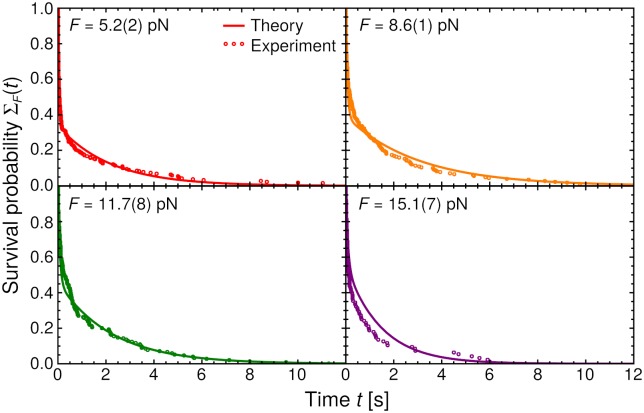
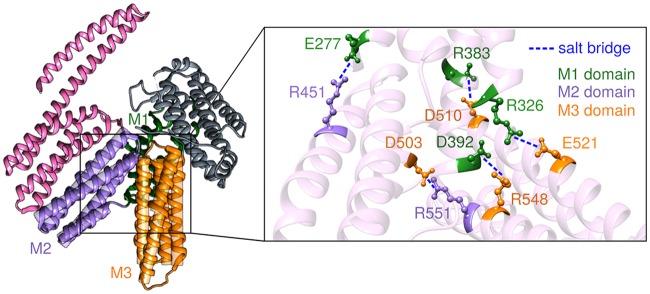
The adherens junctions between epithelial cells involve a protein complex formed by E-cadherin, β-catenin, α-catenin and F-actin. The stability of this complex was a puzzle for many years, since in vitro studies could reconstitute various stable subsets of the individual proteins, but never the entirety. The missing ingredient turned out to be mechanical tension: a recent experiment that applied physiological forces to the complex with an optical tweezer dramatically increased its lifetime, a phenomenon known as catch bonding. However, in the absence of a crystal structure for the full complex, the microscopic details of the catch bond mechanism remain mysterious. Building on structural clues that point to α-catenin as the force transducer, we present a quantitative theoretical model for how the catch bond arises, fully accounting for the experimental lifetime distributions. The underlying hypothesis is that force induces a rotational transition between two conformations of α-catenin, overcoming a significant energy barrier due to a network of salt bridges. This transition allosterically regulates the energies at the interface between α-catenin and F-actin. The model allows us to predict these energetic changes, as well as highlighting the importance of the salt bridge rotational barrier. By stabilizing one of the α-catenin states, this barrier could play a role in how the complex responds to additional in vivo binding partners like vinculin. Since significant conformational energy barriers are a common feature of other adhesion systems that exhibit catch bonds, our model can be adapted into a general theoretical framework for integrating structure and function in a variety of force-regulated protein complexes.
上皮细胞的黏着连接涉及由 E-钙黏蛋白、β-连环蛋白、α-连环蛋白和 F-肌动蛋白组成的蛋白复合物。该复合物的稳定性多年来一直是个谜,因为体外研究可以重新构成单个蛋白质的各种稳定亚基,但从未构成完整的复合物。缺失的成分原来是机械张力:最近的一项实验用光学镊子将生理力施加到复合物上,大大延长了其寿命,这种现象称为捕获键。然而,由于缺乏完整复合物的晶体结构,捕获键机制的微观细节仍然神秘。基于指向α-连环蛋白作为力传感器的结构线索,我们提出了一个定量理论模型,解释了捕获键是如何产生的,完全解释了实验寿命分布。其基本假设是,力诱导α-连环蛋白的两种构象之间的旋转转变,克服了由于盐桥网络引起的显著能量障碍。这种转变变构调节了α-连环蛋白和 F-肌动蛋白之间界面的能量。该模型允许我们预测这些能量变化,并强调盐桥旋转障碍的重要性。通过稳定α-连环蛋白的一种状态,该障碍可能在复合物如何响应其他体内结合伙伴(如 vinculin)方面发挥作用。由于其他表现出捕获键的黏附系统具有显著的构象能量障碍,因此我们的模型可以被改编为一个通用的理论框架,用于整合各种力调节蛋白复合物的结构和功能。