Rahman Heshu Sulaiman
Department of Clinic and Internal Medicine, College of Veterinary Medicine, University of Sulaimani, Sulaimani, Kurdistan Region, Republic of Iraq,
Department of Medical Laboratory Sciences, College of Science, Komar University of Science and Technology, Chaq-Chaq Qularaisee, Sarchinar District, Sulaimani, Kurdistan Region, Republic of Iraq,
Onco Targets Ther. 2018 Aug 6;11:4559-4572. doi: 10.2147/OTT.S170827. eCollection 2018.
The mastic gum resin has been used in traditional Kurdish medicine for treating various disorders such as topical wound and gastric ulcer. The study designed to evaluate the total polyphenol and flavonoid content, free radical scavenging activity, and anticancer effects of mastic gum resin derived from subspecies kurdica.
Folin -Ciocalteau and the aluminum chloride colorimetric assays were used to determine the total phenol and flavonoid contents in the mastic gum resin respectively. Whereas, DPPH and ABTS+ assays were used to determine the antioxidant activities of mastic gum resin. Regarding anticancer activities, the MTT assay was used to study the effect of mastic gum resin on the proliferation of various cancer cells and the morphological changes were identified after Acridine Orange/Propidium Iodide staining. Flow cytometry was applied to determine the influence of mastic gum resin on the apoptosis rate by Annexin V double staining and to investigate the influence on cell cycle progression. Caspase colorimetric assay was used to estimate the hallmark enzyme of apoptosis, and finally RNA were obtained from COLO205 cells and analyzed by qRT-PCR analyses.
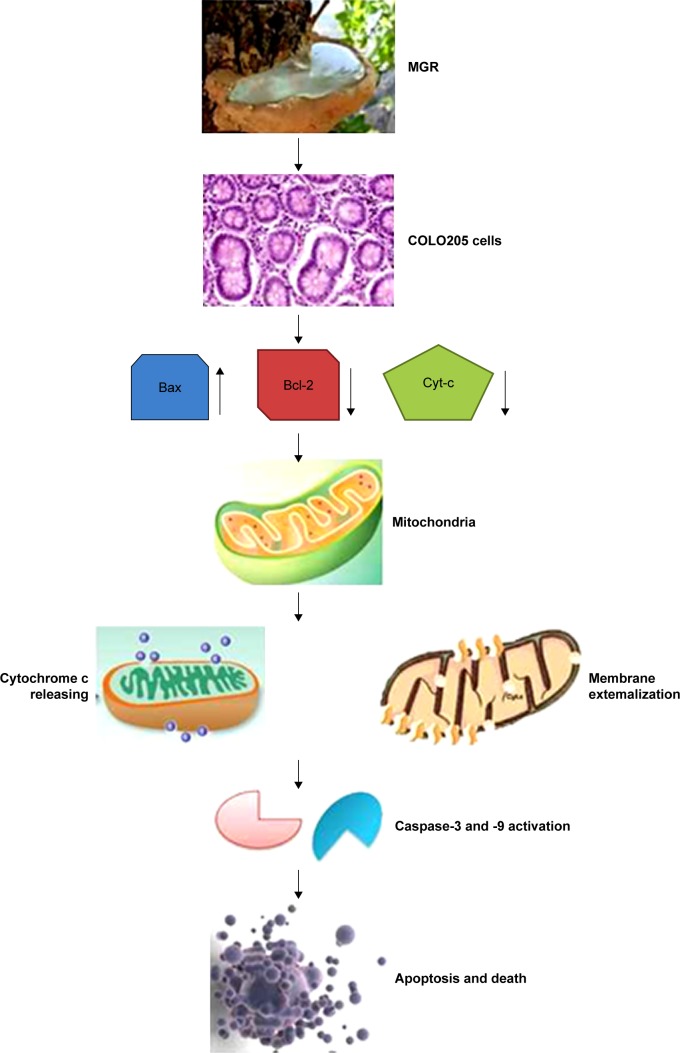
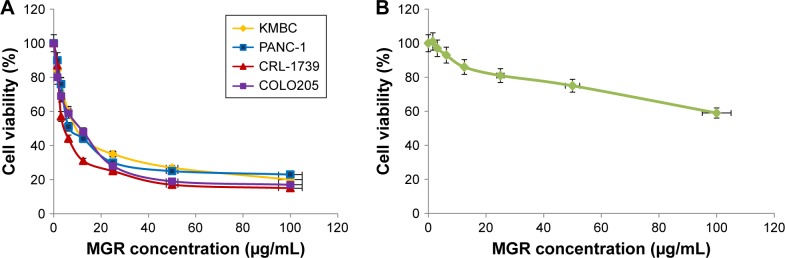
The MTT results showed that the mastic gum resin at concentrations from 0.01 to 100 μM induced death of cancer cells in a dose and time-dependent manner. The mastic gum resin suppressed proliferation of human cancer cells with 72 h IC value of 15.34 ± 0.21, 11.52 ± 0.18, 8.11 ± 0.23 and 5.2 ± 0.8 μg/mL for bile duct cancer (cholangiocarcinoma) (KMBC), pancreatic carcinoma (PANC-1), gastric adenocarcinoma (CRL-1739), and colonic adenocarcinoma (COLO205) cells, respectively. Normal human colon fibroblast (CCD-18Co) cells were not adversely affected by resin treatment. Flow cytometry showed that the mastic gum resin significantly (<0.05) arrested COLO205 cell proliferation at the G2/M phase of cell cycle. The resin caused apoptotic morphological changes in COLO205 cells. The apoptotic effect to mastic gum resin was via the mitochondrial as shown by the up-regulation of Bax, down-regulation of Bcl-2 genes, and activation of caspase-9 and -3 activities.
It was confirmed that the antiproliferative efficacy of the resin is positively correlated with its polyphenolic contents, suggesting a causal link related to exudate content of phenolic acid and flavonoids. The results revealed that the mastic gum resin has potential to be developed as an anticancer and antioxidant product due to its high content of polyphenol compounds.
乳香树脂在库尔德传统医学中用于治疗各种疾病,如局部伤口和胃溃疡。本研究旨在评估库尔德亚种乳香树脂的总多酚和黄酮含量、自由基清除活性及抗癌作用。
分别采用福林 - 酚法和氯化铝比色法测定乳香树脂中的总酚和黄酮含量。同时,采用DPPH和ABTS+法测定乳香树脂的抗氧化活性。关于抗癌活性,采用MTT法研究乳香树脂对各种癌细胞增殖的影响,并在吖啶橙/碘化丙啶染色后鉴定形态学变化。应用流式细胞术通过膜联蛋白V双染法测定乳香树脂对凋亡率的影响,并研究其对细胞周期进程的影响。采用半胱天冬酶比色法评估凋亡的标志性酶,最后从COLO205细胞中提取RNA并通过qRT-PCR分析进行检测。
MTT结果表明,浓度为0.01至100μM的乳香树脂以剂量和时间依赖性方式诱导癌细胞死亡。乳香树脂抑制人癌细胞增殖,胆管癌(KMBC)、胰腺癌(PANC - 1)、胃腺癌(CRL - 1739)和结肠腺癌(COLO205)细胞的72小时IC值分别为15.34±0.21、11.52±0.18、8.11±0.23和5.2±0.8μg/mL。正常人类结肠成纤维细胞(CCD - 18Co)不受树脂处理的不利影响。流式细胞术显示,乳香树脂显著(<0.05)使COLO205细胞增殖停滞在细胞周期的G2/M期。该树脂导致COLO205细胞出现凋亡形态学变化。乳香树脂的凋亡作用通过线粒体介导,表现为Bax上调、Bcl - 2基因下调以及半胱天冬酶 - 9和 - 3活性激活。
证实了该树脂的抗增殖功效与其多酚含量呈正相关,表明与酚酸和黄酮类渗出物含量存在因果关系。结果显示,乳香树脂因其高含量的多酚化合物有潜力开发成为抗癌和抗氧化产品。