Pham Tra My, Petersen Irene, Walters Kate, Raine Rosalind, Manthorpe Jill, Mukadam Naaheed, Cooper Claudia
Department of Primary Care and Population Health, University College London, London, UK.
Department of Clinical Epidemiology, Aarhus University Hospital, Aarhus, Denmark.
Clin Epidemiol. 2018 Aug 8;10:949-960. doi: 10.2147/CLEP.S152647. eCollection 2018.
We compared incidence of dementia diagnosis by white, black, and Asian ethnic groups and estimated the proportion of UK white and black people developing dementia in 2015 who had a diagnosis for the first time in a UK-wide study.
We analyzed primary care electronic health records from The Health Improvement Network database between 2007 and 2015 and compared incidence of dementia diagnosis to dementia incidence from community cohort studies. The study sample comprised of 2,511,681 individuals aged 50-105 years who did not have a dementia diagnosis prior to the start of follow-up.
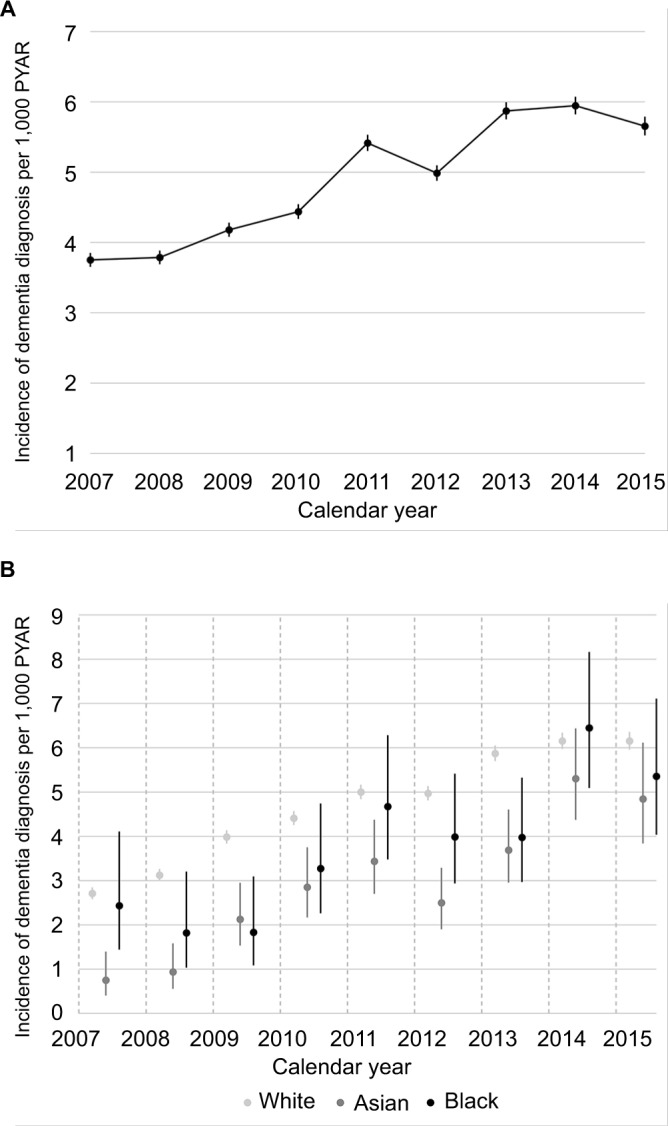
A total of 66,083 individuals had a dementia diagnosis (4.87/1,000 person-years at risk, 95% CI 4.83-4.90); this incidence increased from 3.75 to 5.65/1,000 person-years at risk between 2007 and 2015. Compared with white women, the incidence of dementia diagnosis was 18% lower among Asian women (adjusted incidence rate ratio (IRR) 0.82, 95% CI 0.72-0.95) and 25% higher among black women (IRR 1.25, 95% CI 1.07-1.46). For men, incidence of dementia diagnosis was 28% higher in the black ethnic group (IRR 1.28, 95% CI 1.08-1.50) and 12% lower in the Asian ethnic group (IRR 0.88, 95% CI 0.76-1.01) relative to the white ethnic group. Based on diagnosis incidence in The Health Improvement Network data and projections of incidence from community cohort studies, we estimated that 42% of black men developing dementia in 2015 were diagnosed compared with 53% of white men.
People from the black ethnic group had a higher incidence of dementia diagnosis and those from the Asian ethnic group had lower incidence compared with the white ethnic group. We estimated that black men developing dementia were less likely than white men to have a diagnosis of dementia, indicating that the increased risk of dementia diagnosis reported in the black ethnic group might underestimate the higher risk of dementia in this group. It is unclear whether the lower incidence of dementia diagnosis in the Asian ethnic group reflects lower community incidence or underdiagnosis. A cohort study to determine this is needed.
我们比较了白人、黑人和亚裔族群的痴呆症诊断发病率,并在一项全英范围内的研究中,估算了2015年首次被诊断出痴呆症的英国白人和黑人的比例。
我们分析了2007年至2015年期间来自健康改善网络数据库的初级医疗电子健康记录,并将痴呆症诊断发病率与社区队列研究中的痴呆症发病率进行了比较。研究样本包括2511681名年龄在50 - 105岁之间、在随访开始前未被诊断出患有痴呆症的个体。
共有66083人被诊断出患有痴呆症(风险人群年发病率为4.87/1000人,95%置信区间为4.83 - 4.90);这一发病率在2007年至2015年间从3.75/1000人年上升至5.65/1000人年。与白人女性相比,亚裔女性的痴呆症诊断发病率低18%(调整发病率比(IRR)为0.82,95%置信区间为0.72 - 0.95),而黑人女性则高25%(IRR为1.25,95%置信区间为1.07 - 1.46)。对于男性而言,相对于白人族群,黑人族群的痴呆症诊断发病率高28%(IRR为1.28,95%置信区间为1.08 - 1.50),亚裔族群低12%(IRR为0.88,95%置信区间为0.76 - 1.01)。根据健康改善网络数据中的诊断发病率以及社区队列研究的发病率预测,我们估计2015年患痴呆症的黑人男性中有42%被诊断出来,而白人男性这一比例为53%。
与白人族群相比,黑人族群的痴呆症诊断发病率较高,而亚裔族群较低。我们估计,患痴呆症的黑人男性比白人男性被诊断出痴呆症的可能性更小,这表明黑人族群中报告的痴呆症诊断风险增加可能低估了该族群较高的痴呆症风险。目前尚不清楚亚裔族群中较低的痴呆症诊断发病率是反映了社区发病率较低还是诊断不足。需要进行一项队列研究来确定这一点。