Cheng Larry C, Li Zhen, Graeber Thomas G, Graham Nicholas A, Drake Justin M
Graduate Program in Cellular and Molecular Pharmacology, School of Graduate Studies, Rutgers University, The State University of New Jersey; Graduate Program in Quantitative Biomedicine, School of Graduate Studies, Rutgers University, The State University of New Jersey.
Department of Medicine, Division of Medical Oncology, Rutgers Robert Wood Johnson Medical School.
J Vis Exp. 2018 Aug 2(138):57996. doi: 10.3791/57996.
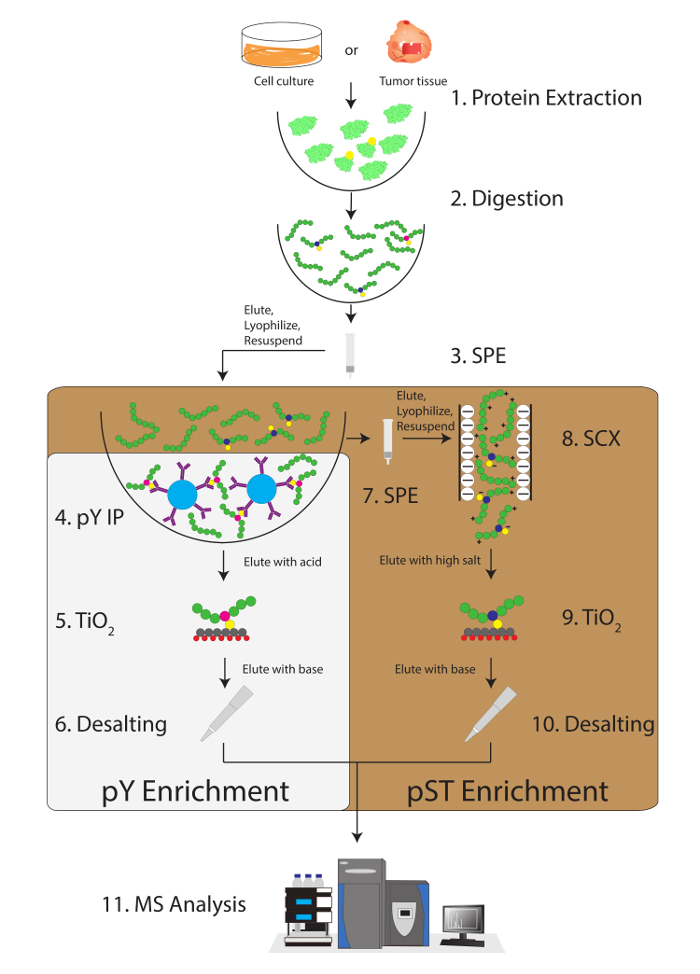
Phosphoproteomics involves the large-scale study of phosphorylated proteins. Protein phosphorylation is a critical step in many signal transduction pathways and is tightly regulated by kinases and phosphatases. Therefore, characterizing the phosphoproteome may provide insights into identifying novel targets and biomarkers for oncologic therapy. Mass spectrometry provides a way to globally detect and quantify thousands of unique phosphorylation events. However, phosphopeptides are much less abundant than non-phosphopeptides, making biochemical analysis more challenging. To overcome this limitation, methods to enrich phosphopeptides prior to the mass spectrometry analysis are required. We describe a procedure to extract and digest proteins from tissue to yield peptides, followed by an enrichment for phosphotyrosine (pY) and phosphoserine/threonine (pST) peptides using an antibody-based and/or titanium dioxide (TiO2)-based enrichment method. After the sample preparation and mass spectrometry, we subsequently identify and quantify phosphopeptides using liquid chromatography-mass spectrometry and analysis software.
磷酸化蛋白质组学涉及对磷酸化蛋白质的大规模研究。蛋白质磷酸化是许多信号转导途径中的关键步骤,并受到激酶和磷酸酶的严格调控。因此,对磷酸化蛋白质组进行表征可能有助于识别肿瘤治疗的新靶点和生物标志物。质谱分析法提供了一种全局检测和量化数千种独特磷酸化事件的方法。然而,磷酸化肽段的丰度远低于非磷酸化肽段,这使得生化分析更具挑战性。为克服这一限制,需要在质谱分析之前采用富集磷酸化肽段的方法。我们描述了一种从组织中提取和消化蛋白质以产生肽段的程序,随后使用基于抗体和/或基于二氧化钛(TiO2)的富集方法富集磷酸化酪氨酸(pY)和磷酸化丝氨酸/苏氨酸(pST)肽段。在样品制备和质谱分析之后,我们随后使用液相色谱-质谱联用仪和分析软件对磷酸化肽段进行鉴定和定量。