Department of Behavioral Science, The University of Texas MD Anderson Cancer Center, Houston, TX.
Center for Clinical Research and Evidence-Based Medicine, Department of Pediatrics, UTHealth, Houston, TX.
Nicotine Tob Res. 2018 Aug 14;20(suppl_1):S81-S87. doi: 10.1093/ntr/nty025.
As the tobacco industry and market evolves, there is a growing need to understand the patterns of use of tobacco products and how they relate to demographics, dependency, withdrawal, and quit behavior.
We analyzed data from wave 1 of the PATH Study consisting of 14856 individuals. Current users were defined as consuming at least 1 of 10 tobacco products. We performed a latent class analysis (LCA) to identify patterns of tobacco use. We used multinomial regression analysis to explore the association between these patterns with covariates representing socioeconomic status dependence/addiction, past quit attempts, and withdrawal severity.
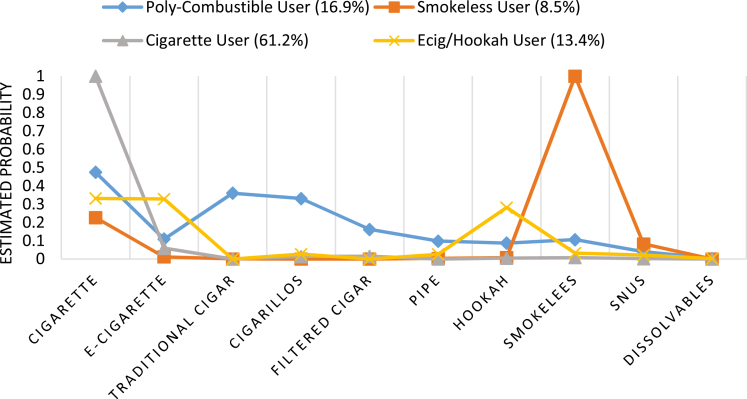
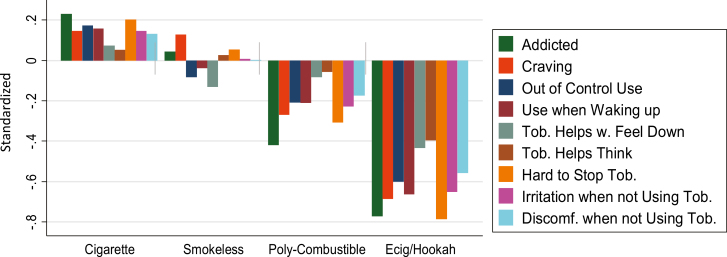
We identified four groups of current tobacco users with distinct profiles: (1) 61% of the sample were identified as cigarette-only users; (2) 9% were smokeless tobacco users; (3) 17% of the sample were characterized by being current users of all types of combustible tobacco including cigars, cigarillos, filtered cigars, and smoking a pipe (4) finally, 13% were e-cig and hookah users. All classes also shared a varying frequency of cigarette use. Exclusive cigarette users were more likely to be older and female, and experienced higher dependency and withdrawal. Users of e-cigs and hookah were the younger, most educated of all four subgroups, and presented the lowest dependency and withdrawal among the four groups.
FDA policy makers may want to discourage the use of tobacco products associated with higher tobacco dependency, and products that may contribute to experiencing higher levels of withdrawal symptoms by the user when trying to quit.
We identified four patterns of tobacco product use that are significantly related to demographic characteristics, dependency, and withdrawal. Policies should target users more likely to use tobacco products that increase dependency and withdrawal, making quitting more difficult.
随着烟草行业和市场的发展,越来越需要了解烟草产品的使用模式,以及它们与人口统计学、依赖、戒断和戒烟行为的关系。
我们分析了 PATH 研究第 1 波的数据,其中包括 14856 人。目前的使用者被定义为至少吸食 10 种烟草产品中的 1 种。我们进行了潜在类别分析(LCA),以确定烟草使用模式。我们使用多项回归分析来探讨这些模式与代表社会经济地位、依赖/成瘾、过去戒烟尝试和戒断严重程度的协变量之间的关系。
我们确定了当前烟草使用者的四个不同群体,具有不同的特征:(1)61%的样本被确定为仅吸食香烟者;(2)9%的样本为咀嚼烟草使用者;(3)17%的样本的特征是当前吸食所有类型可燃烟草的使用者,包括雪茄、小雪茄、过滤雪茄和烟斗;(4)最后,13%的样本为电子烟和水烟使用者。所有类别也都有不同频率的香烟使用。只吸食香烟的人更可能是年长的女性,依赖性和戒断感更高。电子烟和水烟使用者是四个群体中最年轻、受教育程度最高的,在四个群体中表现出最低的依赖性和戒断感。
FDA 政策制定者可能希望阻止使用与更高烟草依赖性相关的烟草产品,以及可能导致使用者在试图戒烟时经历更高水平戒断症状的产品。
我们确定了四种烟草产品使用模式,这些模式与人口统计学特征、依赖性和戒断有显著关系。政策应针对那些更有可能使用增加依赖性和戒断感的烟草产品的使用者,使戒烟变得更加困难。