Department of Organismic and Evolutionary Biology, Harvard University, Cambridge, MA, 02138, USA.
Department of Genetics, Harvard Medical School, Boston, MA, 02115, USA.
Nat Commun. 2018 Aug 20;9(1):3336. doi: 10.1038/s41467-018-05649-9.
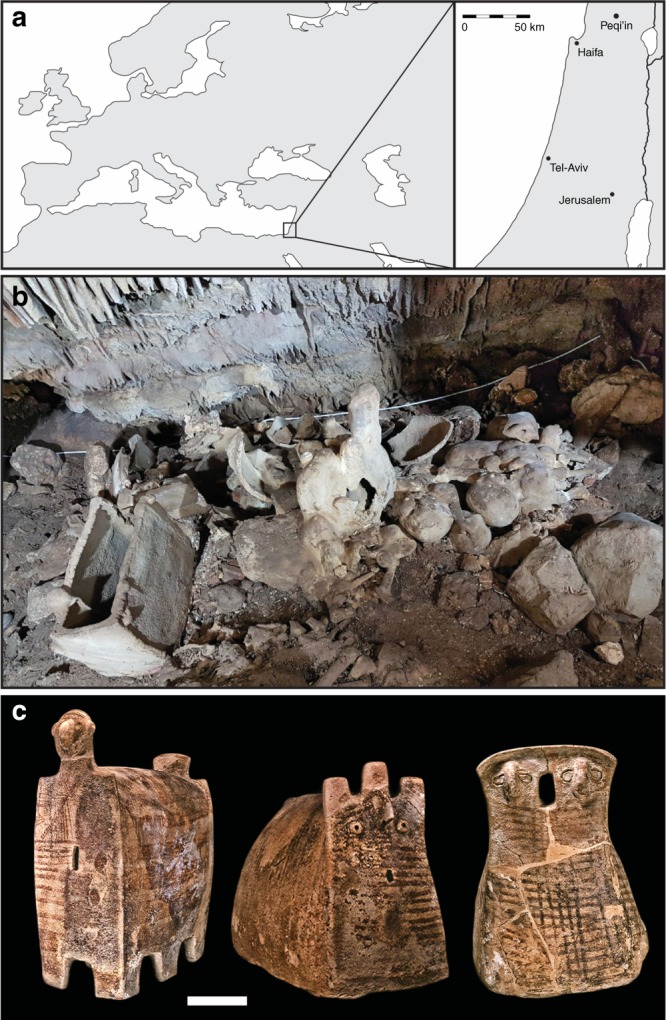
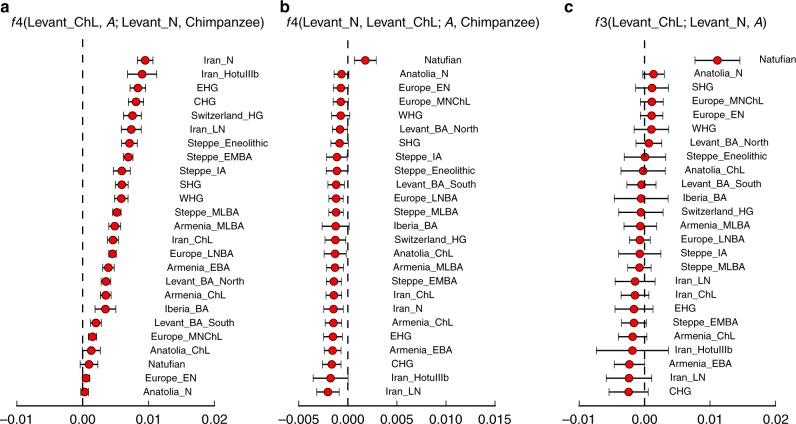
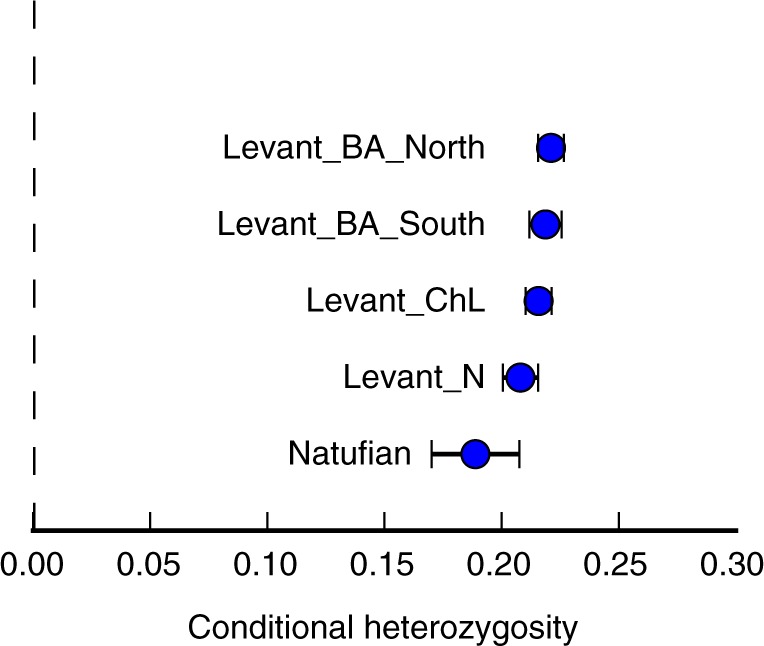
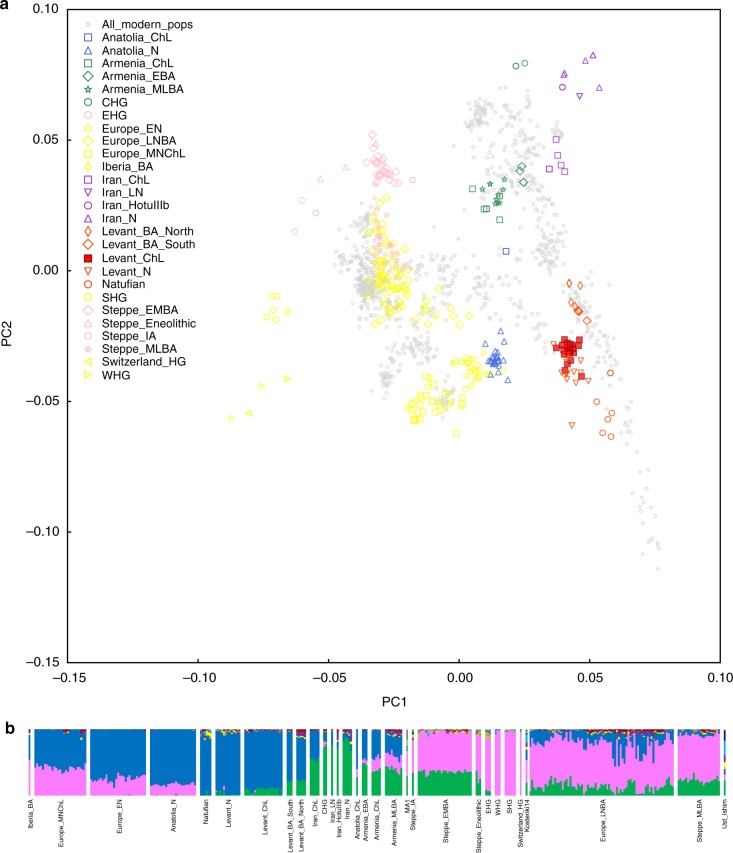
The material culture of the Late Chalcolithic period in the southern Levant (4500-3900/3800 BCE) is qualitatively distinct from previous and subsequent periods. Here, to test the hypothesis that the advent and decline of this culture was influenced by movements of people, we generated genome-wide ancient DNA from 22 individuals from Peqi'in Cave, Israel. These individuals were part of a homogeneous population that can be modeled as deriving ~57% of its ancestry from groups related to those of the local Levant Neolithic, ~17% from groups related to those of the Iran Chalcolithic, and ~26% from groups related to those of the Anatolian Neolithic. The Peqi'in population also appears to have contributed differently to later Bronze Age groups, one of which we show cannot plausibly have descended from the same population as that of Peqi'in Cave. These results provide an example of how population movements propelled cultural changes in the deep past.
黎凡特南部晚期铜石并用时代(公元前 4500-3900/3800 年)的物质文化与之前和之后的时期明显不同。在这里,为了检验这一假说,即这种文化的出现和衰落是受人口流动影响的,我们从以色列皮克辛洞的 22 个人体中提取了全基因组古代 DNA。这些个体属于一个同质群体,可以模拟为从与当地黎凡特新石器时代相关的群体中获得约 57%的祖先,从与伊朗铜石并用时代相关的群体中获得约 17%,从与安纳托利亚新石器时代相关的群体中获得约 26%。皮克辛人群似乎也对后来的青铜时代群体产生了不同的影响,其中一个群体我们表明不太可能是皮克辛洞人群的后裔。这些结果提供了一个例子,说明人口流动如何在远古时代推动了文化的变化。