Guangdong Key Laboratory of Nanomedicine, Shenzhen Engineering Laboratory of Nanomedicine and Nanoformulations, CAS Key Lab for Health Informatics, Shenzhen Institutes of Advanced Technology, Chinese Academy of Sciences, Shenzhen 518055, China.
University of Chinese Academy of Sciences, Beijing 100049, China.
Theranostics. 2018 Jul 16;8(15):4116-4128. doi: 10.7150/thno.26539. eCollection 2018.
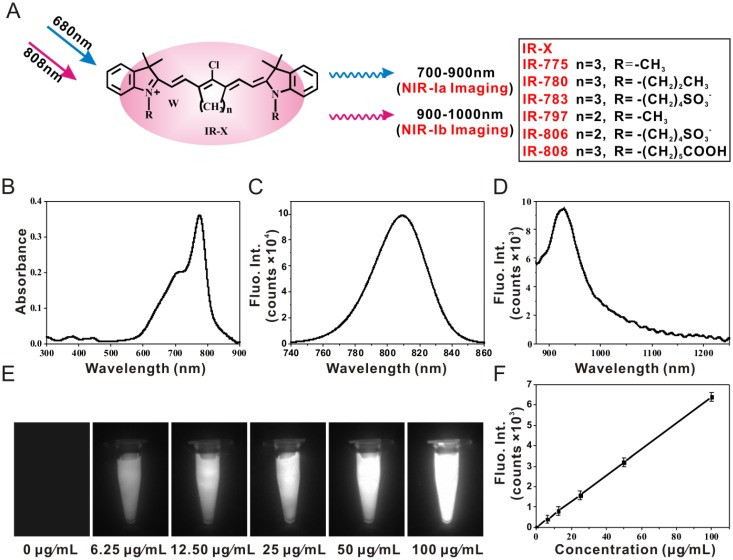
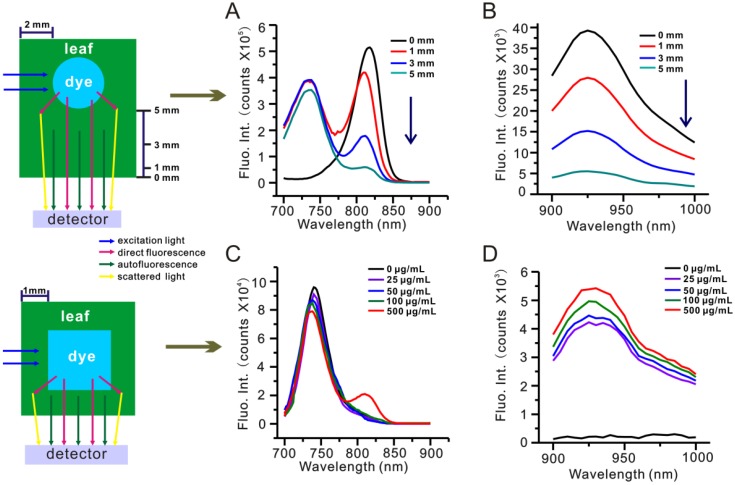
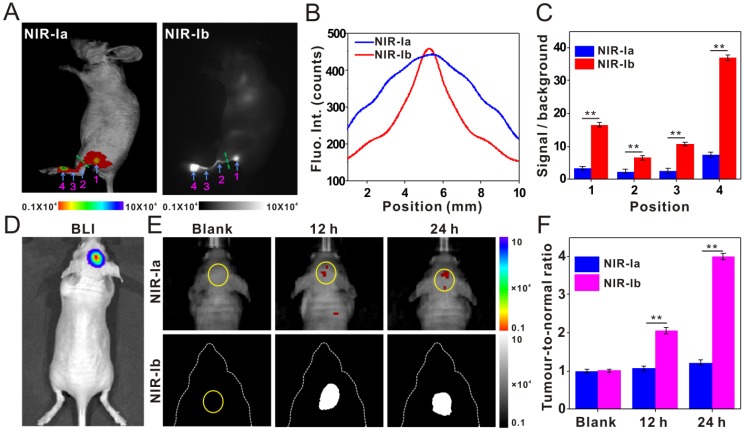
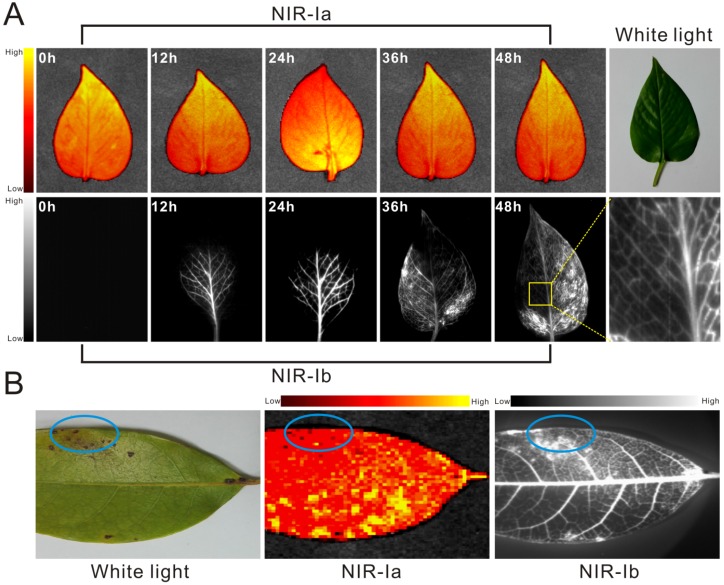
Near-infrared (NIR) fluorescence imaging has relied on fluorophores that emit in the 700-900 nm NIR-Ia or 1,000-1,700 nm NIR-II window for generating deep-tissue images. Up until now, there have been few fluorophores developed for the 900-1,000 nm NIR-Ib window. This is largely because NIR-Ib light is thought to be strongly absorbed by water. : Here we found that six heptamethine dyes had distinct emission peaks in both the NIR-Ia and NIR-Ib window. We tested the performance of these contrast agents by introducing them into the leaves of the common house plant with early stage anthracnose leaf infections from , as well as injecting them into the hind feet of nude mice and tails of tumour-bearing mice . : Heptamethine dyes yielded superior images of leaf venation, anthracnose infection locations, sentinel lymph nodes, brain tumours and subcutaneous tumours in the NIR-Ib window. We found that NIR-Ib images had markedly enhanced signal-to-background ratio because autofluorescence, scattering and light absorption by biological tissues and water were weaker at longer wavelengths. : NIR-Ib fluorescence imaging was a powerful method for studying sentinel lymph nodes, tumours, leaf veins and early anthracnose infection locations in plant leaves. The findings challenge our current view of NIR fluorescence imaging and may have important implications for biomedical research and image-guided cancer surgery.
近红外 (NIR) 荧光成像是依赖于在 700-900nm 的近红外一区 (NIR-Ia) 或 1000-1700nm 的近红外二区 (NIR-II) 窗口发射的荧光团来生成深部组织图像。到目前为止,仅有少数荧光团被开发用于 900-1000nm 的近红外一区 (NIR-Ib) 窗口。这在很大程度上是因为人们认为 NIR-Ib 光会被水强烈吸收。:在这里,我们发现六种庚烷染料在近红外一区和近红外二区都有明显的发射峰。我们通过将这些对比剂引入受炭疽病早期叶片感染的普通室内植物叶片中,以及将其注入裸鼠的后脚和荷瘤小鼠的尾巴中来测试这些造影剂的性能。:庚烷染料在近红外二区产生了卓越的叶片脉络、炭疽病感染位置、前哨淋巴结、脑肿瘤和皮下肿瘤的图像。我们发现,由于生物组织和水的自发荧光、散射和光吸收在较长波长下较弱,因此 NIR-Ib 图像的信号与背景的比值明显增强。:NIR-Ib 荧光成像是研究前哨淋巴结、肿瘤、叶片脉络和植物叶片早期炭疽病感染位置的有力方法。这些发现挑战了我们对近红外荧光成像的现有认识,可能对生物医学研究和图像引导的癌症手术具有重要意义。