Department of Clinical Laboratory, Linyi Central Hospital, Linyi, Shandong, China (mainland).
Department of Pathology, Medical School of Shandong University, Jinan, Shandong, China (mainland).
Med Sci Monit. 2018 Aug 22;24:5840-5850. doi: 10.12659/MSM.909527.
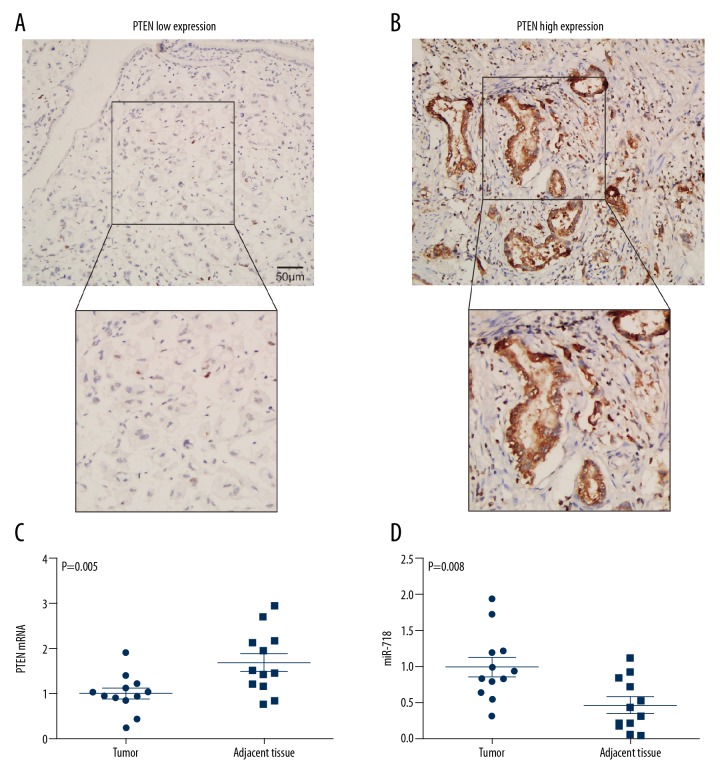
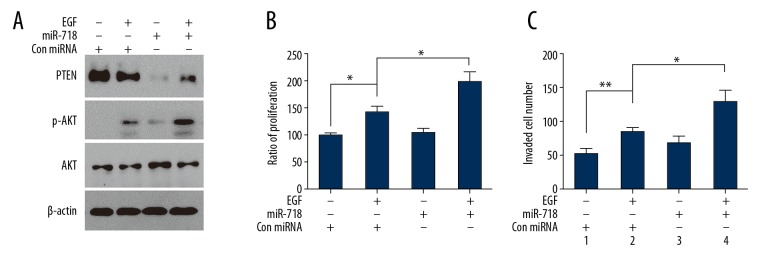
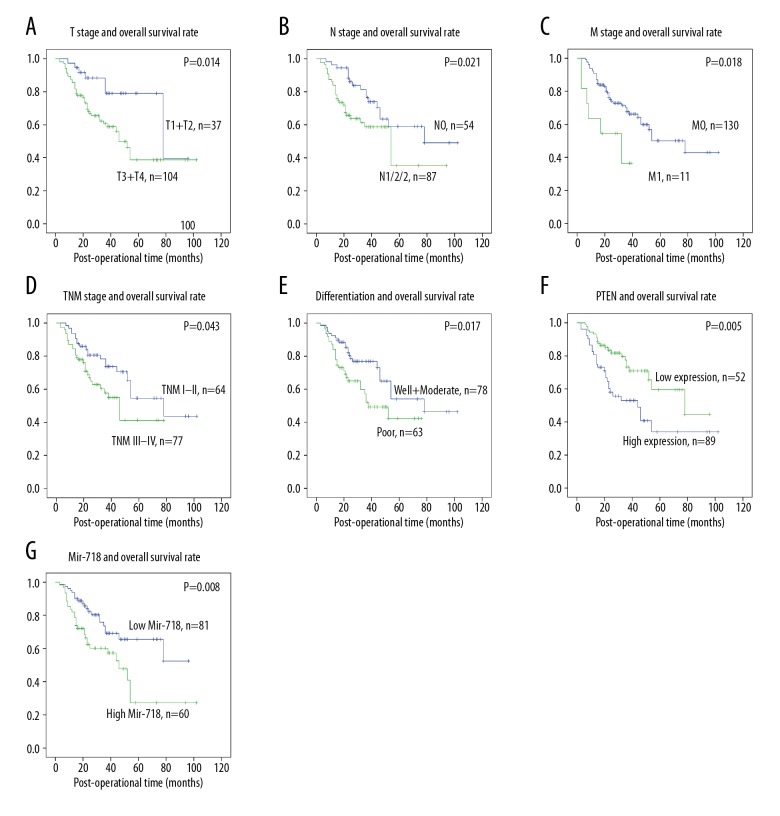
BACKGROUND Phosphatase and tensin homolog (PTEN) is a kind of phosphatase which has been demonstrated to suppress progression of gastric cancer. Many micro-RNAs (miRNAs), such as miR-106b, miR-93, and miR-200c, could inhibit expression of PTEN in cell lines; and many miRNAs including miR-21, miR-22, miR-18a, and miR-222 are related to the progression and prognosis of gastric cancer. However, among these miRNAs, the clinical significance of miR-718 has not yet been elucidated. MATERIAL AND METHODS The expression of PTEN and miR-718 in 141 gastric cancer tissues were detected by immunohistochemistry and quantitative real-time PCR respectively. The correlation between PTEN, miR-718, and the clinicopathological factors was analyzed by χ² test. The prognostic significance of PTEN and miR-718 was evaluated by univariate and multivariate analysis. Luciferase reporter assay was performed to evaluate the regulation of PTEN by miR-718. The effect of miR-718 on gastric cancer proliferation and invasion was investigated by MTT assay and Transwell assay. RESULTS Low expression of PTEN and high expression of miR-718 were both significantly associated with unfavorable prognosis, and both were identified as biomarkers predicting poorer prognosis of patients with gastric cancer. Increased miR-718 expression could decrease PTEN expression, thus enhancing phosphatidylinositide 3-kinases/protein kinase B (PI3K/Akt) signaling. Moreover, the abilities of proliferation and invasion of gastric cells transfected with miR-718 were promoted significantly compared with those transfected with control miRNA. CONCLUSIONS Low expression of PTEN and increased expression of miR-718 in gastric cancer tissues were both independent unfavorable prognostic factors of gastric cancer. Upregulation of miR-718 could increase PI3K/Akt signaling by directly downregulating PTEN, thus promoting the proliferation and invasion of gastric cancer cells.
磷酸酶及张力蛋白同源物(PTEN)是一种磷酸酶,已被证明能抑制胃癌的进展。许多 microRNA(miRNA),如 miR-106b、miR-93 和 miR-200c,可在细胞系中抑制 PTEN 的表达;而许多 miRNA,包括 miR-21、miR-22、miR-18a 和 miR-222,与胃癌的进展和预后有关。然而,在这些 miRNA 中,miR-718 的临床意义尚未阐明。
采用免疫组织化学和实时定量 PCR 分别检测 141 例胃癌组织中 PTEN 和 miR-718 的表达,用 χ²检验分析 PTEN、miR-718 与临床病理因素的相关性,用单因素和多因素分析评价 PTEN 和 miR-718 的预后意义。用荧光素酶报告基因实验评估 miR-718 对 PTEN 的调控作用,用 MTT 检测和 Transwell 检测评价 miR-718 对胃癌增殖和侵袭的影响。
PTEN 低表达和 miR-718 高表达均与不良预后显著相关,均为预测胃癌患者预后不良的标志物。miR-718 表达增加可降低 PTEN 表达,从而增强磷脂酰肌醇 3-激酶/蛋白激酶 B(PI3K/Akt)信号通路。此外,转染 miR-718 的胃癌细胞的增殖和侵袭能力明显强于转染对照 miRNA 的胃癌细胞。
胃癌组织中 PTEN 低表达和 miR-718 高表达均为胃癌的独立不良预后因素。miR-718 的上调可通过直接下调 PTEN 增加 PI3K/Akt 信号通路,从而促进胃癌细胞的增殖和侵袭。