Department of Family Medicine, Taipei Medical University Hospital, Taipei, Taiwan.
School of Public Health, College of Public Health, Taipei Medical University, Taipei, Taiwan.
PLoS One. 2018 Aug 22;13(8):e0199014. doi: 10.1371/journal.pone.0199014. eCollection 2018.
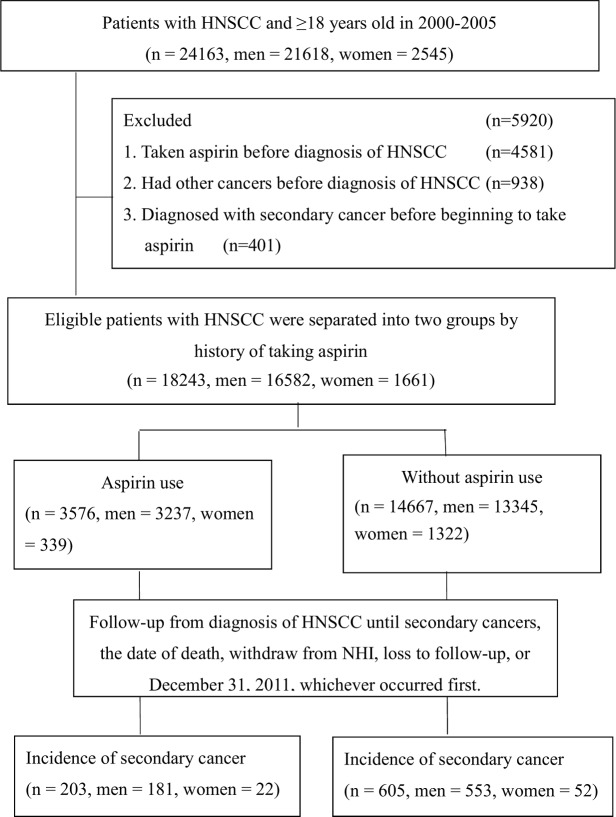
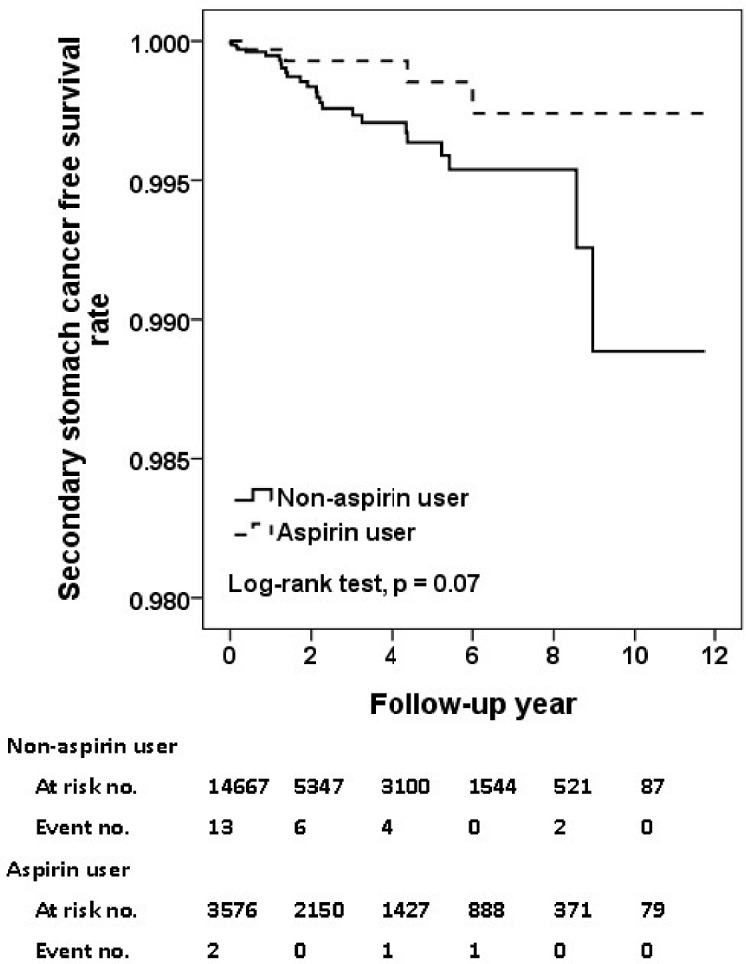
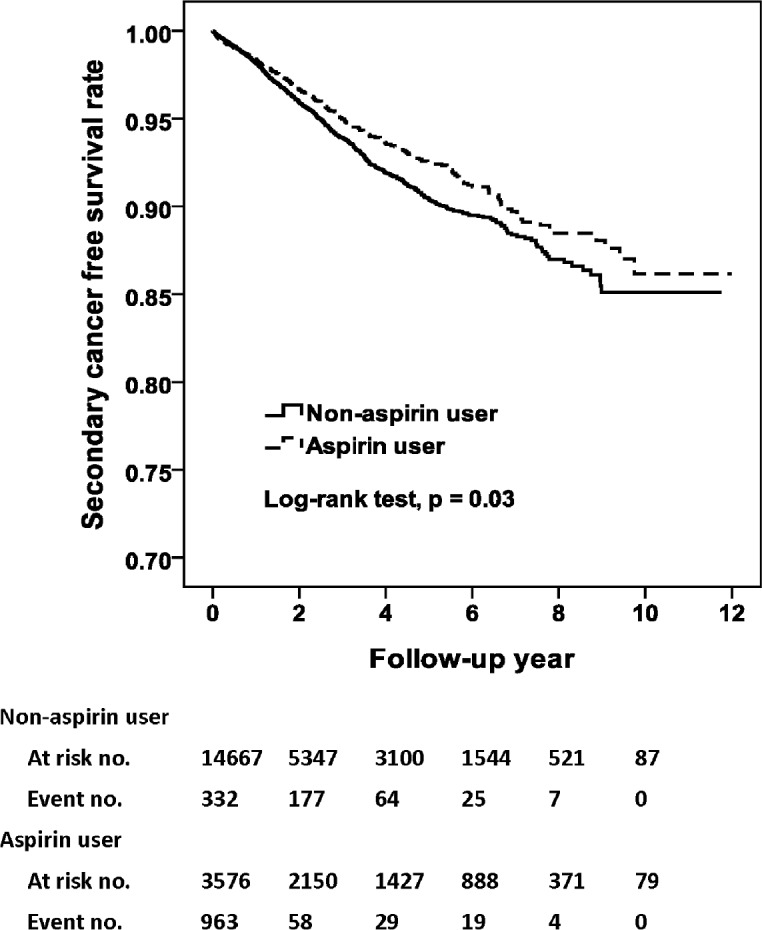
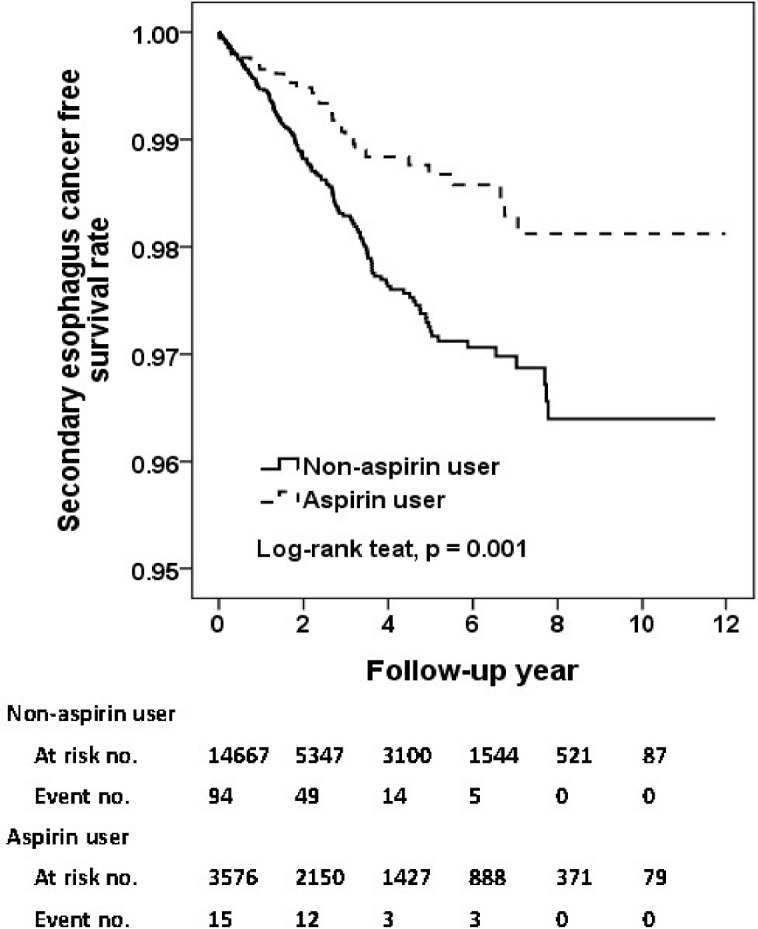
As reported by the Taiwan Cancer Registry in 2013 squamous cell carcinoma of head and neck cancer (HNSCC) was the sixth most frequently diagnosed cancer and the 5th most common cause of cancer related death and its incidence and mortality rate is still rising. The co-occurrence of HNSCC and secondary primary cancer (SPC) and the chemopreventive effect of aspirin on certain malignancies had been reported. Therefore we conducted this national study to investigate the use of aspirin associated with risk reduction of secondary primary cancer for patients with head and neck cancer in Taiwan. We searched the Registry for Catastrophic Illness in the National Health Insurance Research Database (NHIRD) for 18,234 patients (3,576 aspirin users and 14,667 non-aspirin users) diagnosed with HNSCC during 2000-2005. The SPC incidence density during follow-up in 2000-2011 was compared between the groups. For HNSCC patients, aspirin use after diagnosis was significantly associated with SPC risk reduction by 25% (adjusted HR, 0.75; 95% CI, 0.63-0.89; p = 0.001) after multivariate analysis. In the subgroup analysis, we found that esophageal cancer and stomach cancer incidence were significantly reduced after aspirin use (adjusted HR, 0.60; 95% CI, 0.41-0.90; p = 0.01 for esophageal cancer; adjusted HR, 0.27; 95% CI, 0.08-0.87; p = 0.03 for stomach cancer). Aspirin use for 1-3 years was associated with SPC risk reduction by 35% (adjusted HR, 0.65; 95% CI, 0.49-0.87; p = 0.003). SPC risk reduction extended continuously for more than 3 years of follow up (adjusted HR, 0.72; 95% CI, 0.53-0.98; p = 0.030). Our data shows aspirin use was associated with reduced SPC incidence for HNSCC patients, attributed mainly to reduced risk of esophageal and stomach cancer.
据 2013 年台湾癌症登记报告,头颈部癌症(HNSCC)是第六大常见癌症,也是第五大癌症相关死亡原因,其发病率和死亡率仍在上升。已经报道了 HNSCC 与第二原发癌(SPC)的共同发生以及阿司匹林对某些恶性肿瘤的化学预防作用。因此,我们进行了这项全国性研究,以调查在台湾使用阿司匹林是否可以降低头颈部癌症患者的第二原发癌风险。我们在国家健康保险研究数据库(NHIRD)的灾难性疾病登记处中搜索了 18234 名(3576 名阿司匹林使用者和 14667 名非阿司匹林使用者)在 2000-2005 年间被诊断为 HNSCC 的患者。在 2000-2011 年的随访期间,比较了两组的 SPC 发病率密度。多变量分析后,HNSCC 患者诊断后使用阿司匹林与 SPC 风险降低 25%显著相关(调整后的 HR,0.75;95%CI,0.63-0.89;p=0.001)。在亚组分析中,我们发现阿司匹林使用后食管癌和胃癌的发病率显著降低(调整后的 HR,0.60;95%CI,0.41-0.90;p=0.01 用于食管癌;调整后的 HR,0.27;95%CI,0.08-0.87;p=0.03 用于胃癌)。使用阿司匹林 1-3 年与 SPC 风险降低 35%相关(调整后的 HR,0.65;95%CI,0.49-0.87;p=0.003)。SPC 风险降低持续时间超过 3 年的随访时间(调整后的 HR,0.72;95%CI,0.53-0.98;p=0.030)。我们的数据表明,阿司匹林的使用与 HNSCC 患者 SPC 发病率降低有关,主要归因于食管癌和胃癌风险降低。