Department of Ophthalmology, Shuang-Ho Hospital-Taipei Medical University, New Taipei City, Taiwan.
Graduate Institute of Clinical Medicine, College of Medicine, National Taiwan University, Taipei, Taiwan.
PLoS One. 2018 Aug 22;13(8):e0202347. doi: 10.1371/journal.pone.0202347. eCollection 2018.
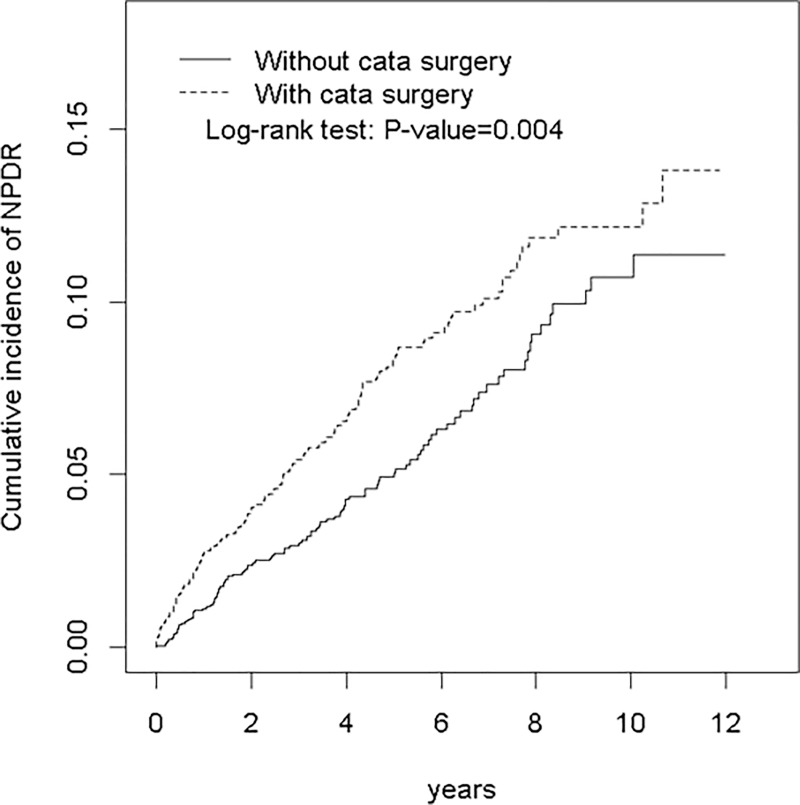
This study explored whether cataract surgery precipitates diabetic retinopathy (DR) development in diabetic patients without previous DR. Patients with the diagnosis of type II diabetes but without DR were selected from the Longitudinal Health Insurance Database 2000. Patients who received cataract surgery between January 1, 2000, and December 31, 2010, were included in the case group, and the control group was matched to the case group by age, sex, and index year. The postoperative incidence rates of nonproliferative diabetic retinopathy (NPDR), proliferative diabetic retinopathy (PDR), and diabetic macular edema (DME) were the main outcomes studied and were adjusted by age, sex, comorbidities, and statin, fibrate, angiotensin-converting-enzyme inhibitor (ACEI), oral hypoglycemic agents (OHA), and insulin use. In our cohort, patients who had dyslipidemia and used statins were more likely to undergo cataract surgery. Among diabetic patients without previous DR, patients receiving cataract surgery had a higher risk of NDPR development (adjusted hazard ratio = 1.48, 95% confidence interval = 1.15-1.91). No statistical difference was observed in PDR or DME development between operative and nonoperative groups. In additional stratified analyses, female sex, older age, comorbidities, surgery within 5 years, statin, ACEI, OHA, and insulin use increased the risk of NPDR development. In an adjusted Cox regression model, cataract surgery, OHA and insulin use were found to be risk factors for NPDR development. Cataract surgery with complications increased post-operative risks for NPDR were even higher, and the significant influence from cataract surgery persisted 5 years after surgery.
本研究旨在探讨白内障手术是否会诱发无既往糖尿病视网膜病变(DR)的糖尿病患者发生 DR。从 2000 年纵向健康保险数据库中筛选出诊断为 2 型糖尿病但无 DR 的患者。将 2000 年 1 月 1 日至 2010 年 12 月 31 日期间接受白内障手术的患者纳入病例组,并通过年龄、性别和指数年与病例组相匹配设立对照组。主要观察术后非增生性糖尿病视网膜病变(NPDR)、增生性糖尿病视网膜病变(PDR)和糖尿病黄斑水肿(DME)的发生率,并通过年龄、性别、合并症以及他汀类药物、贝特类药物、血管紧张素转换酶抑制剂(ACEI)、口服降糖药(OHA)和胰岛素的使用进行调整。在本队列中,患有血脂异常且使用他汀类药物的患者更有可能接受白内障手术。在无既往 DR 的糖尿病患者中,接受白内障手术的患者发生 NDPR 的风险更高(调整后的危险比=1.48,95%置信区间=1.15-1.91)。手术组和非手术组在 PDR 或 DME 发展方面无统计学差异。在进一步的分层分析中,女性、年龄较大、合并症、5 年内手术、他汀类药物、ACEI、OHA 和胰岛素的使用增加了 NPDR 发展的风险。在调整后的 Cox 回归模型中,白内障手术、OHA 和胰岛素的使用被发现是 NPDR 发展的危险因素。伴有并发症的白内障手术术后 NPDR 风险更高,且白内障手术的显著影响可持续 5 年。