Department of Clinical Pathology and Genetics, Sahlgrenska University Hospital, Gothenburg, Sweden.
Department of Molecular and Clinical Medicine, Sahlgrenska Academy, University of Gothenburg, Gothenburg, Sweden.
PLoS One. 2018 Aug 22;13(8):e0202666. doi: 10.1371/journal.pone.0202666. eCollection 2018.
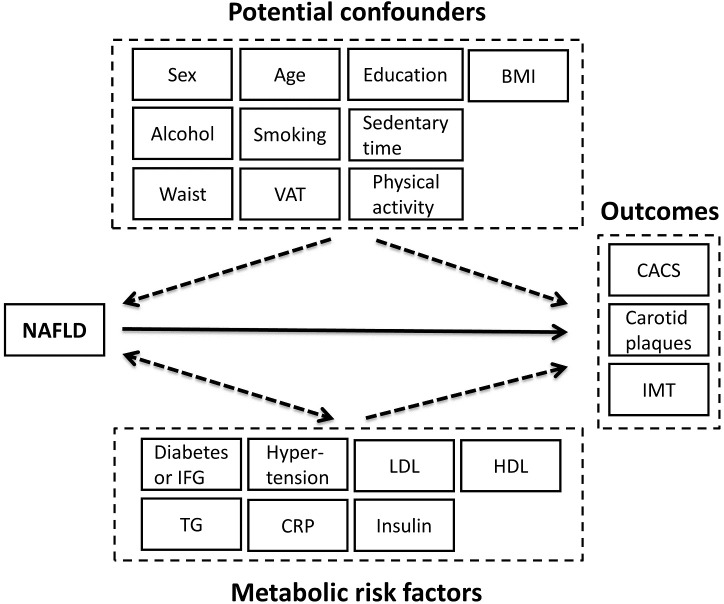
This study aims to estimate the relationship between non-alcoholic fatty liver disease (NAFLD) and measures of atherosclerotic cardiovascular disease (ASCVD), and to determine to what extent such relationships are modified by metabolic risk factors.
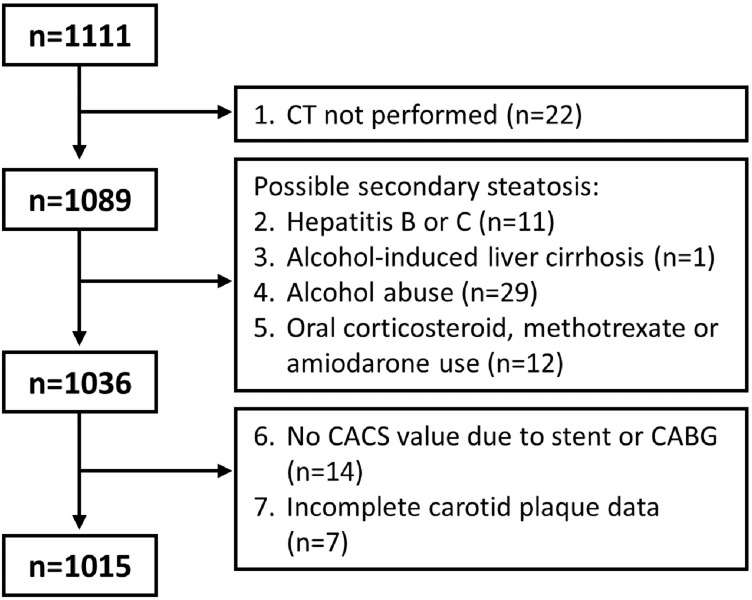
The study was conducted in the population-based Swedish CArdioPulmonary bioImage Study (SCAPIS) pilot cohort (n = 1015, age 50-64 years, 51.2% women). NAFLD was defined as computed tomography liver attenuation ≤40 Hounsfield Units, excluding other causes of liver fat. Coronary artery calcification score (CACS) was assessed using the Agatston method. Carotid plaques and intima media thickness (IMT) were measured by ultrasound. Metabolic status was based on assessments of glucose homeostasis, serum lipids, blood pressure and inflammation. A propensity score model was used to balance NAFLD and non NAFLD groups with regards to potential confounders and associations between NAFLD status and ASCVD variables in relation to metabolic status were examined by logistic and generalized linear regression models.
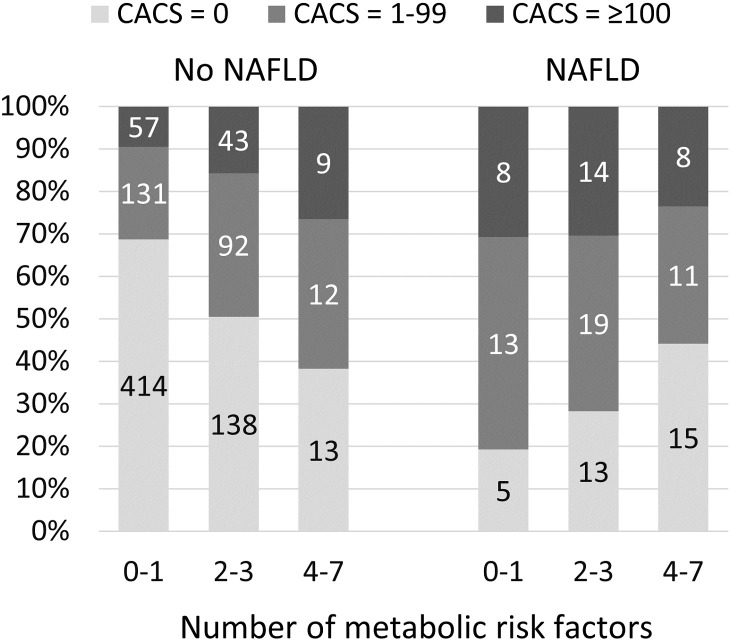
NAFLD was present in 106 (10.4%) of the subjects and strongly associated with obesity-related traits. NAFLD was significantly associated with CACS after adjustment for confounders and metabolic risk factors (OR 1.77, 95% CI 1.07-2.94), but not with carotid plaques and IMT. The strongest association between NAFLD and CACS was observed in subjects with few metabolic risk factors (n = 612 [60% of all] subjects with 0-1 out of 7 predefined metabolic risk factors; OR 5.94, 95% CI 2.13-16.6).
NAFLD was independently associated with coronary artery calcification but not with measures of carotid atherosclerosis in this cohort. The association between NAFLD and CACS was most prominent in the metabolically healthy subjects.
本研究旨在评估非酒精性脂肪性肝病(NAFLD)与动脉粥样硬化性心血管疾病(ASCVD)测量指标之间的关系,并确定代谢危险因素在多大程度上改变了这种关系。
该研究在基于人群的瑞典心肺生物影像学研究(SCAPIS)试点队列中进行(n=1015,年龄 50-64 岁,51.2%为女性)。NAFLD 定义为计算机断层扫描肝脏衰减值≤40 亨氏单位,排除其他肝脏脂肪原因。冠状动脉钙化评分(CACS)采用 Agatston 法评估。颈动脉斑块和内膜中层厚度(IMT)通过超声测量。代谢状态基于葡萄糖稳态、血清脂质、血压和炎症评估。采用倾向评分模型平衡 NAFLD 和非 NAFLD 组的潜在混杂因素,并通过逻辑和广义线性回归模型检查 NAFLD 状态与 ASCVD 变量之间的关系以及代谢状态的相关性。
106 名(10.4%)受试者存在 NAFLD,与肥胖相关特征密切相关。在调整混杂因素和代谢危险因素后,NAFLD 与 CACS 显著相关(OR 1.77,95%CI 1.07-2.94),但与颈动脉斑块和 IMT 无关。在代谢危险因素较少的受试者中(n=612[所有受试者的 60%],有 0-1 种 7 种预设代谢危险因素;OR 5.94,95%CI 2.13-16.6),NAFLD 与 CACS 之间的关联最强。
在本队列中,NAFLD 与冠状动脉钙化独立相关,但与颈动脉粥样硬化的测量指标无关。NAFLD 与 CACS 的相关性在代谢健康的受试者中最为显著。