Institute for Social Research, University of Michigan, PO Box 1248, Ann Arbor, MI 48106-1248, USA.
Institute for Translational Research in Children's Mental Health, Institute of Child Development, University of Minnesota, 1100 Washington Ave S., Suite 101, Minneapolis, MN 55414, USA.
Drug Alcohol Depend. 2018 Oct 1;191:203-209. doi: 10.1016/j.drugalcdep.2018.07.002. Epub 2018 Aug 14.
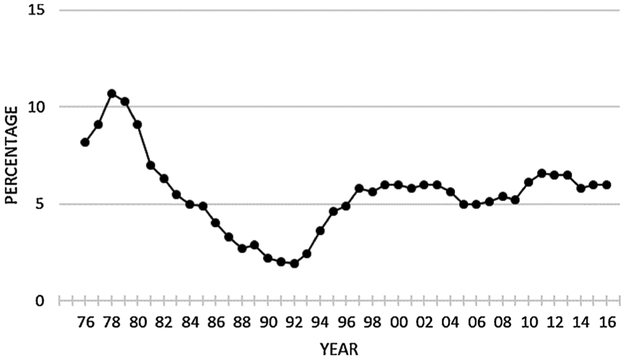
This study examines the extent to which the developmental pattern of frequent marijuana use prevalence from ages 18 to 30 (overall and by gender) has varied across historical time (cohort groups) using data from a national sample of US young adults.
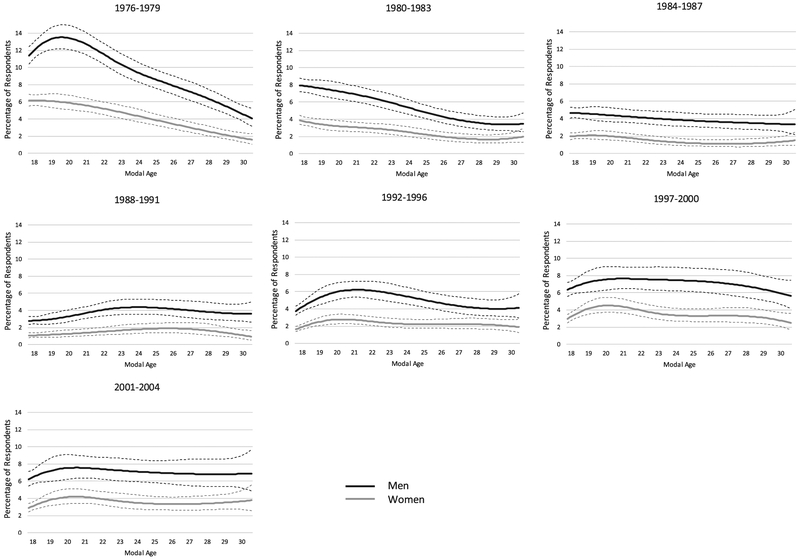
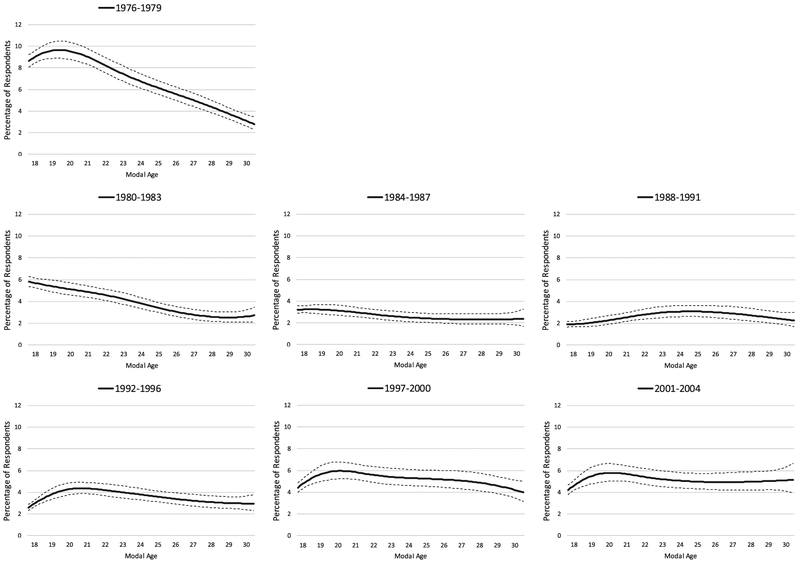
Self-reported data on frequent marijuana use (use on 20+ occasions in the past 30 days) from modal ages 18 to 30 were obtained from 58,059 individuals from 29 sequential cohorts (graduating high school classes of 1976-2004) participating in the Monitoring the Future study. Time-varying effect modeling was used to model cohort group differences in developmental patterns of frequent use overall and by gender.
Developmental patterns of frequent marijuana use prevalence varied meaningfully across cohort groups. Frequent use at age 18 differed significantly across cohort groups as expected based on national data. Among earlier cohort groups (reaching age 30 during 1987-2008), developmental patterns converged by age 30 to relatively low frequent marijuana use prevalence. In contrast, among cohort groups reaching age 30 during 2008-2016, frequent marijuana use at age 30 was significantly higher than all previous cohort groups. Observed cohort differences did not vary significantly by gender.
Cross-cohort convergence in developmental patterns of frequent marijuana use prevalence by age 30 was not observed among recent cohort groups, among whom age 30 frequent marijuana use prevalence was at the highest levels observed since the study began. Higher frequent marijuana use prevalence in late young adulthood has meaningful health risk and service provision implications.
本研究利用美国青年成年人全国样本的数据,考察了从 18 岁到 30 岁(总体上和按性别划分)频繁使用大麻的流行率发展模式在历史时期(队列组)的变化程度。
从参加“监测未来”研究的 29 个连续队列(1976-2004 年高中毕业班级)的 58059 名个体中获得了在过去 30 天内 20 次以上使用大麻(频繁使用)的自我报告数据。采用时变效应模型对总体和按性别划分的频繁使用发展模式的队列组差异进行建模。
频繁使用大麻流行率的发展模式在队列组之间有明显的差异。根据全国数据,18 岁时的频繁使用在队列组之间存在显著差异。在较早的队列组(1987-2008 年达到 30 岁)中,到 30 岁时的发展模式趋于相对较低的频繁使用流行率。相比之下,在 2008-2016 年达到 30 岁的队列组中,30 岁时的大麻频繁使用率显著高于所有之前的队列组。观察到的队列差异在性别上没有显著差异。
在最近的队列组中,到 30 岁时频繁使用大麻流行率的跨队列趋同并未观察到,在这些队列组中,30 岁时的大麻频繁使用率是自研究开始以来观察到的最高水平。在年轻成年人后期出现更高的大麻频繁使用率对健康风险和服务提供具有重要意义。