Society and Health Research Center, Universidad Mayor, Santiago, Chile.
School of Public Health, Universidad Mayor, Santiago, Chile.
Addiction. 2020 Nov;115(11):2089-2097. doi: 10.1111/add.15058. Epub 2020 Apr 15.
Uruguay and Chile have the highest levels of marijuana use in Latin America, and have experienced consistent increases during the last two decades. We aim to calculate separate age-period-cohort (APC) effects for past-year marijuana use in Uruguay and Chile, which have similar epidemiologica, and demographic profiles but diverging paths in cannabis regulation.
APC study in which period and cohort effects were estimated as first derivative deviations from their linear age trend, separately by country and gender.
Uruguay and Chile.
General population between 15 and 64 years.
Past-year marijuana use from household surveys with five repeated cross-sections between 2001 and 2018 in Uruguay (median n = 4616) and 13 between 1994 and 2018 in Chile (median n = 15 895).
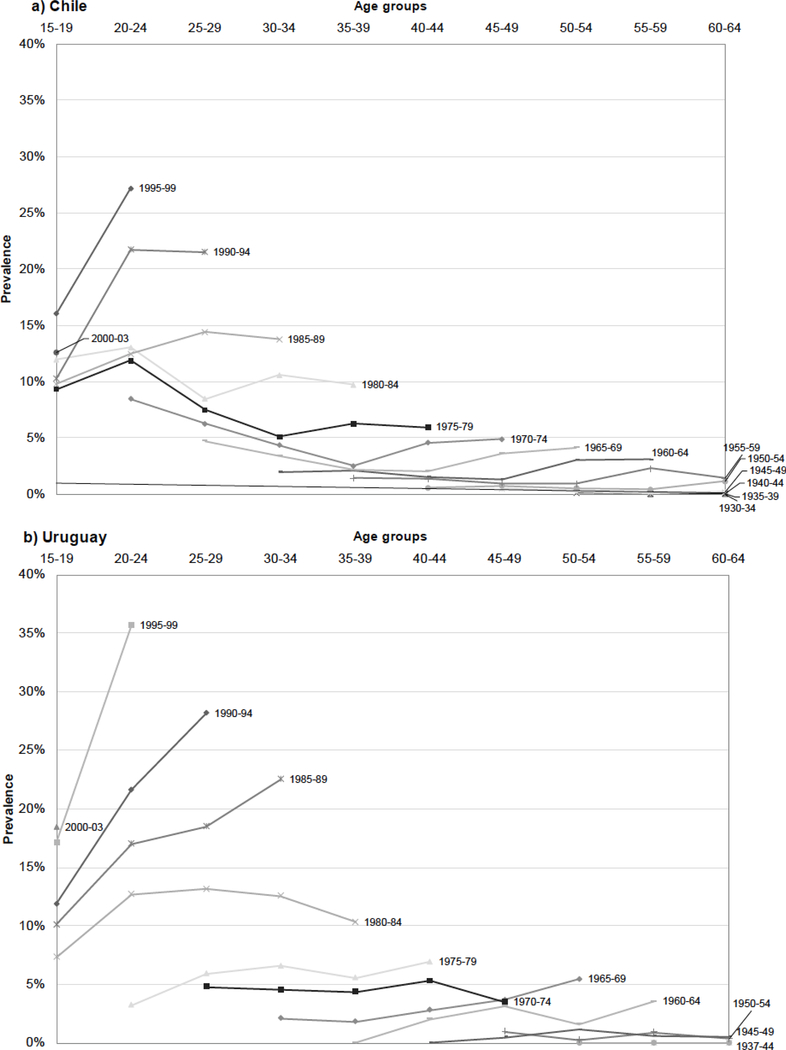
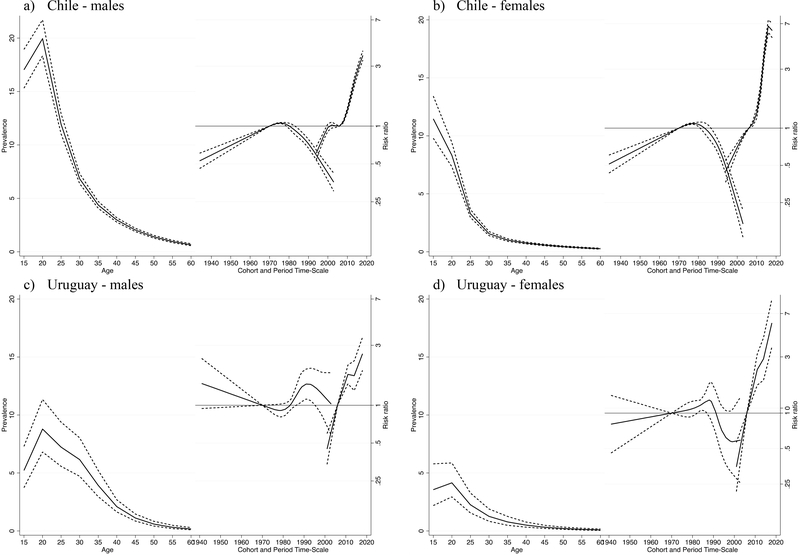
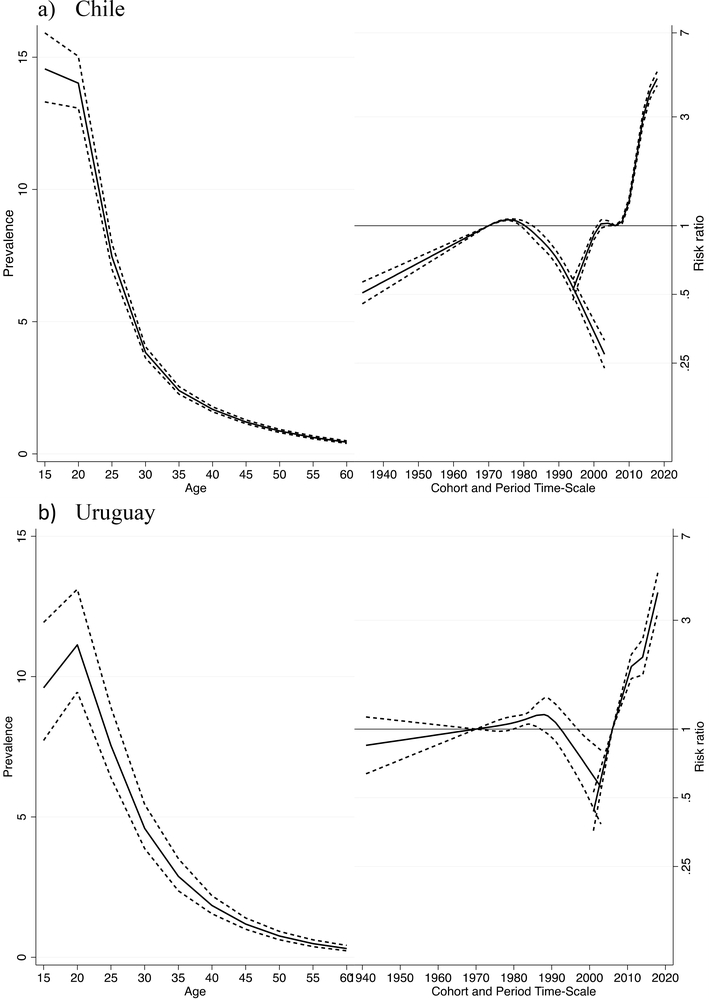
Marijuana use prevalence in both countries peaked at 20-24 years of age and increased consistently across calendar years. Period effects were strong and positive, indicating that increases in use were evident across age groups. Relative to 2006 (reference year), Chilean period effects were approximately 48% lower in 1994 and approximately four times higher in 2018; in Uruguay, these effects were approximately 56% lower in 2001 and almost quadrupled in 2018. We observed non-linear cohort effects in Chile and similar patterns in Uruguay for the overall sample and women. In both countries, marijuana use increased for cohorts born between the mid-1970s and early 1990s, even in the context of rising period effects. Prevalence was consistently larger for men, but period increases were stronger in women.
Age-period-cohort effects on past-year marijuana use appear to have been similar in Chile and Uruguay, decreasing with age and increasing over time at heterogeneous growth rates depending on gender and cohort. Current levels of marijuana use, including age and gender disparities, seem to be associated with recent common historical events in these two countries.
乌拉圭和智利是拉丁美洲大麻使用率最高的国家,在过去二十年中一直呈持续上升趋势。我们旨在计算乌拉圭和智利过去一年大麻使用情况的单独年龄-时期-队列(APC)效应,这两个国家具有相似的流行病学和人口统计学特征,但在大麻监管方面存在不同的路径。
APC 研究,其中通过国家和性别分别估计时期和队列效应作为其线性年龄趋势的一阶导数偏差。
乌拉圭和智利。
15 至 64 岁的普通人群。
2001 年至 2018 年间乌拉圭五次重复横断面调查(中位数 n=4616)和智利 1994 年至 2018 年 13 次调查(中位数 n=15895)中过去一年大麻使用情况。
两国的大麻使用率在 20-24 岁达到峰值,并在历年持续增加。时期效应较强且为正,表明使用的增加在各个年龄组中都很明显。与 2006 年(参考年)相比,智利的时期效应在 1994 年约低 48%,在 2018 年约高 4 倍;在乌拉圭,2001 年的效应约低 56%,2018 年几乎增加了四倍。我们观察到智利存在非线性队列效应,乌拉圭总体样本和女性也存在类似模式。在这两个国家,大麻使用量在 20 世纪 70 年代中期至 90 年代初出生的队列中增加,即使在上升的时期效应背景下也是如此。男性的流行率始终较大,但女性的时期增长率更强。
年龄-时期-队列效应对过去一年大麻使用的影响在智利和乌拉圭似乎相似,随着年龄的增长而降低,并且根据性别和队列以不同的增长率随时间增加。目前的大麻使用率,包括年龄和性别差距,似乎与这两个国家最近的共同历史事件有关。