Zayed Yazan Z M, Aburahma Ahmed M Y, Barbarawi Mahmoud O, Hamid Kewan, Banifadel Momen R N, Rashdan Laith, Bachuwa Ghassan I
Internal Medicine Department, Hurley Medical Center/Michigan State University College of Human Medicine, Flint, MI USA.
East Lansing, USA.
J Intensive Care. 2018 Aug 17;6:51. doi: 10.1186/s40560-018-0320-x. eCollection 2018.
Intravenous fluids are one of the most used medical therapy for patients, especially critically ill patients. We conducted a meta-analysis comparing between balanced crystalloids and normal saline in critically ill patients and its effect on various clinical outcomes.
Meta-analysis and systematic review of randomized clinical trials (RCTs).
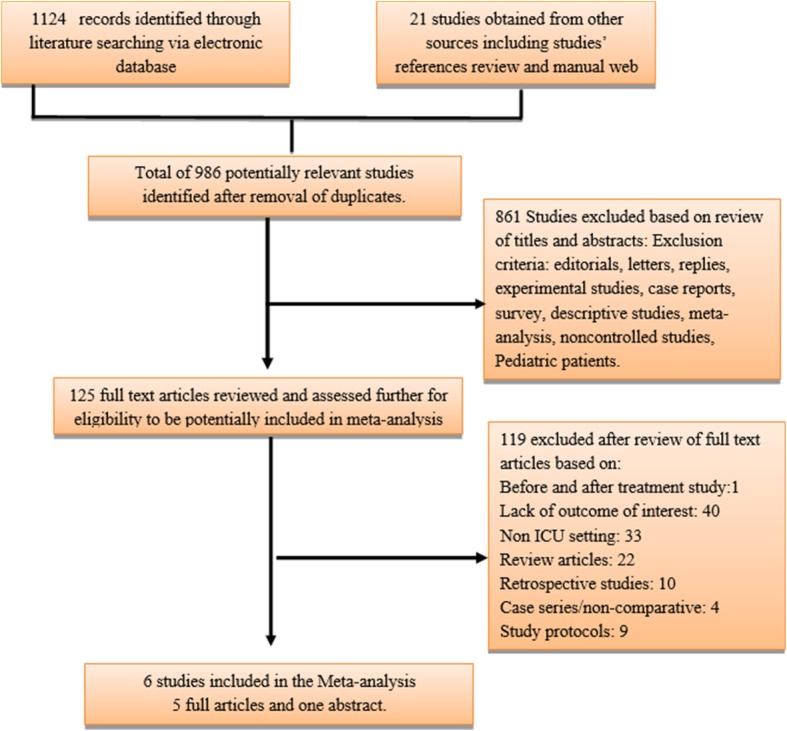
Electronic search was performed using PubMed, Cochrane library, and clinical trials.gov from inception through March 1, 2018, with inclusion of prospective studies that investigated one of the primary outcomes which were acute kidney injury (AKI) and in-hospital mortality while secondary outcomes were intensive care unit (ICU) mortality and new renal replacement therapy (RRT).
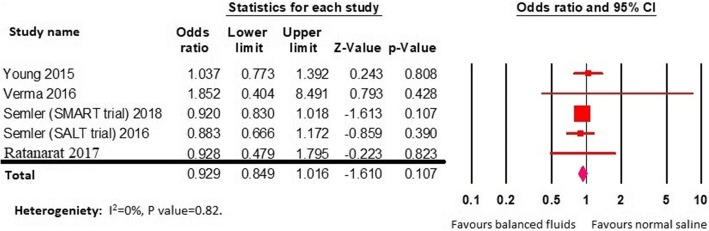
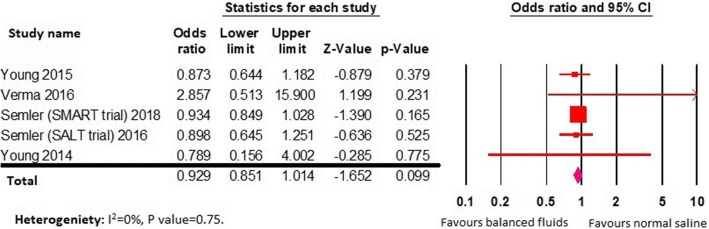
Six RCTs were included. Total of 19,332 patients were included in the final analysis. There was no significant difference in in-hospital mortality (11.5% vs 12.2%; OR 0.92; 95% CI 0.85-1.01; = 0.09; = 0%), incidence of AKI (12% vs 12.7%, OR 0.92; 95% CI 0.84-1.01; = 0.1; = 0), overall ICU mortality (OR 0.9, 95% CI 0.81-1.01, = 0.08, = 0%), or need for new RRT (OR 0.92, 95% CI 0.67-1.28, = 0.65, = 38%) between balanced crystalloids and isotonic saline in critically ill patients.
Balanced crystalloids and isotonic saline have no difference on various clinical outcomes including in-hospital mortality, AKI, overall ICU mortality, and new RRT. Further powerful clinical trials are required to determine the relationship between crystalloid fluid type and clinical outcomes.
静脉输液是对患者尤其是重症患者最常用的医学治疗方法之一。我们进行了一项荟萃分析,比较重症患者使用平衡晶体液和生理盐水的情况及其对各种临床结局的影响。
随机临床试验(RCT)的荟萃分析和系统评价。
使用PubMed、Cochrane图书馆和临床试验.gov进行电子检索,检索时间从数据库建立至2018年3月1日,纳入前瞻性研究,这些研究调查了急性肾损伤(AKI)和住院死亡率这两个主要结局之一,而次要结局为重症监护病房(ICU)死亡率和新的肾脏替代治疗(RRT)。
纳入6项随机对照试验。最终分析共纳入19332例患者。在住院死亡率(11.5%对12.2%;OR 0.92;95%CI 0.85 - 1.01;P = 0.09;I² = 0%)、AKI发生率(12%对12.7%,OR 0.92;95%CI 0.84 - 1.01;P = 0.1;I² = 0)、总体ICU死亡率(OR 0.9,95%CI 0.81 - 1.01,P = 0.08,I² = 0%)或重症患者使用平衡晶体液和等渗盐水后新的RRT需求(OR 0.92,95%CI 0.67 - 1.28,P = 0.65,I² = 38%)方面,均无显著差异。
平衡晶体液和等渗盐水在包括住院死亡率、AKI、总体ICU死亡率和新的RRT等各种临床结局上没有差异。需要进一步开展有力的临床试验来确定晶体液类型与临床结局之间的关系。