Budzianowski Jan, Hiczkiewicz Jarosław, Burchardt Paweł, Pieszko Konrad, Rzeźniczak Janusz, Budzianowski Paweł, Korybalska Katarzyna
Department of Cardiology, Nowa Sól Multidisciplinary Hospital, Nowa Sól, Poland.
Faculty of Medicine and Health Sciences, University of Zielona Góra, Zielona Góra, Poland.
Heart Vessels. 2019 Feb;34(2):352-359. doi: 10.1007/s00380-018-1244-z. Epub 2018 Aug 23.
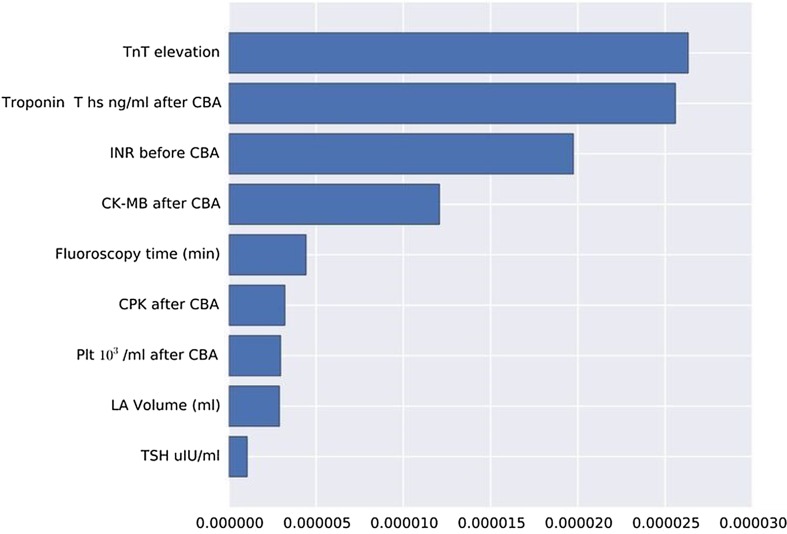
Inflammation, oxidative stress, myocardial injury biomarkers and clinical parameters (longer AF duration, left atrial enlargement, the metabolic syndrome) are factors commonly related to AF recurrence. This study aims to assess the predictive value of laboratory and clinical parameters responsible for early recurrence of atrial fibrillation (ERAF) following cryoballoon ablation (CBA) using statistical assessment and machine learning algorithms. This study group comprised 118 consecutive patients (mean age, 62.5 ± 7.8 years; women 36%) with paroxysmal (54.1%) and persistent (45.9%) AF who underwent their first pulmonary vein isolation (PVI) performed by CBA (Arctic Front Advance 2nd generation 28 mm). The biomarker concentrations were measured at baseline and after CBA in a 24-h follow-up. ERAF was defined as at least a 30-s episode of arrhythmia registered by a 24 h-Holter monitor within the 3 months following the procedure. 56 clinical, laboratory and procedural variables were collected from each patient. We used two classification algorithms: support vector machines, gradient boosted tree. The synthetic minority over-sampling technique (SMOTE) was used to provide a balanced training data set. Within a period of 3 months 21 patients (17.8%) experienced ERAF. The statistical analysis indicated that the lowered levels of post-ablation TnT (p = 0.043) and CK-MB (p = 0.010) with the TnT elevation (p = 0.044) were the predictors of ERAF following CBA. In addition, diabetes and statin treatment were significantly associated with ERAF after CBA (p < 0.05). The machine learning algorithms confirmed the results obtained in the univariate analysis.
炎症、氧化应激、心肌损伤生物标志物和临床参数(房颤持续时间延长、左心房扩大、代谢综合征)是与房颤复发通常相关的因素。本研究旨在使用统计评估和机器学习算法评估负责冷冻球囊消融(CBA)后房颤早期复发(ERAF)的实验室和临床参数的预测价值。该研究组包括118例连续患者(平均年龄62.5±7.8岁;女性占36%),患有阵发性(54.1%)和持续性(45.9%)房颤,他们接受了首次由CBA(第二代北极锋28毫米)进行的肺静脉隔离(PVI)。在基线和CBA后24小时随访时测量生物标志物浓度。ERAF定义为在手术后3个月内通过24小时动态心电图监测记录到至少30秒的心律失常发作。从每位患者收集了56个临床、实验室和手术变量。我们使用了两种分类算法:支持向量机、梯度提升树。使用合成少数过采样技术(SMOTE)来提供平衡的训练数据集。在3个月内,21例患者(17.8%)经历了ERAF。统计分析表明,消融后TnT(p = 0.043)和CK-MB(p = 0.010)水平降低以及TnT升高(p = 0.044)是CBA后ERAF的预测因素。此外,糖尿病和他汀类药物治疗与CBA后的ERAF显著相关(p < 0.05)。机器学习算法证实了单变量分析中获得的结果。