Ng Nga Lee, Brown Steven S, Archibald Alexander T, Atlas Elliot, Cohen Ronald C, Crowley John N, Day Douglas A, Donahue Neil M, Fry Juliane L, Fuchs Hendrik, Griffin Robert J, Guzman Marcelo I, Herrmann Hartmut, Hodzic Alma, Iinuma Yoshiteru, Jimenez José L, Kiendler-Scharr Astrid, Lee Ben H, Luecken Deborah J, Mao Jingqiu, McLaren Robert, Mutzel Anke, Osthoff Hans D, Ouyang Bin, Picquet-Varrault Benedicte, Platt Ulrich, Pye Havala O T, Rudich Yinon, Schwantes Rebecca H, Shiraiwa Manabu, Stutz Jochen, Thornton Joel A, Tilgner Andreas, Williams Brent J, Zaveri Rahul A
School of Chemical and Biomolecular Engineering, Georgia Institute of Technology, Atlanta, GA, USA.
School of Earth and Atmospheric Sciences, Georgia Institute of Technology, Atlanta, GA, USA.
Atmos Chem Phys. 2017;17(3):2103-2162. doi: 10.5194/acp-17-2103-2017.
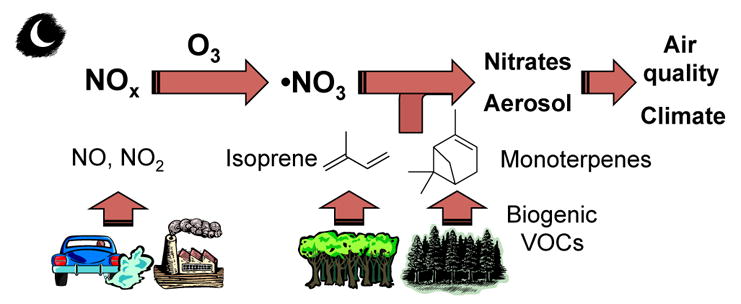
Oxidation of biogenic volatile organic compounds (BVOC) by the nitrate radical (NO) represents one of the important interactions between anthropogenic emissions related to combustion and natural emissions from the biosphere. This interaction has been recognized for more than 3 decades, during which time a large body of research has emerged from laboratory, field, and modeling studies. NO-BVOC reactions influence air quality, climate and visibility through regional and global budgets for reactive nitrogen (particularly organic nitrates), ozone, and organic aerosol. Despite its long history of research and the significance of this topic in atmospheric chemistry, a number of important uncertainties remain. These include an incomplete understanding of the rates, mechanisms, and organic aerosol yields for NO-BVOC reactions, lack of constraints on the role of heterogeneous oxidative processes associated with the NO radical, the difficulty of characterizing the spatial distributions of BVOC and NO within the poorly mixed nocturnal atmosphere, and the challenge of constructing appropriate boundary layer schemes and non-photochemical mechanisms for use in state-of-the-art chemical transport and chemistry-climate models. This review is the result of a workshop of the same title held at the Georgia Institute of Technology in June 2015. The first half of the review summarizes the current literature on NO-BVOC chemistry, with a particular focus on recent advances in instrumentation and models, and in organic nitrate and secondary organic aerosol (SOA) formation chemistry. Building on this current understanding, the second half of the review outlines impacts of NO-BVOC chemistry on air quality and climate, and suggests critical research needs to better constrain this interaction to improve the predictive capabilities of atmospheric models.
硝酸盐自由基(NO)对生物源挥发性有机化合物(BVOC)的氧化作用,是燃烧相关的人为排放与生物圈自然排放之间重要的相互作用之一。这种相互作用已被认识超过30年,在此期间,实验室、实地和模型研究涌现出大量研究成果。NO - BVOC反应通过活性氮(特别是有机硝酸盐)、臭氧和有机气溶胶的区域和全球收支,影响空气质量、气候和能见度。尽管该领域研究历史悠久且此主题在大气化学中具有重要意义,但仍存在一些重要的不确定性。这些不确定性包括对NO - BVOC反应的速率、机制和有机气溶胶产量的理解不完整,对与NO自由基相关的非均相氧化过程的作用缺乏限制,在混合较差的夜间大气中表征BVOC和NO空间分布的困难,以及为最先进的化学传输和化学气候模型构建合适的边界层方案和非光化学机制的挑战。本综述是2015年6月在佐治亚理工学院举办的同名研讨会的成果。综述的前半部分总结了当前关于NO - BVOC化学的文献,特别关注仪器和模型以及有机硝酸盐和二次有机气溶胶(SOA)形成化学方面的最新进展。基于当前的理解,综述的后半部分概述了NO - BVOC化学对空气质量和气候的影响,并提出了关键的研究需求,以更好地限制这种相互作用,提高大气模型的预测能力。