Brandariz David, Smithson Alex, Anton-Vazquez Vanesa
Department of Hospital Pharmacy, Hospital de l'Esperit Sant, Santa Coloma Gramenet, Spain.
Infectious Disease Unit, Hospital de l'Esperit Sant, Santa Coloma de Gramenet, Spain.
Indian J Sex Transm Dis AIDS. 2017 Jul-Dec;38(2):163-170. doi: 10.4103/ijstd.IJSTD_70_17.
The drug reaction with eosinophilia and systemic symptoms (DRESS) syndrome is a life-threatening condition caused by different medications. The objective of this study was to analyze DRESS cases related to antiretroviral therapy in human immunodeficiency virus (HIV) patients.
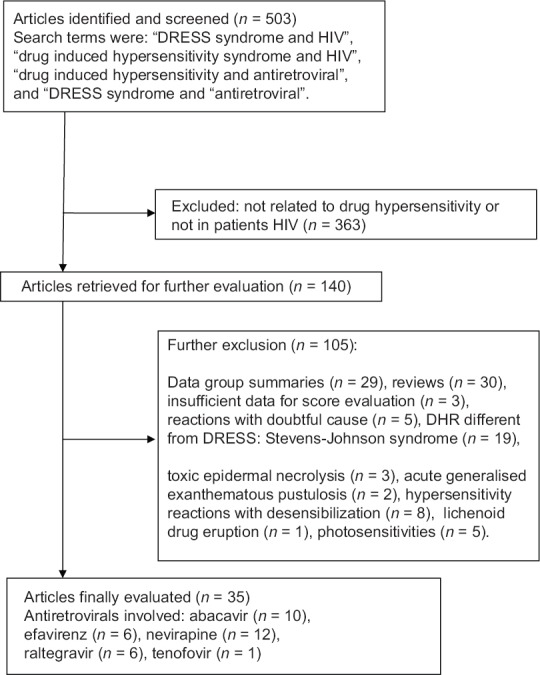
Systematic review of DRESS suspected cases in HIV patients associated to antiretrovirals published between January 1998 and April 2017. The registry of the severe cutaneous adverse reactions score was used to classify each report as a "definitive," "probable," "possible," or "no" DRESS case. Clinical characteristics, management, and outcomes were evaluated.
Thirty-five case reports were analyzed involving 5 antiretrovirals: Abacavir in 10 (28.6%) cases, efavirenz in 6 (17.1%), nevirapine in 12 (34.3%), raltegravir in 6 (17.1%), and tenofovir in 1 (2.9%). Mean age of the patients was 40 ± 13 years, 65% of which were male. A total of 57.1% reports were classified as having a "definitive-probable" DRESS case. Management was based on withdrawal of the causal antiretroviral and corticosteroids in 68.6% of the cases. None of the patients died. Treatment with nevirapine or raltegravir, the longer onset of symptoms and the presence of lymphadenopathy, eosinophilia, liver involvement, and a longer time for clinical resolution were more frequent among "definitive-probable" DRESS cases.
A DRESS syndrome has to be suspected in HIV patients with lymphadenopathy, eosinophilia, and liver involvement developing weeks after the initiation of nevirapine or raltegravir. Suspension of the causal antiretroviral and in most cases treatment with corticosteroids allowed adequate clinical control.
药物超敏反应伴嗜酸性粒细胞增多和全身症状(DRESS)综合征是一种由不同药物引起的危及生命的疾病。本研究的目的是分析人类免疫缺陷病毒(HIV)患者中与抗逆转录病毒治疗相关的DRESS病例。
对1998年1月至2017年4月发表的与抗逆转录病毒药物相关的HIV患者DRESS疑似病例进行系统评价。使用严重皮肤不良反应评分登记册将每份报告分类为“确诊”、“很可能”、“可能”或“不是”DRESS病例。评估临床特征、管理和结果。
分析了35例病例报告,涉及5种抗逆转录病毒药物:阿巴卡韦10例(28.6%),依非韦伦6例(17.1%),奈韦拉平12例(34.3%),拉替拉韦6例(17.1%),替诺福韦1例(2.9%)。患者的平均年龄为40±13岁,其中65%为男性。共有57.1%的报告被分类为“确诊-很可能”DRESS病例。68.6%的病例管理基于停用致病抗逆转录病毒药物和使用皮质类固醇。没有患者死亡。在“确诊-很可能”DRESS病例中,使用奈韦拉平或拉替拉韦治疗、症状出现时间较长以及存在淋巴结病、嗜酸性粒细胞增多、肝脏受累和临床缓解时间较长的情况更为常见。
在开始使用奈韦拉平或拉替拉韦数周后出现淋巴结病、嗜酸性粒细胞增多和肝脏受累的HIV患者中,必须怀疑DRESS综合征。停用致病抗逆转录病毒药物,在大多数情况下使用皮质类固醇治疗可实现充分的临床控制。