Institute for Genome Biology, Leibniz Institute for Farm Animal Biology (FBN), Wilhelm-Stahl-Allee 2, 18196, Dummerstorf, Germany.
Department of Farm Animals and Veterinary Public Health, Institute of Animal Nutrition and Functional Plant Compounds, University of Veterinary Medicine Vienna, Veterinaerplatz 1, 1210, Vienna, Austria.
Sci Rep. 2018 Aug 27;8(1):12903. doi: 10.1038/s41598-018-31072-7.
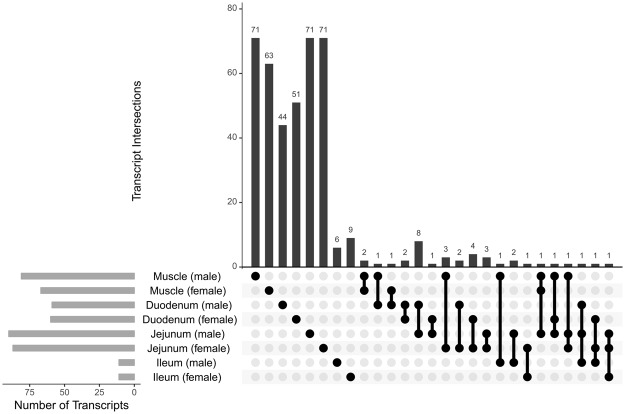
Considerable variation in feed efficiency (FE) has been observed in indigenous and selected meat-type chicken populations. Although this variation could be partially linked to extrinsic factors like diet, housing environment and microbiota, it further illustrates the existence of strong molecular mechanisms enabling the differential allocation of resources for various physiological processes. To further deepen the molecular basis of individual allocation capacity in male and female broilers, an RNA-seq experiment was conducted which based on a phenotyped chicken population divergent in FE. Transcriptional differences linked to FE were pronounced in intestinal and muscular tissue sites of male animals. Specifically, signalling pathways of farnesoid X receptor (FXR) and retinoid X receptor (RXR) might contribute to mediate individual FE. The transcriptional profiles suggested ACSBG2 (muscular lipid utilisation), ASBT (intestinal bile salt transport), CLEC2B (natural killer cell activation), HMGCS2 (jejunal, duodenal and muscular ketogenesis), and SCARB1 (jejunal lipid uptake) as potential mediators driving FE. Results indicate that improvements in FE exploit shifts in resource allocation which might occur at the expense of general immune responsiveness in high efficient male chickens. Consequently, to further improve FE traits and to explore causative molecular patterns, effects originating from sex-dimorphism in chickens need to be taken into consideration.
在本地鸡和选育的肉用型鸡群体中,饲料效率(FE)存在很大的差异。虽然这种差异可能部分与饮食、饲养环境和微生物群等外在因素有关,但它进一步说明了存在强大的分子机制,使资源能够在不同的生理过程中进行差异分配。为了进一步深入研究雄性和雌性肉鸡个体分配能力的分子基础,进行了一项基于 FE 存在差异的表型鸡群的 RNA-seq 实验。雄性动物的肠道和肌肉组织中,与 FE 相关的转录差异明显。具体来说,法尼醇 X 受体(FXR)和视黄醇 X 受体(RXR)信号通路可能有助于介导个体 FE。转录谱表明 ACSBG2(肌肉脂质利用)、ASBT(肠道胆汁盐转运)、CLEC2B(自然杀伤细胞激活)、HMGCS2(回肠、十二指肠和肌肉酮生成)和 SCARB1(回肠脂质摄取)可能是驱动 FE 的潜在介质。结果表明,FE 的提高利用了资源分配的转变,这可能是以高效雄性鸡的一般免疫反应为代价的。因此,为了进一步提高 FE 性状并探索因果分子模式,需要考虑鸡的性别二态性的影响。