Department of Health Security, National Institute for Health and Welfare, P.O.Box 30, 00271, Helsinki, Finland.
School of Medicine, Division of Epidemiology and Public Health, University of Nottingham, Nottingham, UK.
BMC Infect Dis. 2018 Aug 29;18(1):437. doi: 10.1186/s12879-018-3150-5.
International and national travelling has made the rapid spread of infectious diseases possible. Little information is available on the role of major traffic hubs, such as airports, in the transmission of respiratory infections, including seasonal influenza and a pandemic threat. We investigated the presence of respiratory viruses in the passenger environment of a major airport in order to identify risk points and guide measures to minimize transmission.
Surface and air samples were collected weekly at three different time points during the peak period of seasonal influenza in 2015-16 in Finland. Swabs from surface samples, and air samples were tested by real-time PCR for influenza A and B viruses, respiratory syncytial virus, adenovirus, rhinovirus and coronaviruses (229E, HKU1, NL63 and OC43).
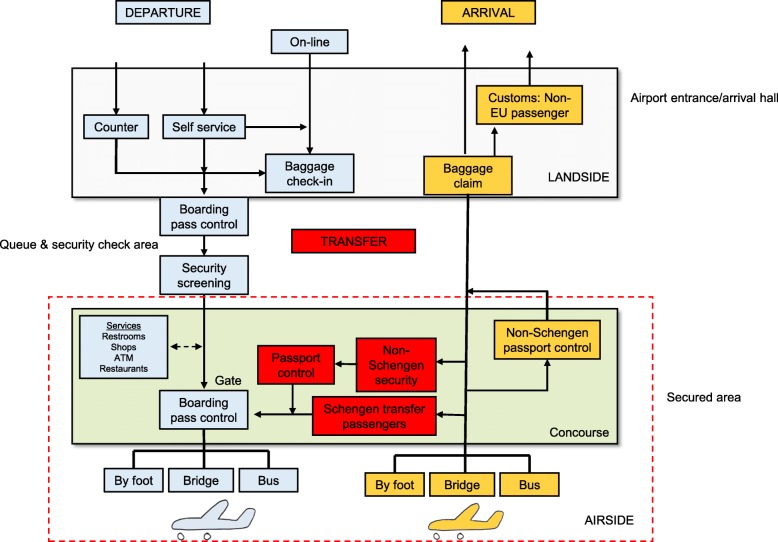
Nucleic acid of at least one respiratory virus was detected in 9 out of 90 (10%) surface samples, including: a plastic toy dog in the children's playground (2/3 swabs, 67%); hand-carried luggage trays at the security check area (4/8, 50%); the buttons of the payment terminal at the pharmacy (1/2, 50%); the handrails of stairs (1/7, 14%); and the passenger side desk and divider glass at a passport control point (1/3, 33%). Among the 10 respiratory virus findings at various sites, the viruses identified were: rhinovirus (4/10, 40%, from surfaces); coronavirus (3/10, 30%, from surfaces); adenovirus (2/10, 20%, 1 air sample, 1 surface sample); influenza A (1/10, 10%, surface sample).
Detection of pathogen viral nucleic acids indicates respiratory viral surface contamination at multiple sites associated with high touch rates, and suggests a potential risk in the identified airport sites. Of the surfaces tested, plastic security screening trays appeared to pose the highest potential risk, and handling these is almost inevitable for all embarking passengers.
国际和国家间的旅行使得传染病的快速传播成为可能。关于主要交通枢纽(如机场)在呼吸道感染(包括季节性流感和大流行威胁)传播中的作用,我们知之甚少。我们调查了主要机场乘客环境中呼吸道病毒的存在情况,以确定风险点并指导采取措施尽量减少传播。
在 2015-16 年芬兰季节性流感高峰期的三个不同时间点,每周采集三次表面和空气样本。用实时 PCR 法检测来自表面样本的拭子和空气样本中的流感 A 和 B 病毒、呼吸道合胞病毒、腺病毒、鼻病毒和冠状病毒(229E、HKU1、NL63 和 OC43)。
在 90 个表面样本中的 9 个(10%)中检测到至少一种呼吸道病毒的核酸,包括:儿童游乐区的塑料玩具狗(3 个拭子中的 2 个,67%);安检区的手提行李托盘(8 个中的 4 个,50%);药房付费终端的按钮(2 个中的 1 个,50%);楼梯扶手(7 个中的 1 个,14%);以及护照检查点的乘客侧桌和隔板玻璃(3 个中的 1 个,33%)。在各种地点的 10 种呼吸道病毒发现中,鉴定出的病毒包括:鼻病毒(10 个中的 4 个,40%,来自表面);冠状病毒(10 个中的 3 个,30%,来自表面);腺病毒(10 个中的 2 个,20%,1 个空气样本,1 个表面样本);流感 A(10 个中的 1 个,10%,表面样本)。
病原体病毒核酸的检测表明,与高接触率相关的多个地点存在呼吸道病毒表面污染,并提示在确定的机场地点存在潜在风险。在所测试的表面中,塑料安检托盘似乎带来的风险最高,所有登机乘客几乎都不可避免地会接触到这些。