Department of Medical IT Convergence Engineering, Kumoh National Institute of Technology, Gumi 39177, Korea.
Berlin Institute of Technology, Machine Learning Group, Marchstrasse 23, 10587 Berlin, Germany.
Sensors (Basel). 2018 Aug 29;18(9):2856. doi: 10.3390/s18092856.
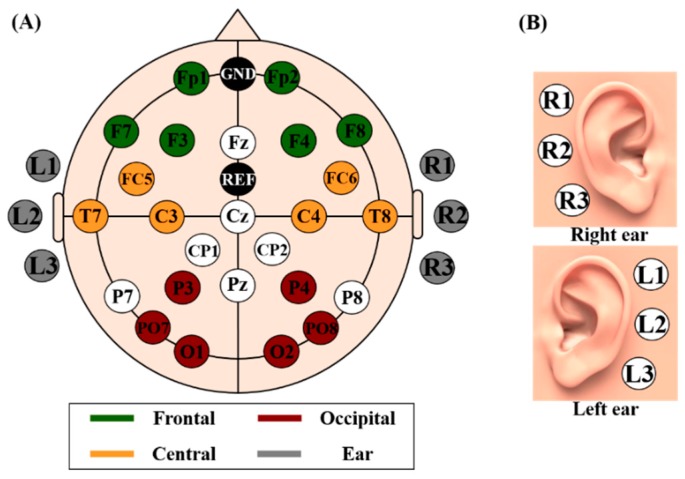
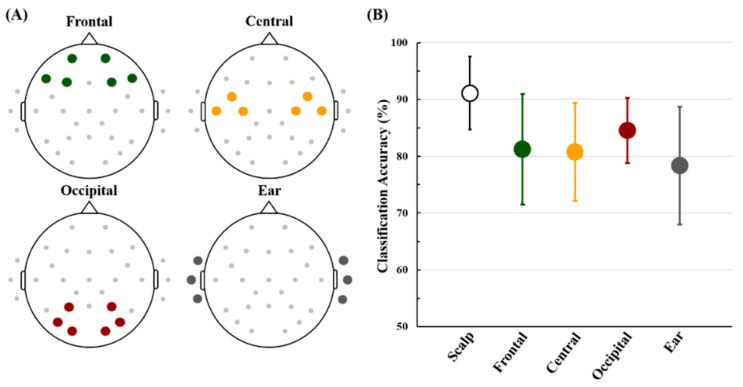
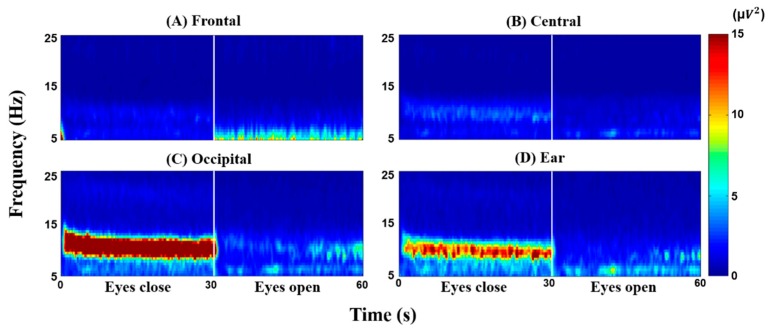
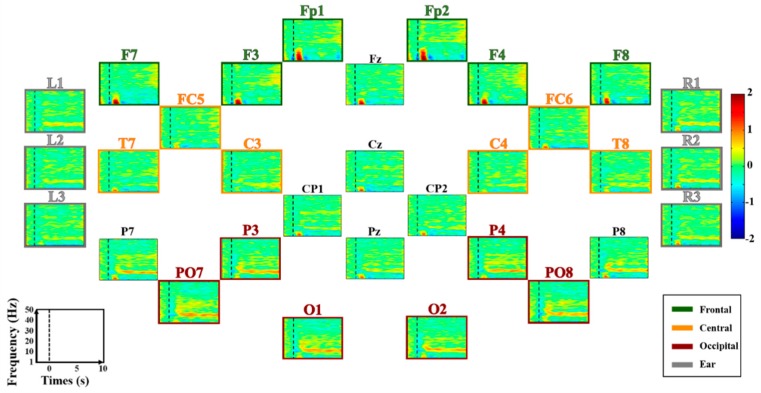
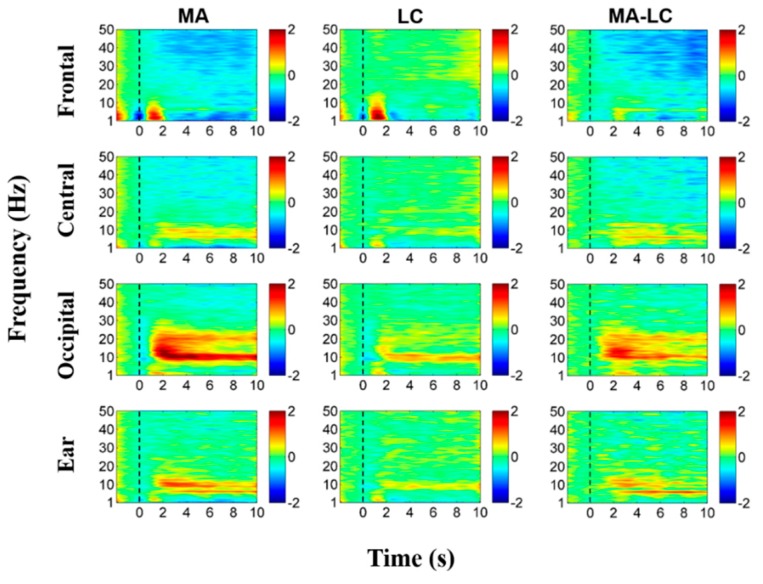
Brain-computer interface (BCI) studies based on electroencephalography (EEG) measured around the ears (ear-EEGs) have mostly used exogenous paradigms involving brain activity evoked by external stimuli. The objective of this study is to investigate the feasibility of ear-EEGs for development of an endogenous BCI system that uses self-modulated brain activity. We performed preliminary and main experiments where EEGs were measured on the scalp and behind the ears to check the reliability of ear-EEGs as compared to scalp-EEGs. In the preliminary and main experiments, subjects performed eyes-open and eyes-closed tasks, and they performed mental arithmetic (MA) and light cognitive (LC) tasks, respectively. For data analysis, the brain area was divided into four regions of interest (ROIs) (i.e., frontal, central, occipital, and ear area). The preliminary experiment showed that the degree of alpha activity increase of the ear area with eyes closed is comparable to those of other ROIs (occipital > ear > central > frontal). In the main experiment, similar event-related (de)synchronization (ERD/ERS) patterns were observed between the four ROIs during MA and LC, and all ROIs showed the mean classification accuracies above 70% required for effective binary communication (MA vs. LC) (occipital = ear = central = frontal). From the results, we demonstrated that ear-EEG can be used to develop an endogenous BCI system based on cognitive tasks without external stimuli, which allows the usability of ear-EEGs to be extended.
基于测量耳周脑电图(EEG)的脑-机接口(BCI)研究大多使用涉及外部刺激引发大脑活动的外源性范式。本研究旨在探索使用自我调节大脑活动的内源性 BCI 系统的耳 EEG 的可行性。我们进行了初步和主要实验,在头皮和耳朵后面测量 EEG,以检查耳 EEG 与头皮 EEG 的可靠性。在初步和主要实验中,受试者分别进行睁眼和闭眼任务、心算(MA)和轻度认知(LC)任务。对于数据分析,大脑区域被分为四个感兴趣区域(ROI)(即额区、中央区、枕区和耳区)。初步实验表明,闭眼时耳区的阿尔法活动增加程度与其他 ROI(枕区>耳区>中央区>额区)相当。在主要实验中,在 MA 和 LC 期间,四个 ROI 之间观察到类似的事件相关去同步(ERD)/同步(ERS)模式,所有 ROI 在 MA 与 LC 之间(枕区=耳区=中央区=额区)均表现出有效二进制通信(MA 与 LC)所需的平均分类准确率均高于 70%。结果表明,耳 EEG 可用于开发基于认知任务的内源性 BCI 系统,而无需外部刺激,从而扩展了耳 EEG 的可用性。