Alsaleh F M, Lemay J, Al Dhafeeri R R, AlAjmi S, Abahussain E A, Bayoud T
Department of Pharmacy Practice, Faculty of Pharmacy, Kuwait University, Kuwait.
Department of Pharmacology and Therapeutics, Faculty of Pharmacy, Kuwait, University, Kuwait.
Saudi Pharm J. 2017 Dec;25(8):1184-1193. doi: 10.1016/j.jsps.2017.09.002. Epub 2017 Sep 13.
To improve patient safety and care, the identification and reporting of adverse drug reactions (ADRs) should be systematic and mandatory for all healthcare professionals (HCPs). Physicians remain the main HCPs with direct patient care whose role in ADRs reporting should not be ignored.
To document the awareness and attitude of physicians working in private and government hospitals in Kuwait with regard to pharmacovigilance (PV) and ADR reporting and to identify their practices of reporting ADRs.
A cross-sectional study was conducted using a paper-based 25-item questionnaire. The Statistical Package for Social Science (SPSS) was used for data analysis.
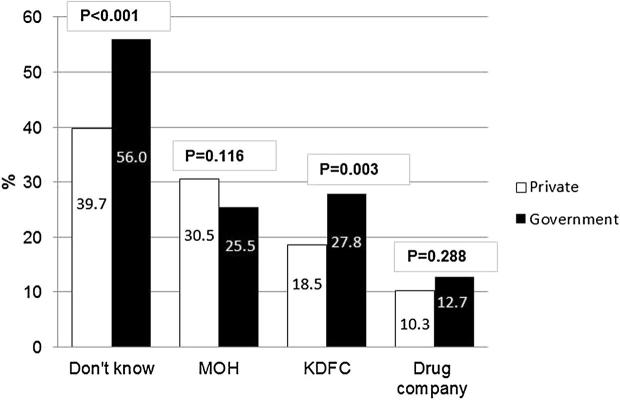
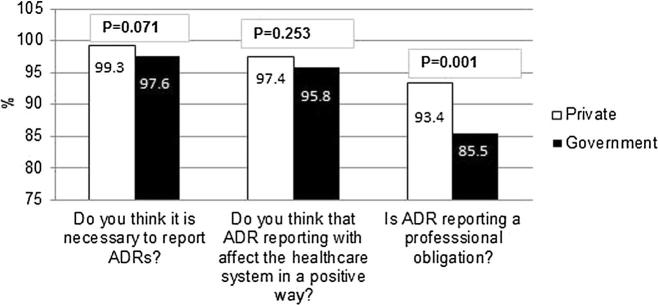
A total of 1017 questionnaires were distributed to the eligible physicians in the government and private hospitals, giving a response rate of 84.2% and 83.0%, respectively (an overall response rate of 83.8%). Private physicians exhibited a better knowledge profile with regards to the purpose of PV (75.2% vs 64.8%; p = 0.002) and the correct ADR definition (75.8% vs 65.3%; p = 0.001). The majority of physicians showed good attitude towards reporting ADRs, nevertheless, private physicians had a significantly stronger belief that reporting ADRs is a professional obligation (93.4% vs 85.5%; p = 0.001). Three quarters of the study population (74.6%) had identified an ADR during their daily practice, however, only a small proportion (34.2%) confirms having ever reported ADRs. Regardless, significantly more private physicians had done so (42.4% vs 29.6%; p < 0.001). ADR reporting was significantly higher in physicians who knew the correct ADRs to be reported (adjusted OR = 1.86, p = 0.036), and those who were aware of any center or ADR reporting system in Kuwait (adjusted OR = 2.88, p = 0.020).
A national PV center empowered by clear legislation on "how" and "what" to report should improve physicians' reporting practices and hence is required in the country. This should be combined with constant training and education in this regard.
为提高患者安全与护理水平,对所有医疗保健专业人员(HCP)而言,药物不良反应(ADR)的识别与报告应系统且强制进行。医生仍是直接负责患者护理的主要医疗保健专业人员,其在ADR报告中的作用不容忽视。
记录科威特私立和公立医院医生对药物警戒(PV)及ADR报告的认知与态度,并确定他们报告ADR的做法。
采用基于纸质的25项问卷进行横断面研究。使用社会科学统计软件包(SPSS)进行数据分析。
共向政府和私立医院符合条件的医生发放了1017份问卷,回复率分别为84.2%和83.0%(总体回复率为83.8%)。私立医生在PV目的(75.2%对64.8%;p = 0.002)和正确的ADR定义(75.8%对65.3%;p = 0.001)方面表现出更好的知识水平。大多数医生对报告ADR态度良好,然而,私立医生更坚信报告ADR是一项专业义务(93.4%对85.5%;p = 0.001)。四分之三的研究人群(74.6%)在日常工作中识别出了ADR,但只有一小部分(34.2%)确认曾报告过ADR。尽管如此,报告过ADR的私立医生明显更多(42.4%对29.6%;p < 0.001)。知道应报告正确ADR的医生以及知晓科威特任何中心或ADR报告系统的医生,其ADR报告率显著更高(调整后的OR = 1.86,p = 0.036),以及(调整后的OR = 2.88,p = 0.020)。
一个依据关于“如何”及“报告什么”的明确立法授权的国家PV中心,应能改善医生的报告做法,因此该国需要这样一个中心。这应与这方面的持续培训和教育相结合。