Department of Psychiatry, University of Botswana Medical School, Private Bag, 00712, Gaborone, Botswana.
Department of Psychiatry, Bowen University Teaching Hospital, Ogbomosho, Nigeria.
BMC Psychiatry. 2018 Aug 31;18(1):270. doi: 10.1186/s12888-018-1844-2.
Substance use amongst university students is a recognized problem worldwide. Few studies have been carried out in this group in Botswana. These studies have been mostly limited to the use of alcohol and tobacco. Therefore, this study was designed to investigate the pattern of general substance use, its association with psychological distress and common socio-demographic factors among first-year undergraduates in a Botswana University.
A total of 401 students were interviewed using a modified W.H.O. student drug use questionnaire and the 12 item General Health Questionnaire (GHQ12) to assess the pattern of psychoactive substance use and its relationship with psychological distress amongst university students in Botswana.
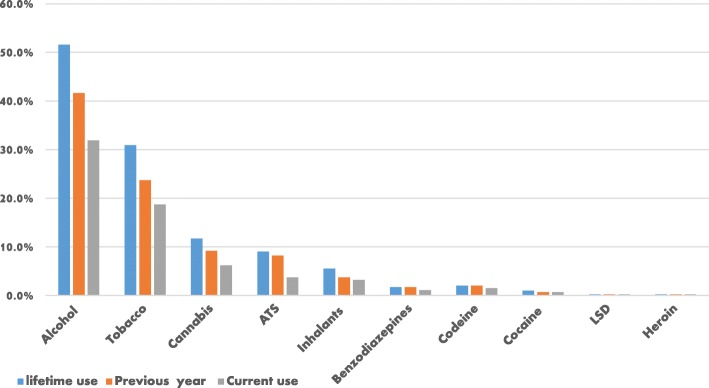
Alcohol was the most (31.9%) commonly used psychoactive substance. Age of debut for most psychoactive substances was between the ages of 15-18 years. Current use of alcohol (p = 0.045), amphetamine-type stimulants (p = 0.004) and benzodiazepines (p = 0.021) were associated with significant psychological distress. A positive relationship was observed between low participation in religious activities and substance use (OR = 4.63, 95%CI: 2.03-10.51), while a negative association was observed between not having a friend who uses drugs and substance use (OR = 0.44, 95%CI: 0.19-0.99).
There is a significant substance abuse problem in the undergraduate population in Botswana. Our findings followed the global trend, with alcohol being the most commonly used substance. Religious participation demonstrates potential to be one of the solutions to this problem, but how to harness its seemingly protective influences is a field for further study.
在全球范围内,大学生的物质使用问题已得到广泛关注。然而,在博茨瓦纳,针对该群体的研究相对较少,且这些研究大多仅限于酒精和烟草的使用。因此,本研究旨在调查博茨瓦纳大学生普遍的物质使用模式,及其与心理困扰和常见社会人口因素的关系。
采用改良后的世界卫生组织学生药物使用调查问卷和 12 项一般健康问卷(GHQ12),对 401 名一年级本科生进行访谈,以评估博茨瓦纳大学生的精神活性物质使用模式及其与心理困扰的关系。
酒精是最常使用的精神活性物质(31.9%)。大多数精神活性物质的首次使用年龄在 15-18 岁之间。目前使用酒精(p=0.045)、苯丙胺类兴奋剂(p=0.004)和苯二氮䓬类药物(p=0.021)与显著的心理困扰相关。低参与宗教活动与物质使用呈正相关(OR=4.63,95%CI:2.03-10.51),而没有朋友使用毒品与物质使用呈负相关(OR=0.44,95%CI:0.19-0.99)。
博茨瓦纳大学生群体中存在显著的物质滥用问题。我们的发现符合全球趋势,酒精是最常使用的物质。宗教参与显示出解决这一问题的潜力,但如何利用其潜在的保护影响是一个有待进一步研究的领域。