Massachusetts General Hospital, Program in Nutritional Metabolism and Harvard Medical School (MT, KVF, LS, MVZ, JL, SKG), Boston, MA, USA.
Inova Heart and Vascular Institute (CD), Falls Church, VA, USA.
EBioMedicine. 2018 Sep;35:58-66. doi: 10.1016/j.ebiom.2018.08.039. Epub 2018 Aug 31.
People with HIV (PWH) demonstrate increased cardiovascular disease (CVD), due in part to increased immune activation, inflammation, and endothelial dysfunction.
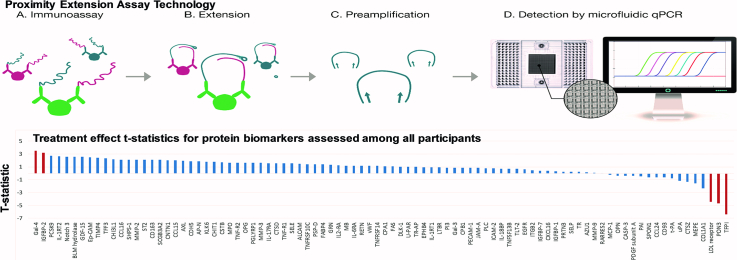
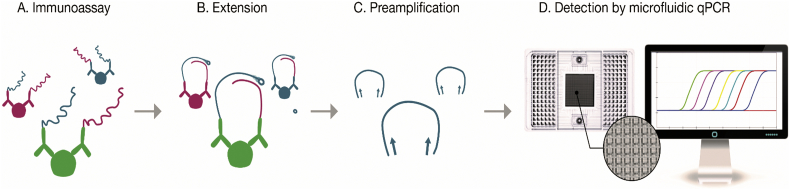
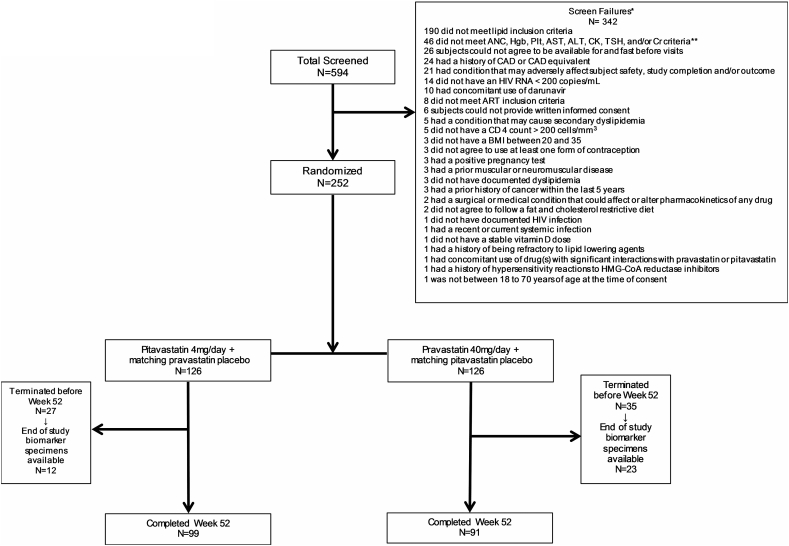
In a randomized trial (INTREPID), 252 HIV-infected participants with dyslipidemia and no history of coronary artery disease were randomized (1:1) to pitavastatin 4 mg vs. pravastatin 40 mg for 52 weeks. Using a proteomic discovery approach, 92 proteins biomarkers were assessed using Proximity Extension Assay technology to determine the effects of statins on key atherosclerosis and CVD pathways among PWH. 225 participants had specimens available for biomarker analysis pre- and post-baseline.
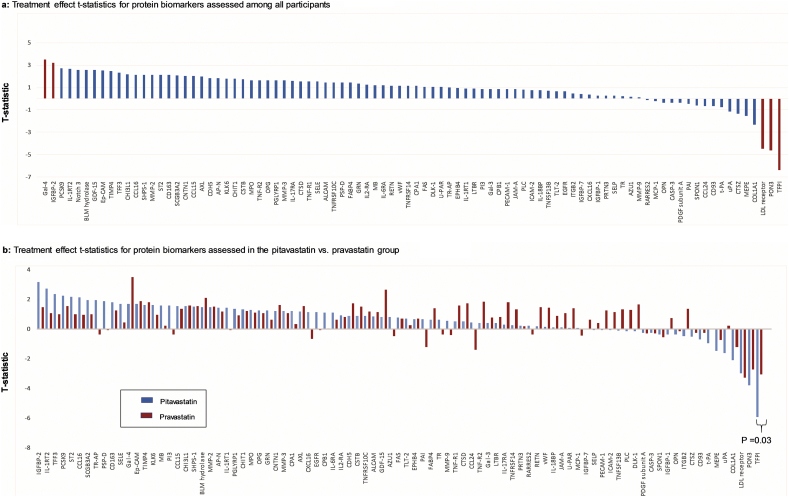
The mean age was 49.5 ± 8.0 (mean ± SD), LDL-C 155 ± 25 mg/dl and CD4 count 620 ± 243 cell/mm. Among all participants, three proteins significantly decreased: tissue factor pathway inhibitor [TFPI; t-statistic = -6.38, FDR p-value<0.0001], paraoxonase 3 [PON3; t-statistic = -4.64, FDR p-value = 0.0003], and LDL-receptor [LDLR; t-statistic = -4.45, FDR p-value = 0.0004]; and two proteins significantly increased galectin-4 [Gal-4; t-statistic = 3.50, FDR p-value = 0.01] and insulin-like growth factor binding protein 2 [IGFBP-2; t-statistic = 3.21, FDR p-value = 0.03]. The change in TFPI was significantly different between the pitavastatin and pravastatin groups. Among all participants, change in TFPI related to the change in LDL-C (r = 0.43, P < 0.0001) and change in Lp-PLA2 (r = 0.29, P < 0.0001).
Using a proteomics approach, we demonstrated that statins led to a significant reduction in the levels of TFPI, PON3, and LDLR and an increase in Gal-4 and IGFBP-2, key proteins involved in coagulation, redox signaling, oxidative stress, and glucose metabolism. Pitavastatin led to a greater reduction in TFPI than pravastatin. These data highlight potential novel mechanisms of statin effects among PWH. FUND: This work was supported by an investigator-initiated grant to S.K.G. from KOWA Pharmaceuticals America, Inc. and the National Institutes of Health [P30 DK040561; Nutrition Obesity Research Center at Harvard]. M.T. was support by National Institutes of Health [5KL2TR001100-05; Harvard Catalyst KL2 grant].
HIV 感染者(PWH)由于免疫激活、炎症和内皮功能障碍增加,心血管疾病(CVD)的风险增加。
在一项随机试验(INTREPID)中,252 名患有血脂异常且无冠状动脉疾病史的 HIV 感染者被随机(1:1)分为匹伐他汀 4mg 组和普伐他汀 40mg 组,治疗 52 周。使用蛋白质组学发现方法,使用接近延伸分析技术(Proximity Extension Assay technology)评估 92 种蛋白质生物标志物,以确定他汀类药物对 PWH 中动脉粥样硬化和 CVD 关键途径的影响。225 名参与者在基线前和基线时有标本进行生物标志物分析。
平均年龄为 49.5±8.0(均值±标准差),LDL-C 为 155±25mg/dl,CD4 计数为 620±243 个/mm。在所有参与者中,有三种蛋白质显著降低:组织因子途径抑制剂 [TFPI;t 统计量=-6.38,FDR p 值<0.0001]、对氧磷酶 3 [PON3;t 统计量=-4.64,FDR p 值=0.0003]和 LDL 受体 [LDLR;t 统计量=-4.45,FDR p 值=0.0004];两种蛋白质显著增加:半乳糖凝集素-4 [Gal-4;t 统计量=3.50,FDR p 值=0.01]和胰岛素样生长因子结合蛋白 2 [IGFBP-2;t 统计量=3.21,FDR p 值=0.03]。TFPI 的变化在匹伐他汀和普伐他汀组之间有显著差异。在所有参与者中,TFPI 的变化与 LDL-C 的变化相关(r=0.43,P<0.0001)和脂蛋白相关磷脂酶 A2(Lp-PLA2)的变化相关(r=0.29,P<0.0001)。
使用蛋白质组学方法,我们证明他汀类药物可显著降低 TFPI、PON3 和 LDLR 的水平,并增加 Gal-4 和 IGFBP-2 的水平,这些是参与凝血、氧化还原信号、氧化应激和葡萄糖代谢的关键蛋白质。匹伐他汀可较普伐他汀更显著地降低 TFPI。这些数据突出了他汀类药物在 PWH 中的潜在新作用机制。
这项工作得到了 KOWA 制药美国公司和美国国立卫生研究院(S.K.G. 的一项调查员发起的赠款)[P30 DK040561;哈佛的营养肥胖研究中心]的支持。M.T. 得到了美国国立卫生研究院(5KL2TR001100-05;哈佛 Catalyst KL2 赠款)的支持。