Franke C A, Rice C M, Strauss J H, Hruby D E
Mol Cell Biol. 1985 Aug;5(8):1918-24. doi: 10.1128/mcb.5.8.1918-1924.1985.
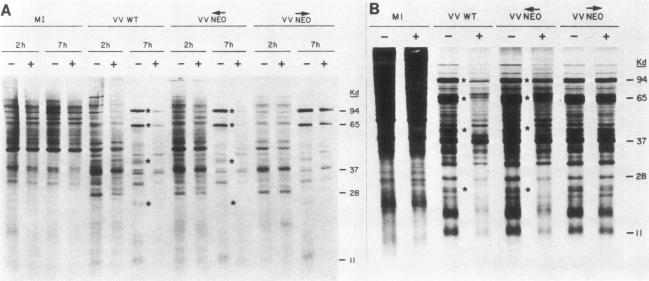
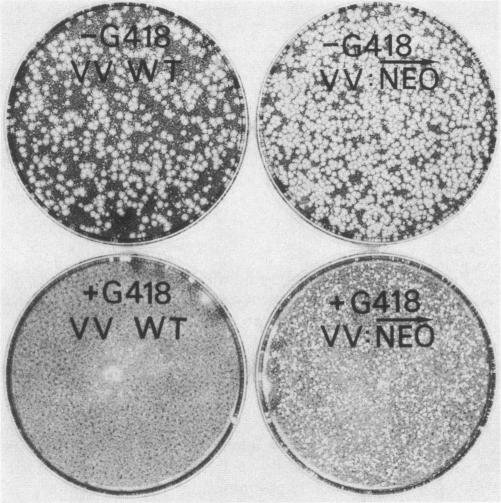
The antibiotic G418 was shown to be an effective inhibitor of vaccinia virus replication when an appropriate concentration of it was added to cell monolayers 48 h before infection. Genetic engineering techniques were used in concert with DNA transfection protocols to construct vaccinia virus recombinants containing the neomycin resistance gene (neo) from transposon Tn5. These recombinants contained the neo gene linked in either the correct or incorrect orientation relative to the vaccinia virus 7.5-kilodalton gene promoter which is expressed constitutively throughout the course of infection. The vaccinia virus recombinant containing the chimeric neo gene in the proper orientation was able to grow and form plaques in the presence of G418, whereas both the wild-type and the recombinant virus with the neo gene in the opposite polarity were inhibited by more than 98%. The effect of G418 on virus growth may be mediated at least in part by selective inhibition of the synthesis of a subset of late viral proteins. These results are discussed with reference to using this system, the conferral of resistance to G418 with neo as a positive selectable marker, to facilitate constructing vaccinia virus recombinants which contain foreign genes of interest.
当在感染前48小时向细胞单层中添加适当浓度的抗生素G418时,它被证明是痘苗病毒复制的有效抑制剂。基因工程技术与DNA转染方案协同使用,构建了含有来自转座子Tn5的新霉素抗性基因(neo)的痘苗病毒重组体。这些重组体中neo基因与痘苗病毒7.5千道尔顿基因启动子的连接方向正确或错误,该启动子在感染过程中持续表达。含有正确方向嵌合neo基因的痘苗病毒重组体能够在G418存在下生长并形成噬斑,而野生型和neo基因极性相反的重组病毒均受到超过98%的抑制。G418对病毒生长的影响可能至少部分是通过选择性抑制晚期病毒蛋白亚群的合成来介导的。本文参照使用该系统(以neo赋予对G418的抗性作为阳性选择标记)来促进构建含有感兴趣的外源基因的痘苗病毒重组体,对这些结果进行了讨论。