Rönnlund Michael, Carelli Maria G
Department of Psychology, Umeå University, Umeå, Sweden.
Front Psychol. 2018 Aug 24;9:1356. doi: 10.3389/fpsyg.2018.01356. eCollection 2018.
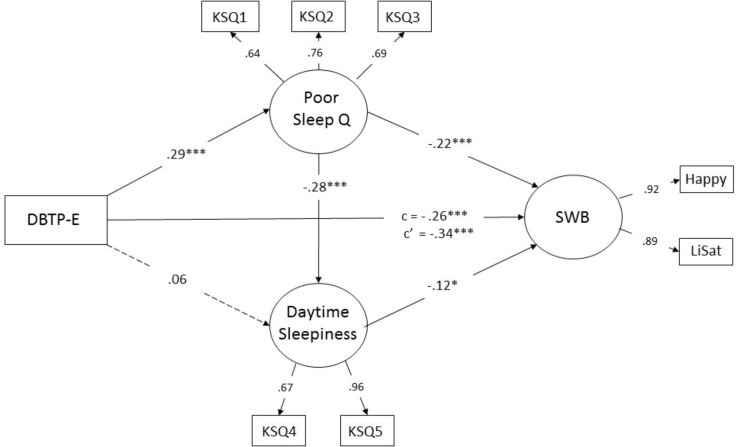
This study examined the extent to which individual differences in time perspective, i.e., habitual way of relating to the personal past, present, and future, are associated with sleep quality and daytime sleepiness in a sample of older adults. The participants ( = 437, 60-90 years) completed the Karolinska Sleep Questionnaire (KSQ), a the Swedish version of the Zimbardo Time Perspective Inventory (S-ZTPI), and two ratings of subjective well-being (SWB) (life satisfaction, happiness). Based on established relationships between dimension of time perspective and other variables (e.g., depression) and relations between negative retrospection (rumination) and negative prospection (worry) in prior studies, we expected higher scores on Past Negative and Future Negative to be linked to poor sleep quality and (indirectly) increased daytime sleepiness. Moreover, we examined the possibility that variations in perceived sleep and sleepiness during the day mediates the expected association between an aggregate measure of deviations from a so called balanced time perspective (DBTP) and SWB. In regression analyses controlling for demographic factors (age, sex, and work status), higher scores on Past Negative and Future Negative predicted poorer sleep quality and higher levels of daytime sleepiness. Additionally, most of the association between time perspective and daytime sleepiness was accounted for by individual differences in sleep quality. Finally, structural equation modeling yielded results consistent with the hypothesis that variations in sleep mediate part of the negative relationship between DBTP and SWB. Given that good sleep is essential to multiple aspects of health, future studies evaluating relationships between time perspective and adverse health outcomes should consider sleep quality as a potentially contributing factor.
本研究考察了时间观的个体差异,即与个人过去、现在和未来相关的习惯方式,在多大程度上与老年人样本中的睡眠质量和日间嗜睡相关。参与者(n = 437,60 - 90岁)完成了卡罗林斯卡睡眠问卷(KSQ)、瑞典版的津巴多时间观量表(S - ZTPI)以及两项主观幸福感(SWB)评分(生活满意度、幸福感)。基于先前研究中时间观维度与其他变量(如抑郁)之间已确立的关系以及消极回顾(反刍)与消极展望(担忧)之间的关系,我们预期过去消极和未来消极得分较高与睡眠质量差以及(间接)日间嗜睡增加有关。此外,我们考察了日间感知睡眠和嗜睡的变化是否介导了偏离所谓平衡时间观的综合测量(DBTP)与SWB之间预期关联的可能性。在控制人口统计学因素(年龄、性别和工作状态)的回归分析中,过去消极和未来消极得分较高预示着睡眠质量较差和日间嗜睡程度较高。此外,时间观与日间嗜睡之间的大部分关联是由睡眠质量的个体差异造成的。最后,结构方程模型得出的结果与以下假设一致,即睡眠变化介导了DBTP与SWB之间负相关关系的一部分。鉴于良好睡眠对健康的多个方面至关重要,未来评估时间观与不良健康结果之间关系的研究应将睡眠质量视为一个潜在的促成因素。