Buchner Laura, Amesberger Günter, Finkenzeller Thomas, Moore Stephanie R, Würth Sabine
Department of Sport and Exercise Science, University of Salzburg, Salzburg, Austria.
Front Psychol. 2022 Jul 29;13:948906. doi: 10.3389/fpsyg.2022.948906. eCollection 2022.
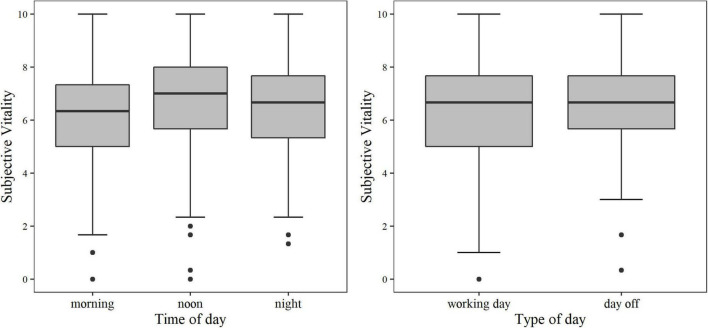
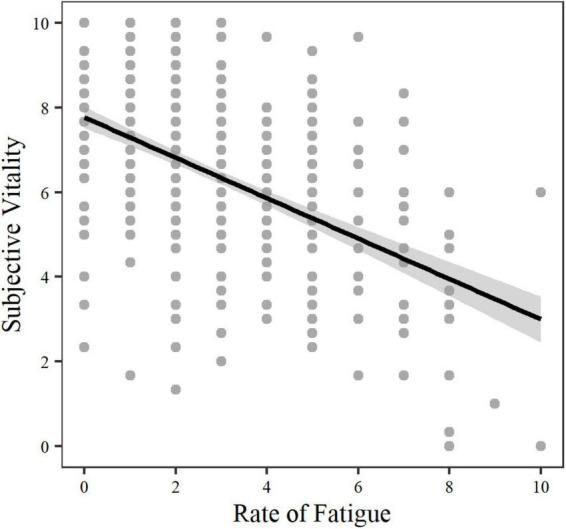
Subjective vitality describes the positive feeling of experiencing physical and mental energy, which can lead to purposive actions, but no German instruments exist with action-oriented verbiage: This work supports the development and modification of already existing German Subjective Vitality Scales and provides further evidence for its psychometric properties. In a first step ( = 56) two modified (action-oriented) short-forms were developed. An extension of time perspectives (past, present, future) should also enrich the scale by enhancing the accuracy of self-reports. Study 1 ( = 183) then examined the psychometric properties for each time perspective. Study 2 ( = 27) was a 6-day diary study to identify the reliability of within- and between-person differences in vitality over time and working days with responses recorded three times per day. The exploratory factor analysis from study 1 revealed a three-factor solution with three items each. Test-retest reliability was moderate for the past and future time perspective and less stable for state subjective vitality. The modified German Subjective Vitality Scale (SVS-GM) showed divergent validity with fatigue, negative affect, and optimism, and convergent but distinguishable validity with life satisfaction, positive affect, and perceived self-efficacy. High reliability for daily vitality measures (with lower vitality rates in the morning) was found in study 2, but no substantial variation was found between working days and days off. The SVS-GM shows good psychometric properties in different settings and provides researchers with a 3-item (for cross-sectional or longitudinal studies) and 1-item (for short screenings) version to measure subjective vitality in German-speaking populations.
主观活力描述的是体验到身心能量的积极感受,这种感受会引发有目的的行动,但目前还没有德语版的以行动为导向措辞的测量工具:本研究支持对现有的德语主观活力量表进行开发和修订,并为其心理测量特性提供了进一步的证据。第一步(N = 56),开发了两个经过修改的(以行动为导向的)简版量表。扩展时间视角(过去、现在、未来)也应通过提高自我报告的准确性来丰富该量表。研究1(N = 183)随后检验了每个时间视角的心理测量特性。研究2(N = 27)是一项为期6天的日记研究,旨在确定活力在个体内部和个体之间随时间以及工作日的差异的可靠性,每天记录三次回复。研究1的探索性因素分析得出了一个三因素解决方案,每个因素有三个项目。重测信度在过去和未来时间视角下为中等,而状态主观活力的稳定性较差。修改后的德语主观活力量表(SVS-GM)与疲劳、消极情绪和乐观主义表现出区分效度,与生活满意度、积极情绪和感知自我效能表现出聚合但可区分的效度。研究2发现日常活力测量具有较高的信度(早晨活力水平较低),但工作日和休息日之间没有发现实质性差异。SVS-GM在不同情境下都表现出良好的心理测量特性,并为研究人员提供了一个3项目版本(用于横断面或纵向研究)和一个1项目版本(用于简短筛查),以测量德语人群的主观活力。