Sydney School of Veterinary Science, Faculty of Science, University of Sydney, Camperdown, NSW, Australia.
Department of Epidemiology and Public Health, Sciensano, Brussels, Belgium.
PLoS One. 2018 Sep 12;13(9):e0202580. doi: 10.1371/journal.pone.0202580. eCollection 2018.
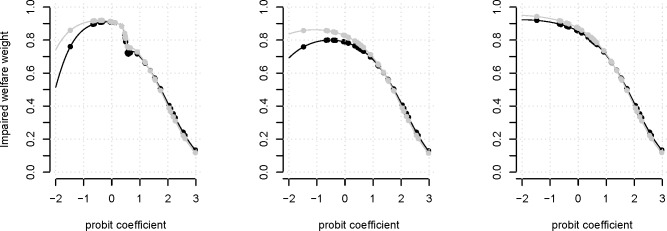
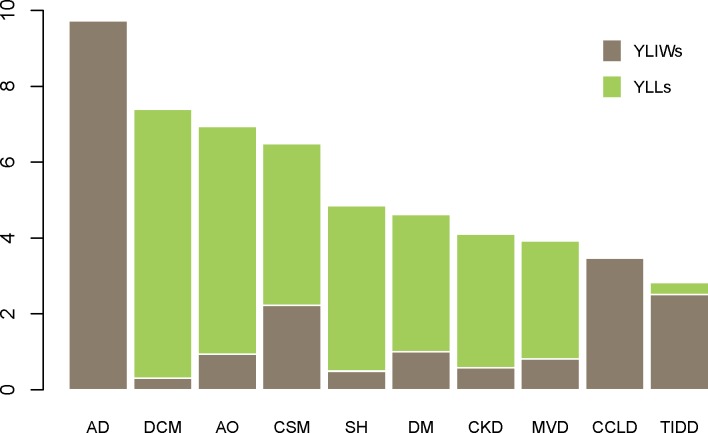
Currently, separate measures are used to estimate the impact of animal diseases on mortality and animal welfare. This article introduces a novel metric, the Welfare-Adjusted Life Year (WALY), to estimate disease impact by combining welfare compromise and premature death components. Adapting the Disability-Adjusted Life Year approach used in human health audits, we propose WALY as the sum of a) the years lived with impaired welfare due to a particular cause and b) the years of life lost due to the premature death from the same cause. The years lived with impaired welfare are the product of the average duration of each welfare impediment, reflecting the actual condition that compromises animal welfare, the probability of an incident case developing and impaired welfare weights, representing the degree of impaired welfare. The years of life lost are calculated using the standard expected lifespan at the time of premature death. To demonstrate the concept, we estimated WALYs for 10 common canine diseases, namely mitral valve disease, dilated cardiomyopathy, chronic kidney disease, diabetes mellitus, atopic dermatitis, splenic haemangiosarcoma, appendicular osteosarcoma, cranial cruciate ligament disease, thoracolumbar intervertebral disc disease and cervical spondylomyelopathy. A survey of veterinarians (n = 61) was conducted to elicit impaired welfare weights for 35 welfare impediments. Paired comparison was the primary method to elicit weights, whereas visual analogue scale and time trade-off approaches rescaled these weights onto the desired scale, from 0 (the optimal welfare imaginable) to 1 (the worst welfare imaginable). WALYs for the 10 diseases were then estimated using the impaired welfare weights and published epidemiological data on disease impacts. Welfare impediment "amputation: one limb" and "respiratory distress" had the lowest and highest impaired welfare weights at 0.134 and 0.796, rescaled with a visual analogue scale, and 0.117 and 0.857, rescaled with time trade-off. Among the 10 diseases, thoracolumbar intervertebral disc disease and atopic dermatitis had the smallest and greatest adverse impact on dogs with WALYs at 2.83 (95% UI: 1.54-3.94) and 9.73 (95% uncertainty interval [UI]: 7.17-11.8), respectively. This study developed the WALY metric and demonstrated that it summarises welfare compromise as perceived by humans and total impact of diseases in individual animals. The WALY can potentially be used for prioritisation of disease eradication and control programs, quantification of population welfare and longitudinal surveillance of animal welfare in companion animals and may possibly be extended to production animals.
目前,分别采用不同的方法来估计动物疾病对死亡率和动物福利的影响。本文引入了一种新的指标,即福利调整生命年(WALY),通过结合福利受损和提前死亡两个因素来估计疾病的影响。我们借鉴了人类健康审计中使用的伤残调整生命年方法,提出 WALY 是以下两部分的总和:a)由于特定原因导致福利受损而导致的生活年数,b)因同一原因导致的过早死亡而导致的生命损失年数。生活在福利受损的年限是每个福利障碍平均持续时间的乘积,反映了实际损害动物福利的情况,发病病例发展的概率和福利受损权重,代表福利受损的程度。生命损失年限是根据提前死亡时的标准预期寿命计算得出的。为了演示这一概念,我们估算了 10 种常见犬病的 WALYs,即二尖瓣疾病、扩张型心肌病、慢性肾脏病、糖尿病、特应性皮炎、脾血管肉瘤、附肢骨肉瘤、十字韧带疾病、胸腰椎椎间盘疾病和颈椎脊髓病。我们对 61 名兽医进行了一项调查,以确定 35 种福利障碍的福利受损权重。配对比较是确定权重的主要方法,而视觉模拟量表和时间权衡方法则将这些权重重新调整到所需的 0(可想象的最佳福利)到 1(可想象的最差福利)的范围内。然后,根据受损的福利权重和已发表的疾病影响流行病学数据,估算了这 10 种疾病的 WALYs。福利障碍“截肢:一条腿”和“呼吸困难”的福利受损权重最低和最高,分别为 0.134 和 0.796(重新调整为视觉模拟量表)和 0.117 和 0.857(重新调整为时间权衡)。在这 10 种疾病中,胸腰椎椎间盘疾病和特应性皮炎对狗的影响最小和最大,WALYs 分别为 2.83(95%置信区间[UI]:1.54-3.94)和 9.73(95%UI:7.17-11.8)。本研究开发了 WALYs 指标,并证明它总结了人类感知到的福利受损情况和单个动物中疾病的总影响。WALYs 可用于疾病根除和控制计划的优先级排序、群体福利的量化以及伴侣动物的动物福利纵向监测,并且可能扩展到生产动物。