Bohn Jan-Paul, Steurer Michael
Department of Internal Medicine V, Medical University of Innsbruck, Anichstraße 35, 6020 Innsbruck, Austria.
Memo. 2018;11(3):241-246. doi: 10.1007/s12254-018-0428-7. Epub 2018 Aug 15.
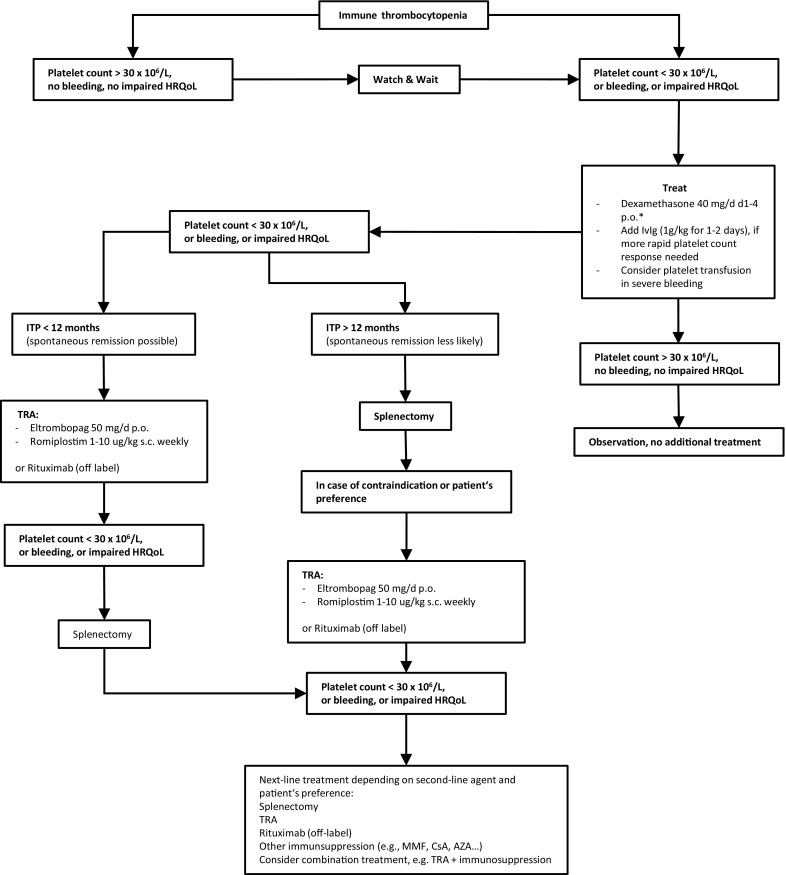
Immune thrombocytopenia (ITP) is an acquired autoimmune phenomenon resulting in low platelet count and increased bleeding risk. Goals of upfront management include prompt control of severe bleeding-which is rare-as well as induction and maintenance of a hemostatic platelet count. Thus, optimal management of ITP patients is often challenging and requires a highly individualized approach. Many patients may not suffer significant bleeding despite severe thrombocytopenia and the risk of toxicity associated with treatment may outweigh its benefit. Most patients treated with standard first-line regimen of glucocorticoids achieve an initial response. However, the rate of long-term remission remains low and multiple lines of therapy are often required. Current investigations aim at defining the subgroup of patients at risk of relapse and providing intensified risk-balanced induction regimens to improve long-term disease control. This short review summarizes current and emerging treatment strategies in adult ITP.
免疫性血小板减少症(ITP)是一种获得性自身免疫现象,会导致血小板计数降低和出血风险增加。初始治疗的目标包括迅速控制严重出血(这种情况很少见)以及诱导并维持止血所需的血小板计数。因此,ITP患者的最佳治疗往往具有挑战性,需要高度个体化的方法。许多患者尽管血小板严重减少,但可能不会发生明显出血,而且治疗相关的毒性风险可能超过其益处。大多数接受糖皮质激素标准一线治疗方案的患者会有初始反应。然而,长期缓解率仍然很低,通常需要多种治疗方案。目前的研究旨在确定有复发风险的患者亚组,并提供强化的风险平衡诱导方案,以改善疾病的长期控制。这篇简短综述总结了成人ITP的当前和新兴治疗策略。