Feldman Gilad, Chandrashekar Subramanya Prasad
Department of Work and Social Psychology, Maastricht University, Maastricht, the Netherlands.
Department of Management, Hong Kong University of Science and Technology, Clear Water Bay, Kowloon, Hong Kong SAR.
Soc Psychol Personal Sci. 2018 Jul;9(5):539-549. doi: 10.1177/1948550617713254. Epub 2017 Jul 25.
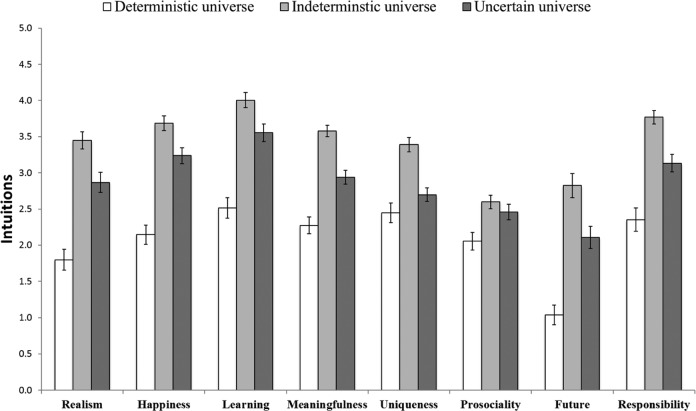
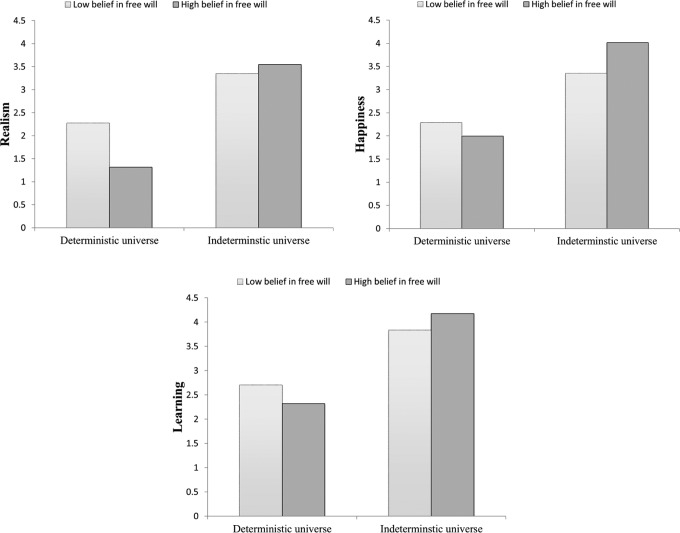
We linked between the social psychology and experimental philosophy paradigms for the study of folk intuitions and beliefs regarding the concept of free will to answer three questions: (1) What intuitions do people have about free will and determinism? (2) Do free will beliefs predict differences in free will and determinism intuitions? and (3) Is there more to free will and determinism than experiencing certainty or uncertainty about the nature of the universe? Overall, laypersons viewed the universe as allowing for human indeterminism, and they did so with certainty. Examining intuitions of prosociality, future orientation, learning, meaningfulness, human uniqueness, and well-being, ratings were highest in the indeterministic universe condition and lowest in the deterministic universe condition, both significantly different from the uncertain universe condition. Participants' free will beliefs had only weak impact on realism, happiness, and learning intuitions but did not reverse the general intuition favoring indeterminism and showed no impact on other intuitions.
我们将社会心理学和实验哲学范式联系起来,以研究关于自由意志概念的民间直觉和信念,从而回答三个问题:(1)人们对自由意志和决定论有哪些直觉?(2)自由意志信念能否预测自由意志和决定论直觉上的差异?以及(3)自由意志和决定论是否不仅仅是对宇宙本质体验到确定或不确定?总体而言,外行人认为宇宙允许人类的非决定论,而且他们对此很确定。在考察亲社会、未来取向、学习、意义、人类独特性和幸福感的直觉时,在非决定论宇宙条件下的评分最高,在决定论宇宙条件下的评分最低,两者均与不确定宇宙条件有显著差异。参与者的自由意志信念对现实主义、幸福感和学习直觉的影响微弱,但并未扭转支持非决定论的总体直觉,且对其他直觉没有影响。