MRC Unit for Lifelong Health and Ageing at UCL, London, UK.
MRC Unit for Lifelong Health and Ageing at UCL, London, UK.
Exp Gerontol. 2018 Oct 2;112:92-96. doi: 10.1016/j.exger.2018.09.008. Epub 2018 Sep 15.
There is evidence that paternal age may influence offspring telomere length, but the joint effects of father's and mother's age are unclear. We evaluated whether parental ages, individually and jointly, were associated with offspring telomere length and shortening.
We included 2305 British birth cohort participants with measured leukocyte telomere length (LTL) at age 53, among whom 941 had a second measurement at age 60-64. Linear regressions were performed to assess the associations of father's and mother's age at birth and the parental age gap, i.e. the difference between maternal and paternal age with LTL and LTL change.
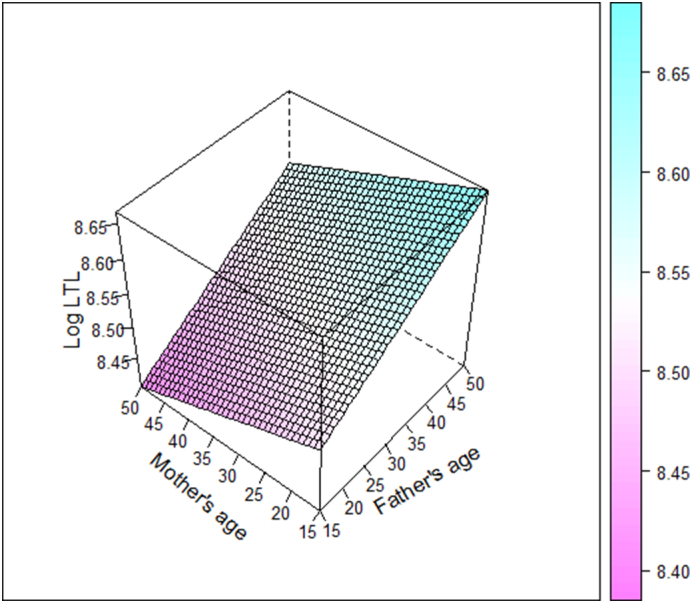
A one year increase in father's age corresponded to a 0.26% (95% CI: 0.04-0.47%) increase in offspring LTL at age 53 in the sex-adjusted model. No association was observed for mother's age. Associations of father's or mother's age with offspring LTL at age 53 went to opposite directions when both parental ages were included together. For the difference in parental age, every year that fathers were older than mothers corresponded to a 0.94% (95% CI, 0.38-1.50%) increase in LTL at age 53 after adjustment for potential confounders. Neither parental ages nor the difference in parental ages were correlated with LTL change.
There was a joint effect of parental ages on offspring telomere length, further denoting a complex role of reproductive age in offspring health and ageing.
有证据表明,父亲的年龄可能会影响后代的端粒长度,但父母年龄的共同影响尚不清楚。我们评估了父母的年龄,单独和联合,是否与后代的端粒长度和缩短有关。
我们纳入了 2305 名英国出生队列参与者,他们在 53 岁时测量了白细胞端粒长度(LTL),其中 941 人在 60-64 岁时有第二次测量。线性回归用于评估父亲和母亲的出生年龄以及父母年龄差距(即母亲和父亲年龄之间的差异)与 LTL 和 LTL 变化的关系。
在调整性别后,父亲年龄每增加一岁,与 53 岁时后代 LTL 增加 0.26%(95%CI:0.04-0.47%)相关。母亲年龄与后代 LTL 无关。当同时考虑父母双方的年龄时,父亲或母亲的年龄与后代 53 岁时的 LTL 之间的关联方向相反。对于父母年龄的差异,父亲比母亲年长一年,在调整了潜在混杂因素后,与 53 岁时的 LTL 增加 0.94%(95%CI,0.38-1.50%)相关。父母年龄和父母年龄差异均与 LTL 变化无关。
父母年龄对后代端粒长度有共同影响,进一步表明生殖年龄在后代健康和衰老中起着复杂的作用。