Jones Eric C, Storksdieck Martin, Rangel Maria L
School of Public Health, University of Texas Health Science Center at Houston, Houston, TX, United States.
Center for Research on Lifelong STEM Learning, Oregon State University, Corvallis, OR, United States.
Front Public Health. 2018 Sep 4;6:240. doi: 10.3389/fpubh.2018.00240. eCollection 2018.
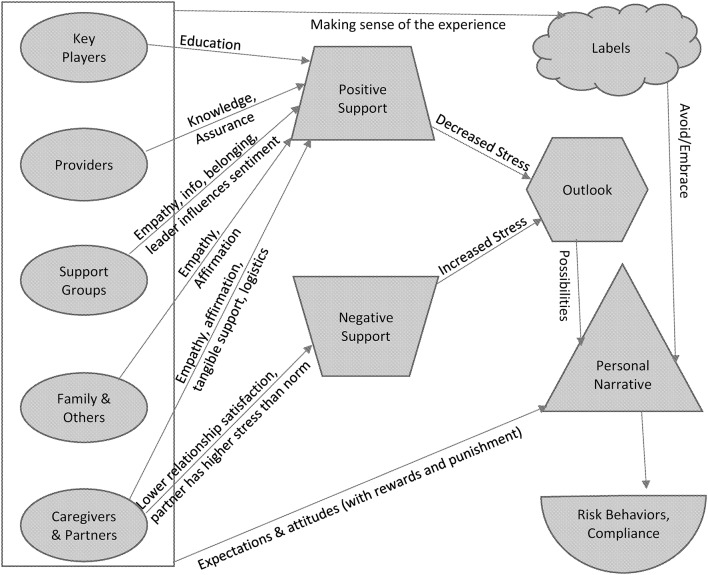
Little research is currently available that captures variation in the degree to which individuals who have, or had cancer in the past (but are in remission) integrate their cancer experience into their sense of self or their cancer-associated identity. Such research should cover how those identities shape personal narratives within existing or new social networks so that, ultimately, we understand the implications for treatment choices and health outcomes. Particularly understudied are the social factors influencing the incorporation of cancer into identity, learning, and behavior. Social network analysis captures specific relationships, what they offer, and the structure or constellation of these relationships around someone who has cancer or has had cancer. Some studies point to potential cultural differences in ethnic or social groups in how social influences on the cancer experience play out in terms of individual coping strategies. In some populations, social cohesion or tight networks are common and of particular importance to individuals and include social institutions like church communities. Social status might also generate social pressures not typically noticed or experienced by other groups. We will discuss how social network analysis can be used to elucidate these factors and, conversely, how the specific context of cancer diagnosis can be used through social network analysis to better understand the role of community in helping individuals address situations of severe adversity.
目前几乎没有研究能够了解过去患过癌症(但已缓解)的个体将其癌症经历融入自我认知或癌症相关身份认同的程度差异。此类研究应涵盖这些身份认同如何在现有或新的社交网络中塑造个人叙事,以便我们最终理解其对治疗选择和健康结果的影响。尤其未得到充分研究的是影响癌症融入身份认同、学习和行为的社会因素。社会网络分析能够捕捉特定关系、它们所提供的内容以及围绕患癌或曾患癌者的这些关系的结构或组合。一些研究指出,在种族或社会群体中,社会对癌症经历的影响在个体应对策略方面可能存在潜在的文化差异。在一些人群中,社会凝聚力或紧密的网络很常见,对个体尤为重要,其中包括像教会社区这样的社会机构。社会地位也可能产生其他群体通常未注意到或经历过的社会压力。我们将讨论如何利用社会网络分析来阐明这些因素,反之,如何通过社会网络分析利用癌症诊断的具体背景来更好地理解社区在帮助个体应对严重逆境情况中的作用。