Neftci Emre O
Department of Cognitive Sciences, UC Irvine, Irvine, CA 92697-5100, USA; Department of Computer Science, UC Irvine, Irvine, CA 92697-5100, USA.
iScience. 2018 Jul 27;5:52-68. doi: 10.1016/j.isci.2018.06.010. Epub 2018 Jul 3.
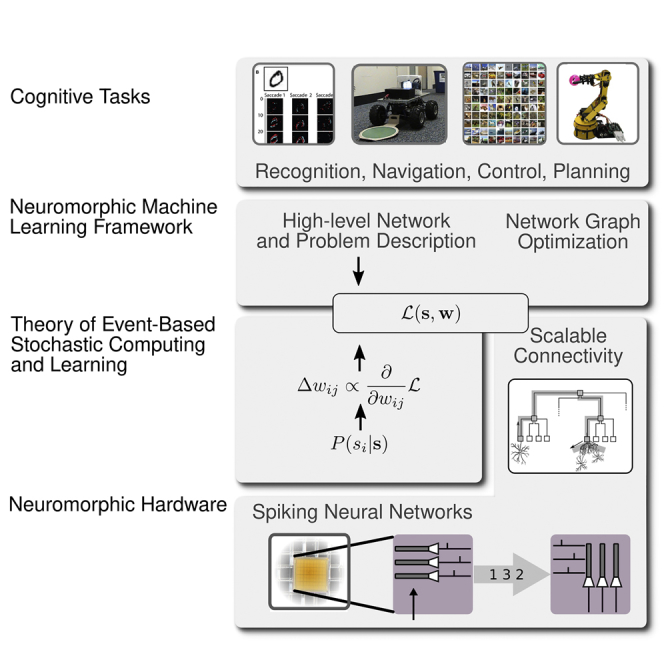
The success of deep networks and recent industry involvement in brain-inspired computing is igniting a widespread interest in neuromorphic hardware that emulates the biological processes of the brain on an electronic substrate. This review explores interdisciplinary approaches anchored in machine learning theory that enable the applicability of neuromorphic technologies to real-world, human-centric tasks. We find that (1) recent work in binary deep networks and approximate gradient descent learning are strikingly compatible with a neuromorphic substrate; (2) where real-time adaptability and autonomy are necessary, neuromorphic technologies can achieve significant advantages over main-stream ones; and (3) challenges in memory technologies, compounded by a tradition of bottom-up approaches in the field, block the road to major breakthroughs. We suggest that a neuromorphic learning framework, tuned specifically for the spatial and temporal constraints of the neuromorphic substrate, will help guiding hardware algorithm co-design and deploying neuromorphic hardware for proactive learning of real-world data.
深度神经网络的成功以及近期行业对受大脑启发的计算的参与,正在引发人们对神经形态硬件的广泛兴趣,这种硬件可在电子基板上模拟大脑的生物过程。本综述探讨了基于机器学习理论的跨学科方法,这些方法使神经形态技术能够应用于现实世界中以人类为中心的任务。我们发现:(1)二元深度网络和近似梯度下降学习方面的近期工作与神经形态基板惊人地兼容;(2)在需要实时适应性和自主性的情况下,神经形态技术相对于主流技术可实现显著优势;(3)存储技术方面的挑战,再加上该领域自下而上方法的传统,阻碍了重大突破的道路。我们建议,专门针对神经形态基板的空间和时间约束进行调整的神经形态学习框架,将有助于指导硬件算法协同设计,并部署神经形态硬件以主动学习现实世界的数据。