Detorakis Georgios, Sheik Sadique, Augustine Charles, Paul Somnath, Pedroni Bruno U, Dutt Nikil, Krichmar Jeffrey, Cauwenberghs Gert, Neftci Emre
Department of Cognitive Sciences, University of California, Irvine, Irvine, CA, United States.
Biocircuits Institute, University of California, San Diego, La Jolla, CA, United States.
Front Neurosci. 2018 Aug 29;12:583. doi: 10.3389/fnins.2018.00583. eCollection 2018.
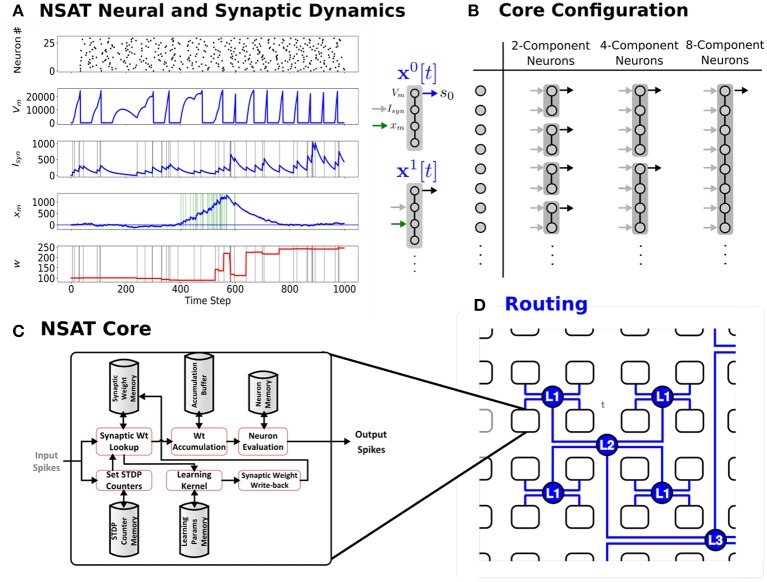
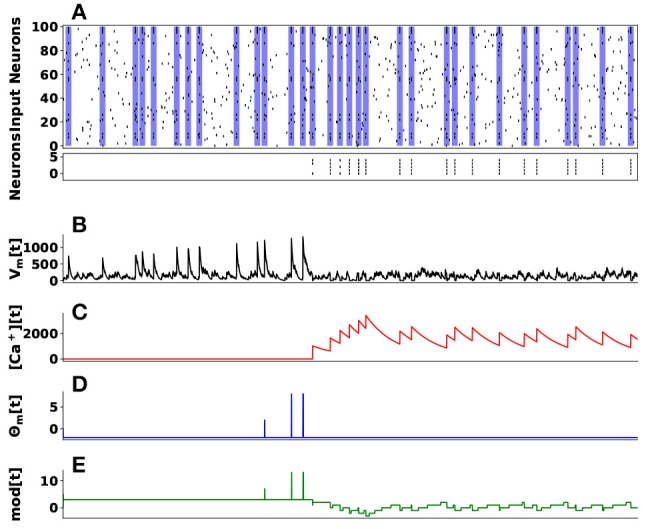
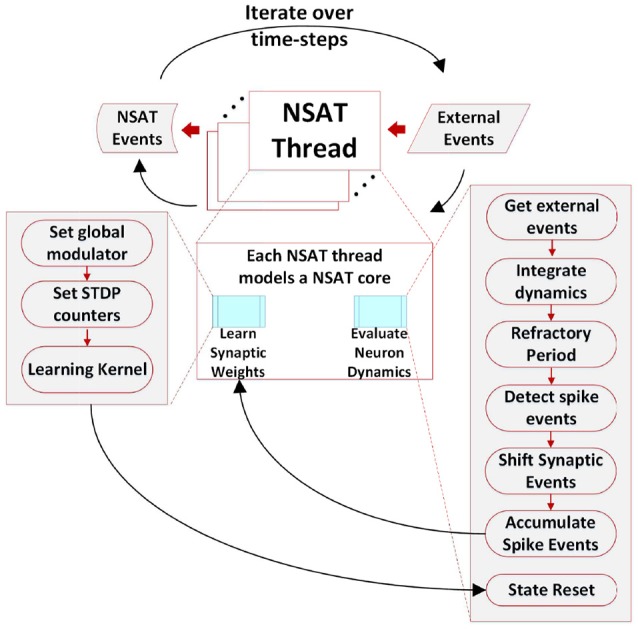
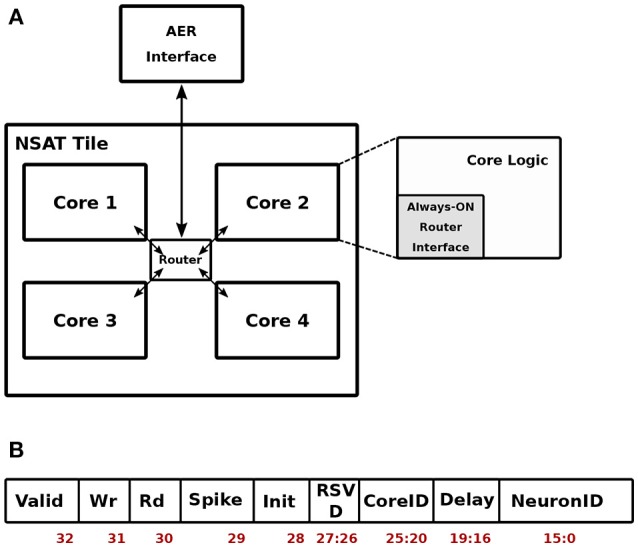
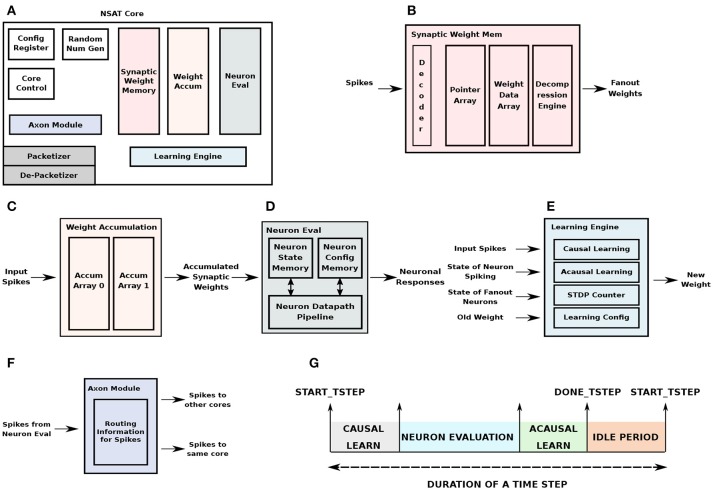
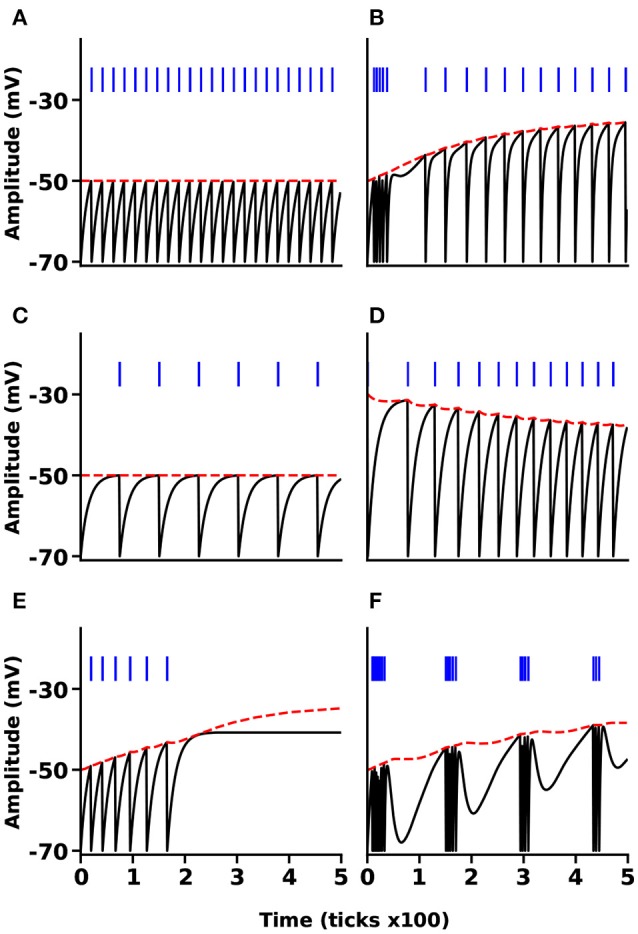
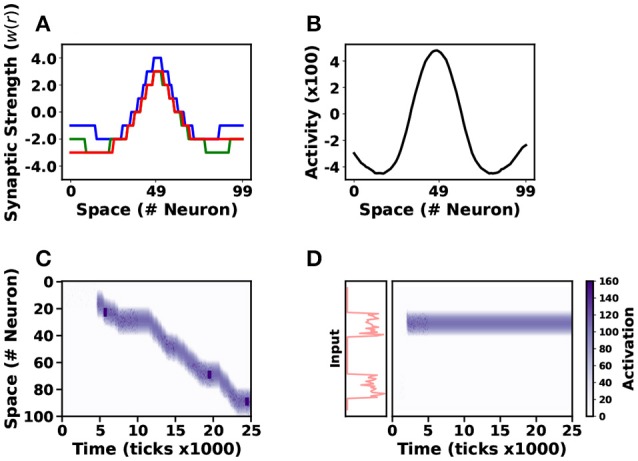
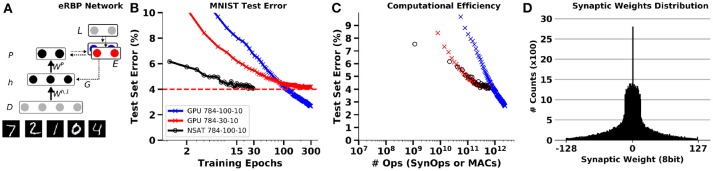
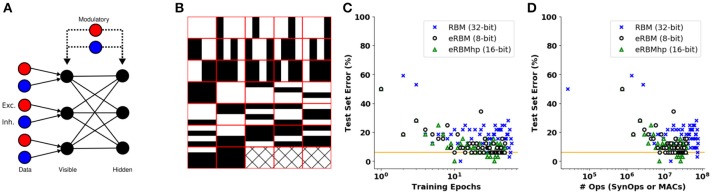
Embedded, continual learning for autonomous and adaptive behavior is a key application of neuromorphic hardware. However, neuromorphic implementations of embedded learning at large scales that are both flexible and efficient have been hindered by a lack of a suitable algorithmic framework. As a result, most neuromorphic hardware are trained off-line on large clusters of dedicated processors or GPUs and transferred to the device. We address this by introducing the neural and synaptic array transceiver (NSAT), a neuromorphic computational framework facilitating flexible and efficient embedded learning by matching algorithmic requirements and neural and synaptic dynamics. NSAT supports event-driven supervised, unsupervised and reinforcement learning algorithms including deep learning. We demonstrate the NSAT in a wide range of tasks, including the simulation of Mihalas-Niebur neuron, dynamic neural fields, event-driven random back-propagation for event-based deep learning, event-based contrastive divergence for unsupervised learning, and voltage-based learning rules for sequence learning. We anticipate that this contribution will establish the foundation for a new generation of devices enabling adaptive mobile systems, wearable devices, and robots with data-driven autonomy.
用于自主和自适应行为的嵌入式持续学习是神经形态硬件的关键应用。然而,缺乏合适的算法框架阻碍了大规模灵活高效的嵌入式学习的神经形态实现。因此,大多数神经形态硬件都是在大型专用处理器集群或图形处理器上进行离线训练,然后再转移到设备上。我们通过引入神经和突触阵列收发器(NSAT)来解决这个问题,NSAT是一个神经形态计算框架,通过匹配算法要求与神经和突触动力学来促进灵活高效的嵌入式学习。NSAT支持事件驱动的监督学习、无监督学习和强化学习算法,包括深度学习。我们在广泛的任务中展示了NSAT,包括米哈拉斯-尼布尔神经元的模拟、动态神经场、基于事件的深度学习的事件驱动随机反向传播、无监督学习的基于事件的对比散度以及序列学习的基于电压的学习规则。我们预计这一贡献将为新一代设备奠定基础,这些设备能够实现具有数据驱动自主性的自适应移动系统、可穿戴设备和机器人。