Laboratory of Biomolecular Research, Paul Scherrer Institute (PSI), 5232 Villigen PSI, Switzerland.
Department of Biology, ETH Zürich, Wolfgang-Pauli-Strasse 27, 8093 Zürich, Switzerland.
Sci Adv. 2018 Sep 19;4(9):eaat7052. doi: 10.1126/sciadv.aat7052. eCollection 2018 Sep.
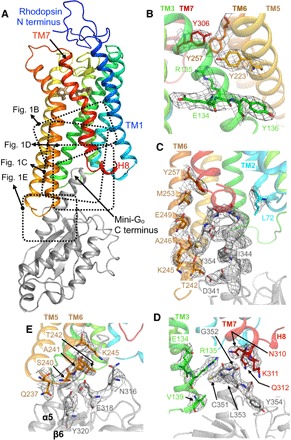
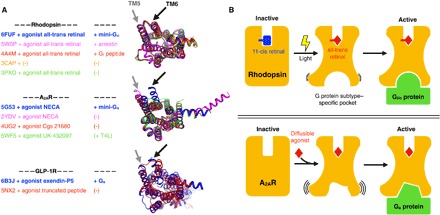
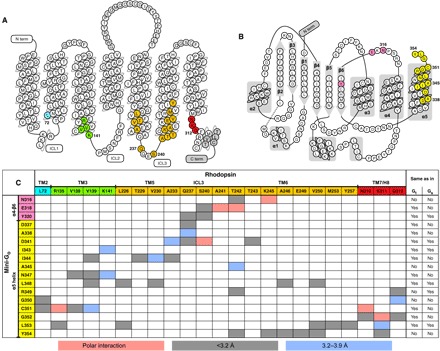
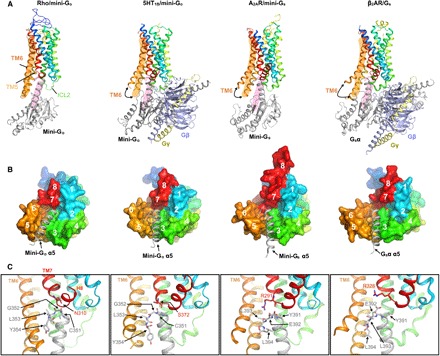
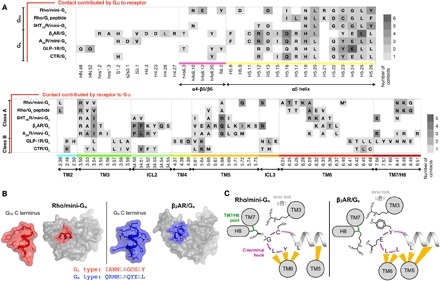
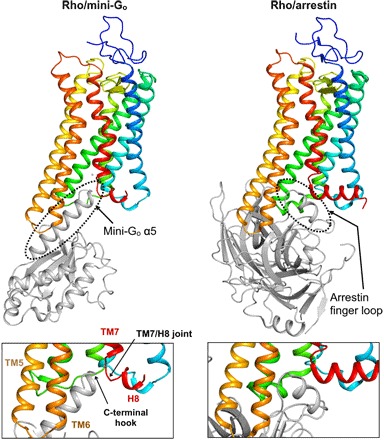
Selective coupling of G protein (heterotrimeric guanine nucleotide-binding protein)-coupled receptors (GPCRs) to specific Gα-protein subtypes is critical to transform extracellular signals, carried by natural ligands and clinical drugs, into cellular responses. At the center of this transduction event lies the formation of a signaling complex between the receptor and G protein. We report the crystal structure of light-sensitive GPCR rhodopsin bound to an engineered mini-G protein. The conformation of the receptor is identical to all previous structures of active rhodopsin, including the complex with arrestin. Thus, rhodopsin seems to adopt predominantly one thermodynamically stable active conformation, effectively acting like a "structural switch," allowing for maximum efficiency in the visual system. Furthermore, our analysis of the well-defined GPCR-G protein interface suggests that the precise position of the carboxyl-terminal "hook-like" element of the G protein (its four last residues) relative to the TM7/helix 8 (H8) joint of the receptor is a significant determinant in selective G protein activation.
G 蛋白(异三聚体鸟苷酸结合蛋白)偶联受体(GPCR)与特定 Gα-蛋白亚型的选择性偶联对于将天然配体和临床药物携带的细胞外信号转化为细胞反应至关重要。在这种转导事件的中心,受体和 G 蛋白之间形成了一个信号复合物。我们报告了光敏感 GPCR 视紫红质与工程化的迷你 G 蛋白结合的晶体结构。该受体的构象与所有先前的活性视紫红质结构相同,包括与阻滞蛋白的复合物。因此,视紫红质似乎主要采用一种热力学稳定的活性构象,有效地充当“结构开关”,从而在视觉系统中实现最大效率。此外,我们对明确的 GPCR-G 蛋白界面的分析表明,G 蛋白羧基末端“钩状”元件(其最后四个残基)相对于受体 TM7/螺旋 8(H8)连接处的精确位置是选择性 G 蛋白激活的重要决定因素。