Rajaram Ajay, Bale Gemma, Kewin Matthew, Morrison Laura B, Tachtsidis Ilias, St Lawrence Keith, Diop Mamadou
Imaging Program, Lawson Health Research Institute, 268 Grosvenor St., London, ON, N6A 4V2, Canada.
Department of Medical Biophysics, Western University, 1151 Richmond St., London, ON, N6A 3K7, Canada.
Biomed Opt Express. 2018 May 10;9(6):2588-2603. doi: 10.1364/BOE.9.002588. eCollection 2018 Jun 1.
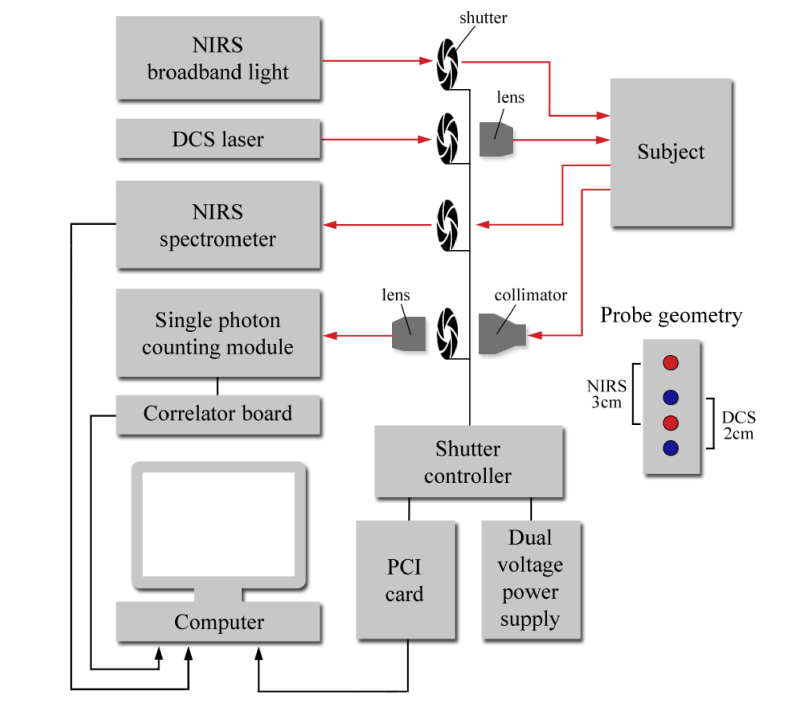
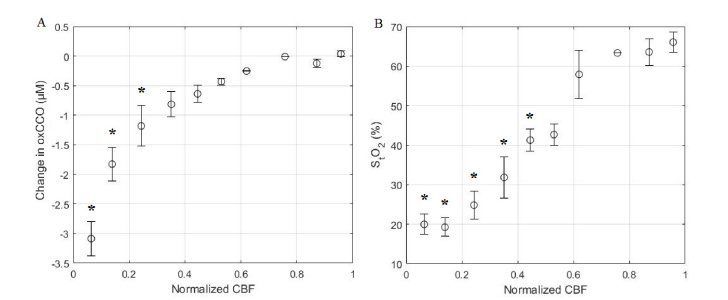
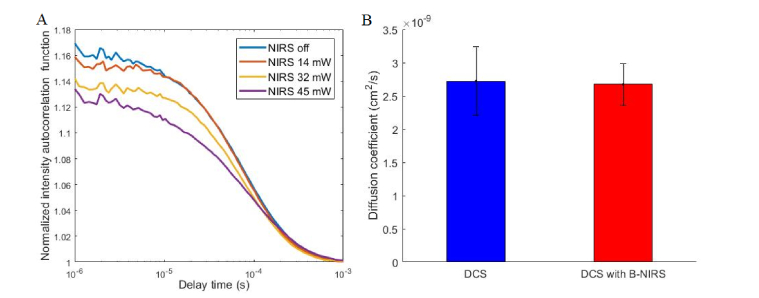
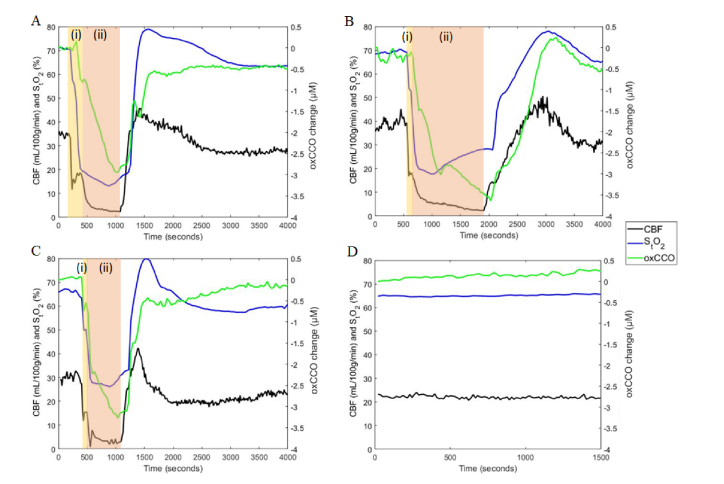
Preterm infants born with very low birth weights are at a high risk of brain injury, in part because the premature brain is believed to be prone to periods of low cerebral blood flow (CBF). Tissue damage is likely to occur if reduction in CBF is sufficient to impair cerebral energy metabolism for extended periods. Therefore, a neuromonitoring method that can detect reductions in CBF, large enough to affect metabolism, could alert the neonatal intensive care team before injury occurs. In this report, we present the development of an optical system that combines diffuse correlation spectroscopy (DCS) for monitoring CBF and broadband near-infrared spectroscopy (B-NIRS) for monitoring the oxidation state of cytochrome c oxidase (oxCCO) - a key biomarker of oxidative metabolism. The hybrid instrument includes a multiplexing system to enable concomitant DCS and B-NIRS measurements while avoiding crosstalk between the two subsystems. The ability of the instrument to monitor dynamic changes in CBF and oxCCO was demonstrated in a piglet model of neonatal hypoxia-ischemia (HI). Experiments conducted in eight animals, including two controls, showed that oxCCO exhibited a delayed response to ischemia while CBF and tissue oxygenation (SO) responses were instantaneous. These findings suggest that simultaneous neuromonitoring of perfusion and metabolism could provide critical information regarding clinically significant hemodynamic events prior to the onset of brain injury.
出生时体重极低的早产儿面临脑损伤的高风险,部分原因是人们认为早产的大脑容易出现脑血流量(CBF)降低的时期。如果脑血流量的减少足以长时间损害脑能量代谢,就可能会发生组织损伤。因此,一种能够检测到足以影响代谢的脑血流量减少的神经监测方法,可以在损伤发生前提醒新生儿重症监护团队。在本报告中,我们介绍了一种光学系统的开发,该系统结合了用于监测脑血流量的扩散相关光谱法(DCS)和用于监测细胞色素c氧化酶(oxCCO)氧化状态的宽带近红外光谱法(B-NIRS)——氧化代谢的关键生物标志物。该混合仪器包括一个多路复用系统,以实现DCS和B-NIRS的同步测量,同时避免两个子系统之间的串扰。该仪器监测脑血流量和oxCCO动态变化的能力在新生仔猪缺氧缺血(HI)模型中得到了验证。在包括两只对照动物在内的八只动物身上进行的实验表明,oxCCO对缺血的反应具有延迟性,而脑血流量和组织氧合(SO)反应是即时的。这些发现表明,同时进行灌注和代谢的神经监测可以在脑损伤发生前提供有关具有临床意义的血流动力学事件的关键信息。