Yan Shujuan, Zhang Ruyi, Wu Ke, Cui Jing, Huang Shifeng, Ji Xiaojuan, An Liping, Yuan Chengfu, Gong Cheng, Zhang Linghuan, Liu Wei, Feng Yixiao, Zhang Bo, Dai Zhengyu, Shen Yi, Wang Xi, Luo Wenping, Liu Bo, Haydon Rex C, Lee Michael J, Reid Russell R, Wolf Jennifer Moriatis, Shi Qiong, Luu Hue H, He Tong-Chuan, Weng Yaguang
Ministry of Education Key Laboratory of Diagnostic Medicine and School of Laboratory Medicine, Chongqing Medical University, Chongqing 400016, China.
Molecular Oncology Laboratory, Department of Orthopaedic Surgery and Rehabilitation Medicine, The University of Chicago Medical Center, Chicago, IL 60637, USA.
Genes Dis. 2018 Apr 27;5(2):172-184. doi: 10.1016/j.gendis.2018.04.006. eCollection 2018 Jun.
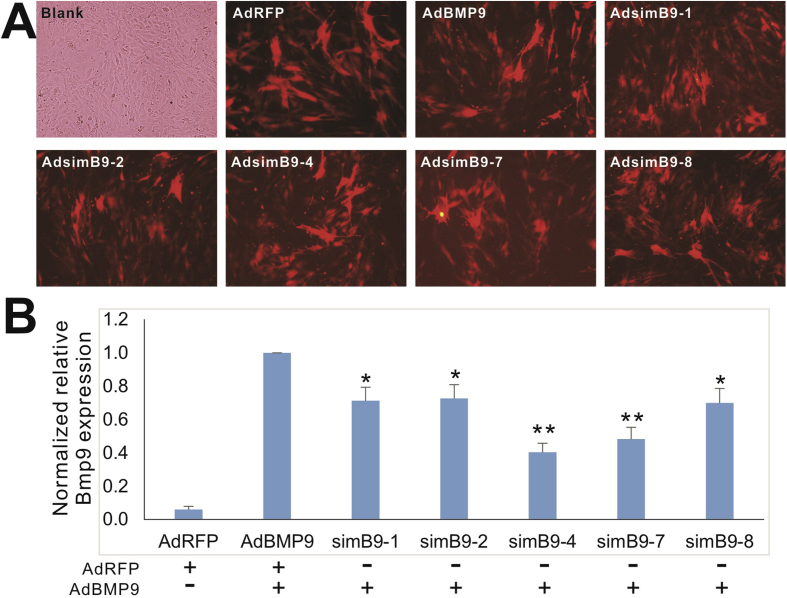
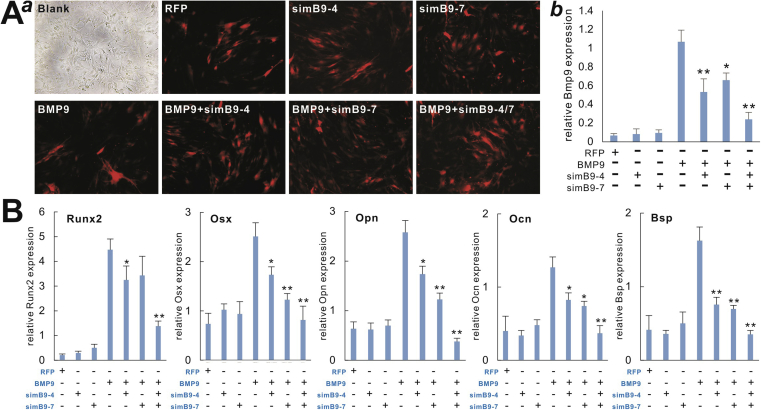
Mesenchymal stem cells (MSCs) are multipotent stem cells and capable of differentiating into multiple cell types including osteoblastic, chondrogenic and adipogenic lineages. We previously identified BMP9 as one of the most potent BMPs that induce osteoblastic differentiation of MSCs although exact molecular mechanism through which BMP9 regulates osteogenic differentiation remains to be fully understood. Here, we seek to develop a recombinant adenovirus system to optimally silence mouse BMP9 and then characterize the important role of BMP9 in osteogenic differentiation of MSCs. Using two different siRNA bioinformatic prediction programs, we design five siRNAs targeting mouse BMP9 (or simB9), which are expressed under the control of the converging H1 and U6 promoters in recombinant adenovirus vectors. We demonstrate that two of the five siRNAs, simB9-4 and simB9-7, exhibit the highest efficiency on silencing exogenous mouse BMP9 in MSCs. Furthermore, simB9-4 and simB9-7 act synergistically in inhibiting BMP9-induced expression of osteogenic markers, matrix mineralization and ectopic bone formation from MSCs. Thus, our findings demonstrate the important role of BMP9 in osteogenic differentiation of MSCs. The characterized simB9 siRNAs may be used as an important tool to investigate the molecular mechanism behind BMP9 osteogenic signaling. Our results also indicate that recombinant adenovirus-mediated expression of siRNAs is efficient and sustained, and thus may be used as an effective delivery vehicle of siRNA therapeutics.
间充质干细胞(MSCs)是多能干细胞,能够分化为多种细胞类型,包括成骨细胞系、软骨细胞系和脂肪细胞系。我们之前鉴定出BMP9是诱导MSCs成骨分化的最有效骨形态发生蛋白(BMP)之一,尽管BMP9调节成骨分化的确切分子机制仍有待充分了解。在此,我们试图开发一种重组腺病毒系统,以最佳方式沉默小鼠BMP9,然后表征BMP9在MSCs成骨分化中的重要作用。使用两种不同的siRNA生物信息学预测程序,我们设计了五种靶向小鼠BMP9(或simB9)的siRNA,它们在重组腺病毒载体中在聚合的H1和U6启动子的控制下表达。我们证明,五种siRNA中的两种,simB9-4和simB9-7,在沉默MSCs中外源小鼠BMP9方面表现出最高效率。此外,simB9-4和simB9-7在抑制BMP9诱导的成骨标志物表达、基质矿化和MSCs异位骨形成方面具有协同作用。因此,我们的研究结果证明了BMP9在MSCs成骨分化中的重要作用。所表征的simB9 siRNAs可作为研究BMP9成骨信号背后分子机制的重要工具。我们的结果还表明,重组腺病毒介导的siRNAs表达是高效且持续的,因此可作为siRNA治疗剂的有效递送载体。