Zahraei Seyed Mohsen, Mohammadbeigi Abolfazl, Mohammadsalehi Narges, Sabouri Azam, Afrashteh Sima, Arsang Jang Shahram, Ansari Hossein, Khazaei Salman
Center for Communicable Diseases Control, Ministry of Health and Medical Education, Tehran, Iran.
Neurology and Neurosciences Research Center, Qom University of Medical Sciences, Qom, Iran.
J Res Health Sci. 2018 Jun 30;18(3):e00418.
The elimination target for measles as an acute and contagious disease in Eastern Mediterranean Region (EMR) and Iran is planned by high-quality surveillance. We aimed to monitor the surveillance quality indicators of measles by in all districts of Iran during 2014-16.
A cross-sectional study.
Four quality surveillance indicators of measles including non measles discarded rate, percent of suspected cases with adequate investigation, percent of adequate blood specimen collection and percent with timely availability of laboratory results were assessed in Iran. Surveillance data of measles were extracted from the measles surveillance system and the risk point score for each district was calculated based on WHO Risk Assessment Tool by a function of four indicators.
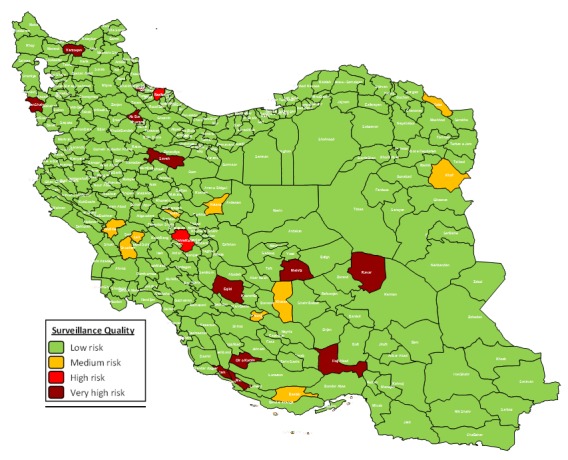
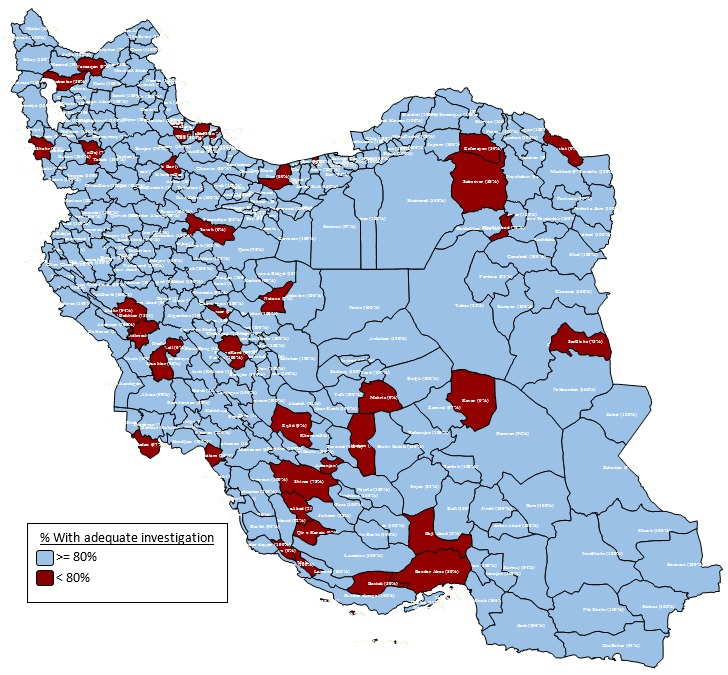
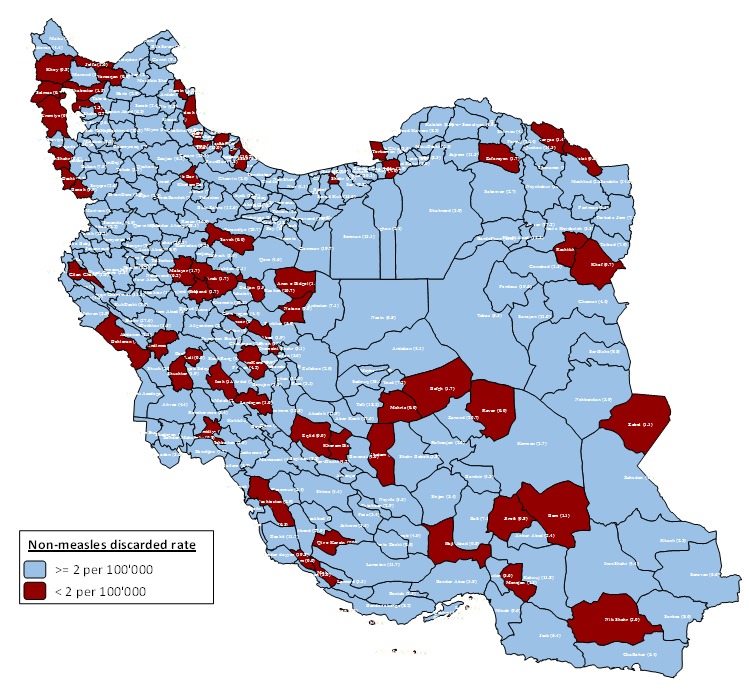
Overall, 14312 suspected cases and 322 districts were assessed and the risk points of measles' quality surveillance showed that 92.8% of Iranian districts were categorized as low risk, 2.8% medium risk, 0.62% high risk and 3.73% very high-risk category. The appropriate non measles discarded rate indicator was 87.3%. The percent of suspected cases with adequate investigation (more than 2 per 100000 people) was 87.9%. Moreover, the average of percent adequate blood specimen collection and percent with timely availability of laboratory results was 85.16% and 85.71%, respectively in all Iranian districts.
The surveillance quality indicators in Iran were good and higher than the WHO plans. Increasing the percentage of non-measles discarded rate could improve the poor quality in high risk and very high-risk districts.
东地中海区域(EMR)和伊朗计划通过高质量监测实现消除麻疹这一急性传染病的目标。我们旨在监测2014 - 2016年期间伊朗所有地区麻疹监测质量指标。
一项横断面研究。
在伊朗评估了麻疹的四个质量监测指标,包括非麻疹病例排除率、进行充分调查的疑似病例百分比、采集充足血标本的百分比以及实验室结果及时可得的百分比。从麻疹监测系统提取麻疹监测数据,并根据世界卫生组织风险评估工具,通过四个指标的函数计算每个地区的风险点得分。
总体上,评估了14312例疑似病例和322个地区,麻疹质量监测的风险点显示,92.8%的伊朗地区被归类为低风险,2.8%为中等风险,0.62%为高风险,3.73%为极高风险类别。合适的非麻疹病例排除率指标为87.3%。进行充分调查的疑似病例百分比(每10万人超过2例)为87.9%。此外,伊朗所有地区采集充足血标本的百分比和实验室结果及时可得的百分比平均值分别为85.16%和85.71%。
伊朗的监测质量指标良好,高于世界卫生组织的计划。提高非麻疹病例排除率百分比可改善高风险和极高风险地区的质量不佳状况。