Zahraei Seyed Mohsen, Zamani Golamabbas, Mohammadbeigi Abolfazl, Asgarian Azadeh, Afrashteh Sima, Gharibnavaz Hassan, Haghgou Mojtaba, Kone Souleymane
Center for Communicable Diseases Control, Ministry of Health and Medical Education, Tehran, Iran.
Neurosciences Research Center, Department of Epidemiology and Biostatistics, Qom University of Medical Sciences, Qom, Iran.
Heliyon. 2020 May 20;6(5):e04016. doi: 10.1016/j.heliyon.2020.e04016. eCollection 2020 May.
Vaccine wastage is one of quality indicators of immunization program and high vaccine wastage will increase overall costs and impede efforts towards a more efficient and sustainable program. We aimed at estimating of the wastage rates of Measles-Mumps-Rubella (MMR) and pentavalent (diphtheria-tetanus-pertussis-hepatitis B -Haemophilus influenza type b) vaccines in different vaccine vial sizes.
Multicentre descriptive study using existing data.
This study was in three provinces (Hamadan, Kermanshah and Kordestan) of Iran including 131,135 populations with 2,548 under-1years children. Twenty-seven health facilities were selected randomly from nine districts in three provinces of western part of Iran. Six-months data including vaccination and vaccine stock records collected from April to September 2017. Finally, number of opened vials and number of target population vaccinated were collected and data were analysed to estimate the wastage rates in both unopened and opened vials of both antigens.
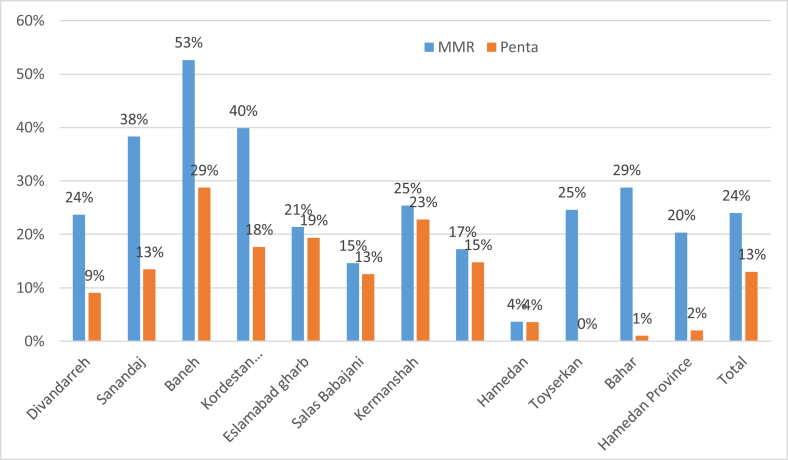
The wastage rate for combined MMR 2-dose and 5-dose opened vials for three provinces was 29%(Hamadan 18%, Kermanshah 14% and Kordestan 52%). The wastage rate for combined pentavalent single-dose and 10-dose vials for three provinces was 17% (in Kordestan33%, 11% Kermanshah 11% and Hamedan 3%). The total average of pentavalent single-dose and 10-dose vials wastage rate was 5% and varied 13% for urban and 3% for rural areas. The average of discarded unopened vials wastage rate in all facilities for MMR was 3.9% (3.2% for MMR 2-dose vial and 10.2% for MMR 5-dose vial). This rate was 1.7% for pentavalent total (1.9% for single dose vial and 0.4% for 10 dose vial).
The vaccine wastage rates in Iran are in line with other countries and lower than the suggested rate based on WHO policies for multi-dose vials. The wastage rates were different for in provinces, districts and health facilities. The MMR total wastage rate in rural is higher than those in urban areas. However, the pentavalent total wastage rate was higher in urban area.
疫苗浪费是免疫规划的质量指标之一,高疫苗浪费率会增加总体成本,并阻碍实现更高效和可持续规划的努力。我们旨在估算不同疫苗瓶规格的麻疹-腮腺炎-风疹(MMR)疫苗和五价(白喉-破伤风-百日咳-乙型肝炎- b型流感嗜血杆菌)疫苗的浪费率。
利用现有数据进行的多中心描述性研究。
本研究在伊朗的三个省份(哈马丹、克尔曼沙阿和库尔德斯坦)开展,涉及131,135人,其中1岁以下儿童有2548名。从伊朗西部三个省份的九个地区随机选取了27个卫生机构。收集了2017年4月至9月期间包括疫苗接种和疫苗库存记录在内的六个月数据。最后,收集了已开封疫苗瓶数量和接种目标人群数量,并对数据进行分析,以估算两种抗原未开封和已开封疫苗瓶的浪费率。
三个省份MMR两剂次和五剂次已开封疫苗瓶的总浪费率为29%(哈马丹18%,克尔曼沙阿14%,库尔德斯坦52%)。三个省份五价单剂量和十剂量疫苗瓶的总浪费率为17%(库尔德斯坦33%,克尔曼沙阿11%,哈马丹3%)。五价单剂量和十剂量疫苗瓶的总平均浪费率为5%,城市地区为13%,农村地区为3%。所有机构中MMR未开封废弃疫苗瓶的平均浪费率为3.9%(MMR两剂次疫苗瓶为3.2%,MMR五剂次疫苗瓶为10.2%)。五价疫苗总体的这一比率为1.7%(单剂量疫苗瓶为1.9%,十剂量疫苗瓶为0.4%)。
伊朗的疫苗浪费率与其他国家一致,低于世卫组织针对多剂量疫苗瓶政策建议的比率。不同省份、地区和卫生机构的浪费率存在差异。农村地区MMR总浪费率高于城市地区。然而,城市地区五价疫苗总浪费率更高。