Mohammadbeigi Abolfazl, Zahraei Seyed Mohsen, Asgarian Azadeh, Afrashteh Sima, Mohammadsalehi Narges, Khazaei Salman, Ansari Hossein
Research Center for Environmental Pollutants, Qom University of Medical Sciences, Qom, Iran.
Centre for Communicable Diseases Control, Ministry of Health and Medical Education, Tehran, Iran.
Heliyon. 2018 Nov 1;4(11):e00886. doi: 10.1016/j.heliyon.2018.e00886. eCollection 2018 Nov.
Based on the World Health Organization (WHO) reports the EMRO countries did not reached to eradication of measles at 2010. This study aimed to estimate the risk of measles outbreak in different districts of Iran to identify high-risk areas based on WHO measles programmatic risk assessment tool.
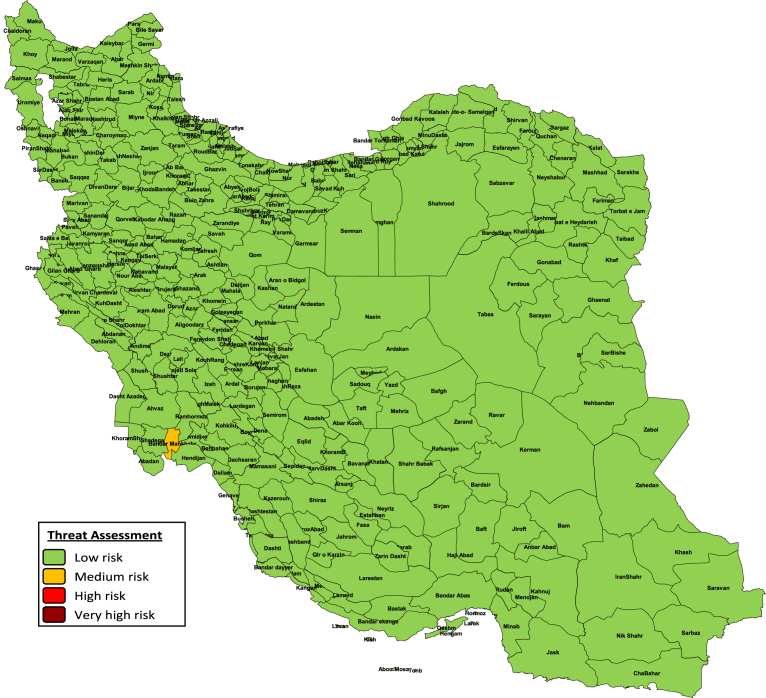
The WHO measles programmatic risk assessment tool was used to estimate the overall risk of measles in 31 providences and 322 districts of Iran at 2017. The measles risk was calculated by a function of four indicator scores including population immunity, surveillance quality, program performance, and threat assessment and the overall risk of measles for each districts calculated. Then, the tool assigned each district a risk category of low, medium, high, or very high according to the overall risk score.
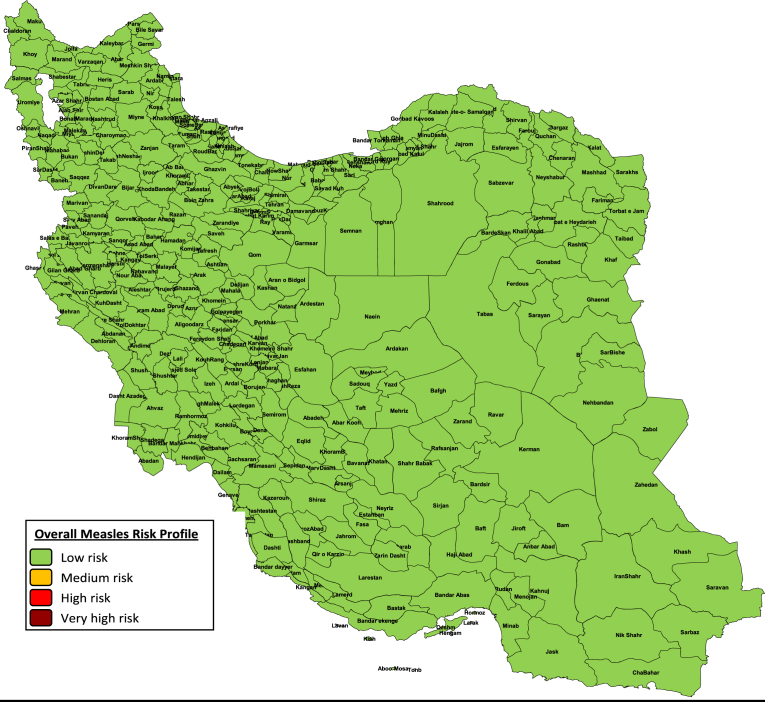
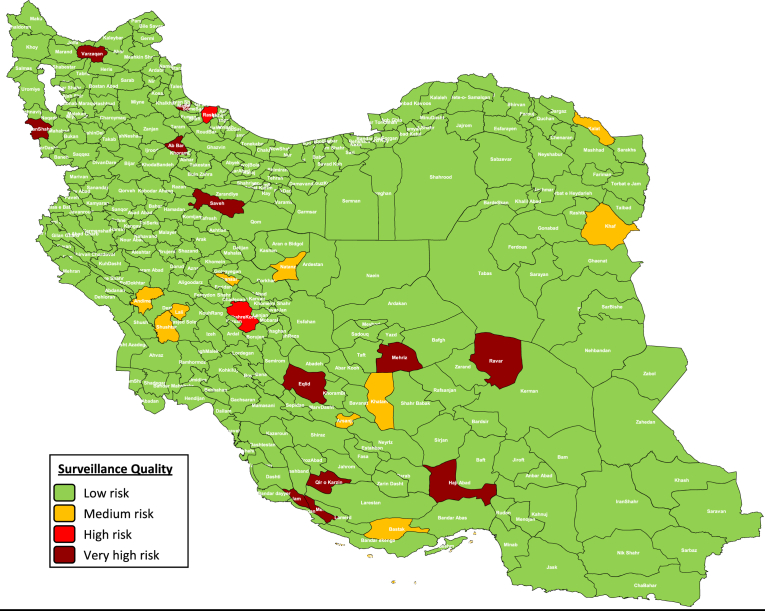
Of the 322 districts in Iran, all districts were categorized as low risk and there was no very high risk, high risk and medium risk district in Iran. Twenty-six districts (7.4%) received to risk point higher than 20. Based on population immunity and program delivery performance indicators, all districts in Iarn were categorized as low risk and 92.86% of districts were in low risk category by surveillance quality indicator.
The overall risk of measles profile was categorized as low risk and Iranian practices for measles elimination is very good in comparing other studies in this area. However, more attempts should be conducted to sustaining the surveillance quality indicators in all districts.
根据世界卫生组织(WHO)的报告,东地中海区域办事处(EMRO)的国家在2010年尚未实现麻疹消除目标。本研究旨在根据WHO麻疹规划风险评估工具,估算伊朗不同地区麻疹暴发的风险,以确定高风险地区。
使用WHO麻疹规划风险评估工具估算2017年伊朗31个省和322个地区的麻疹总体风险。麻疹风险通过四个指标得分的函数计算得出,这四个指标包括人群免疫力、监测质量、规划执行情况和威胁评估,并计算每个地区的麻疹总体风险。然后,该工具根据总体风险得分将每个地区分为低、中、高或极高风险类别。
在伊朗的322个地区中,所有地区均被归类为低风险,伊朗没有极高风险、高风险和中风险地区。26个地区(7.4%)的风险得分高于20。根据人群免疫力和规划实施绩效指标,伊朗所有地区均被归类为低风险,92.86%的地区根据监测质量指标处于低风险类别。
麻疹总体风险状况被归类为低风险,与该领域的其他研究相比,伊朗消除麻疹的做法非常好。然而,应做出更多努力以维持所有地区的监测质量指标。