Kwon Dong Rak, Park Gi-Young, Moon Yong Suk, Lee Sang Chul
Department of Rehabilitation Medicine, Catholic University of Daegu School of Medicine, Daegu, South Korea.
Department of Anatomy, Catholic University of Daegu School of Medicine, Daegu, South Korea.
Cell Transplant. 2018 Nov;27(11):1613-1622. doi: 10.1177/0963689718799040. Epub 2018 Oct 1.
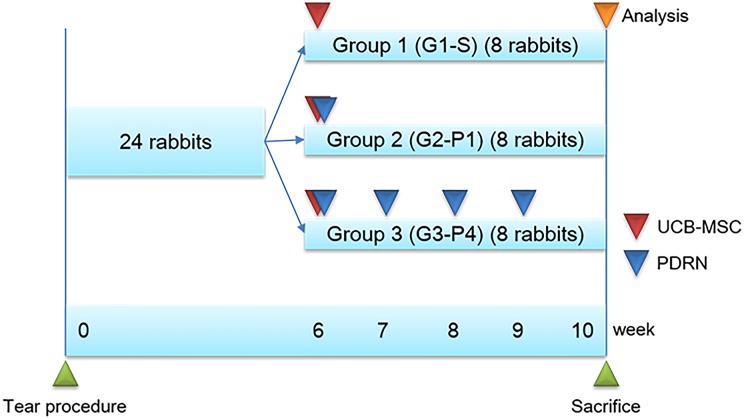
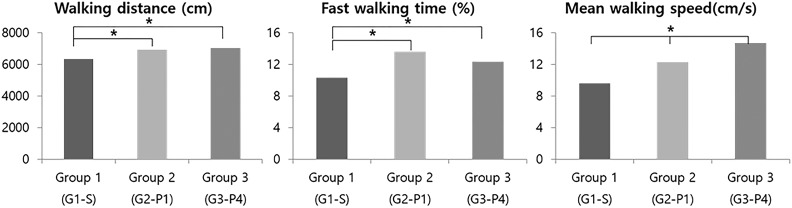
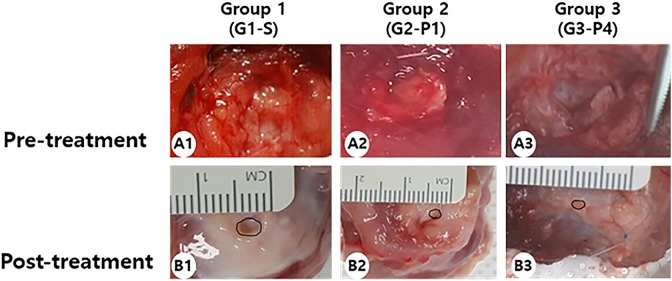
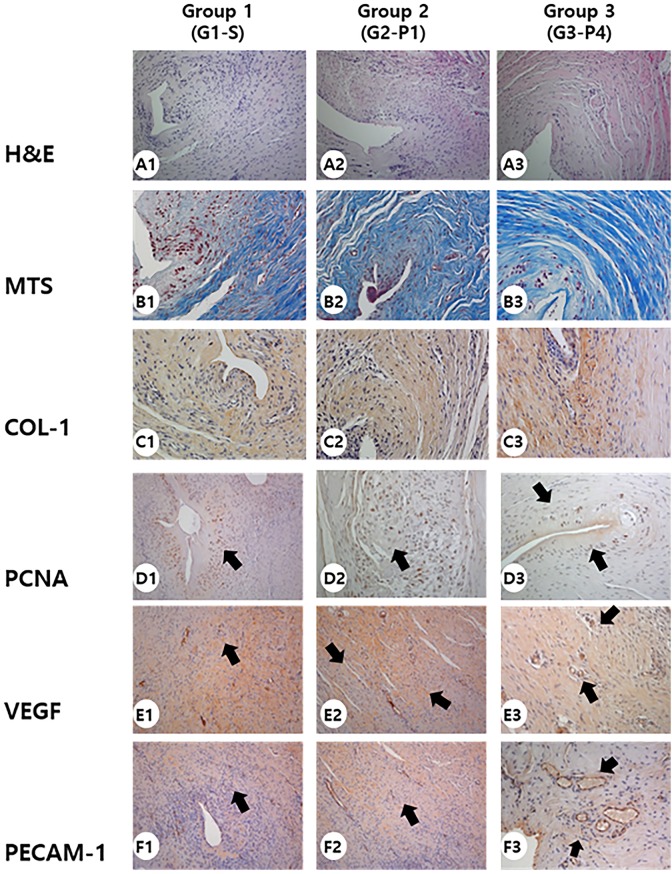
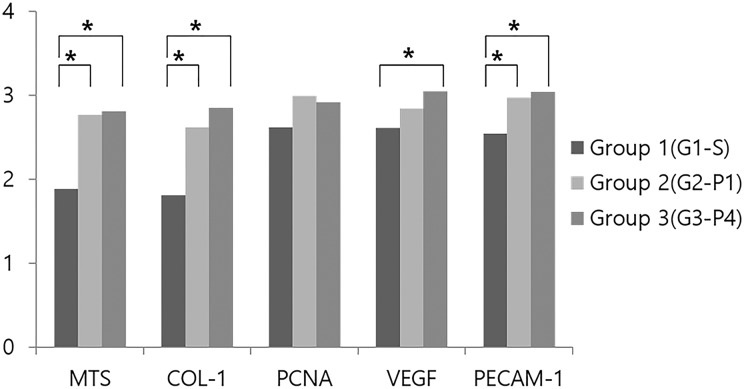
While therapies using mesenchymal stem cells (MSCs) to treat rotator cuff tendon tear (RCTT) have yielded some promising preliminary results, MSCs therapy has not yet completely regenerated full-thickness RCTT (FTRCTT). It has recently been reported that polydeoxyribonucleotide (PDRN) is effective in the treatment of chronic rotator cuff disease. We hypothesized that local injection of human umbilical cord blood-derived (UCB)-MSCs with PDRN would be more effective in regenerating tendon tear than UCB-MSCs alone. The purpose of this study was to evaluate the effects of UCB-MSCs combined with different doses of PDRN on the regeneration of RCTT in a chronic RCTT model by using a rabbit model. New Zealand white rabbits ( = 24) with FTRCTT were allocated randomly into three groups (8 rabbits per group). Three different injectants (G1-S, 0.2 mL UCB-MSCs; G2-P1, 0.2 mL UCB-MSCs with one injection of 0.2 mL PDRN; G3-P4, 0.2 mL UCB-MSCs, and four injections of 0.2 mL PDRN per week) were injected into FTRCTT under US-guidance. After the rabbits were euthanized, we evaluated ross morphological and histological change. Motion analysis was also performed. There were significant differences in gross morphological changes between before, and at 4 weeks after injection, in all three groups, but no differences were found among the three groups. Masson's trichrome (MT) or anti-type 1 collagen antibody (COL-1)-positive cell densities in G2-P1 and G3-P4 were improved significantly compared with those in G1-S, but showed no significant difference between G2-P1 and G3-P4. On motion analysis, walking distance and fast walking time in G2-P1 and G3-P4 were significantly longer/higher than those in G1-S, but showed no significant differences between G2-P1 and G3-P4. These results demonstrated that there was no significant difference in the gross morphologic change of tendon tear between UCB-MSCs only and combination with PDRN injection in rabbit model of chronic traumatic FTRCTT. Furthermore, there were no significant differences in the regenerative effects between high and low doses of (0.8 and 0.2) mL of PDRN.
虽然使用间充质干细胞(MSCs)治疗肩袖肌腱撕裂(RCTT)的疗法已取得了一些有前景的初步成果,但MSCs疗法尚未完全实现全层RCTT(FTRCTT)的再生。最近有报道称,聚脱氧核糖核苷酸(PDRN)在治疗慢性肩袖疾病方面有效。我们假设,局部注射人脐带血来源(UCB)的MSCs与PDRN联合使用在肌腱撕裂再生方面比单独使用UCB-MSCs更有效。本研究的目的是通过使用兔模型,评估UCB-MSCs联合不同剂量PDRN对慢性RCTT模型中RCTT再生的影响。将患有FTRCTT的新西兰白兔(n = 24)随机分为三组(每组8只兔子)。在超声引导下,将三种不同的注射剂(G1-S,0.2 mL UCB-MSCs;G2-P1,0.2 mL UCB-MSCs加一次0.2 mL PDRN注射;G3-P4,0.2 mL UCB-MSCs,每周注射四次0.2 mL PDRN)注射到FTRCTT中。兔子安乐死后,我们评估了大体形态和组织学变化。还进行了运动分析。三组在注射前和注射后4周的大体形态变化均有显著差异,但三组之间未发现差异。与G1-S组相比,G2-P1组和G3-P4组的Masson三色染色(MT)或抗I型胶原抗体(COL-1)阳性细胞密度显著改善,但G2-P1组和G3-P4组之间无显著差异。在运动分析中,G2-P1组和G3-P4组的行走距离和快走时间显著长于/高于G1-S组,但G2-P1组和G3-P4组之间无显著差异。这些结果表明,在慢性创伤性FTRCTT兔模型中,仅UCB-MSCs与联合注射PDRN在肌腱撕裂的大体形态变化上无显著差异。此外,高剂量(0.8 mL)和低剂量(0.2 mL)PDRN的再生效果也无显著差异。