From the Department of Mathematics, Uppsala University, 75105 Uppsala, Sweden
From the Department of Mathematics, Uppsala University, 75105 Uppsala, Sweden.
J Biol Chem. 2018 Dec 7;293(49):18854-18863. doi: 10.1074/jbc.RA118.003795. Epub 2018 Oct 3.
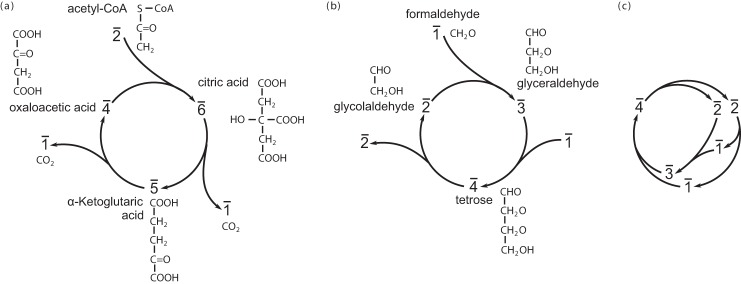
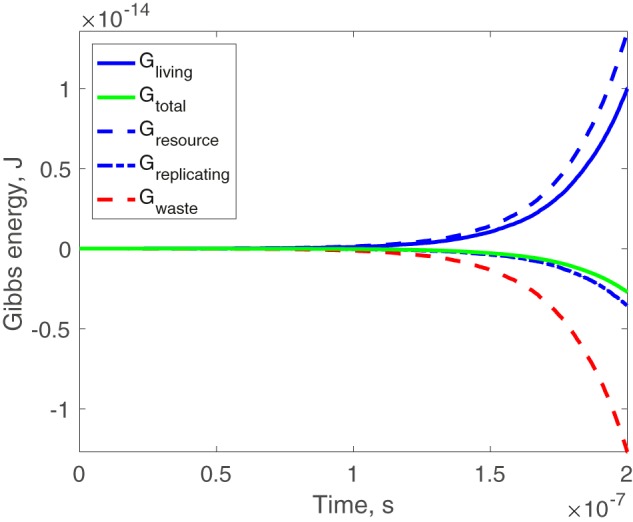
Explaining the origin of life requires us to elucidate how self-replication arises. To be specific, how can a self-replicating entity develop spontaneously from a chemical reaction system in which no reaction is self-replicating? Previously proposed mathematical models either supply an explicit framework for a minimal living system or consider only catalyzed reactions, and thus fail to provide a comprehensive theory. Here, we set up a general mathematical model for chemical reaction systems that properly accounts for energetics, kinetics, and the conservation law. We found that 1) some systems are collectively catalytic, a mode whereby reactants are transformed into end products with the assistance of intermediates (as in the citric acid cycle), whereas some others are self-replicating, that is, different parts replicate each other and the system self-replicates as a whole (as in the formose reaction, in which sugar is replicated from formaldehyde); 2) side reactions do not always inhibit such systems; 3) randomly chosen chemical universes (namely random artificial chemistries) often contain one or more such systems; 4) it is possible to construct a self-replicating system in which the entropy of some parts spontaneously decreases, in a manner similar to that discussed by Schrödinger; and 5) complex self-replicating molecules can emerge spontaneously and relatively easily from simple chemical reaction systems through a sequence of transitions. Together, these results start to explain the origins of prebiotic evolution.
解释生命的起源需要我们阐明自我复制是如何产生的。具体来说,一个自我复制的实体如何能够从没有自我复制反应的化学反应系统中自发地发展起来?以前提出的数学模型要么为最小生命系统提供了一个明确的框架,要么只考虑催化反应,因此无法提供全面的理论。在这里,我们为化学反应系统建立了一个通用的数学模型,该模型恰当地考虑了能量学、动力学和守恒定律。我们发现:1)有些系统是集体催化的,反应物在中间产物的辅助下转化为终产物(如柠檬酸循环),而有些系统是自我复制的,即不同部分相互复制,系统作为一个整体自我复制(如甲糖醛酸反应,其中糖由甲醛复制而来);2)副反应并不总是抑制这些系统;3)随机选择的化学宇宙(即随机人工化学)通常包含一个或多个这样的系统;4)有可能构建一个自我复制系统,其中一些部分的熵可以自发下降,类似于薛定谔所讨论的那样;5)复杂的自我复制分子可以通过一系列的转变,从简单的化学反应系统中自发而相对容易地出现。总的来说,这些结果开始解释前生物进化的起源。