Department of Psychiatry, Washington University School of Medicine, St. Louis, MO, USA.
Department of Computer Science, University of Granada, Granada, Spain.
Mol Psychiatry. 2020 Oct;25(10):2295-2312. doi: 10.1038/s41380-018-0263-6. Epub 2018 Oct 3.
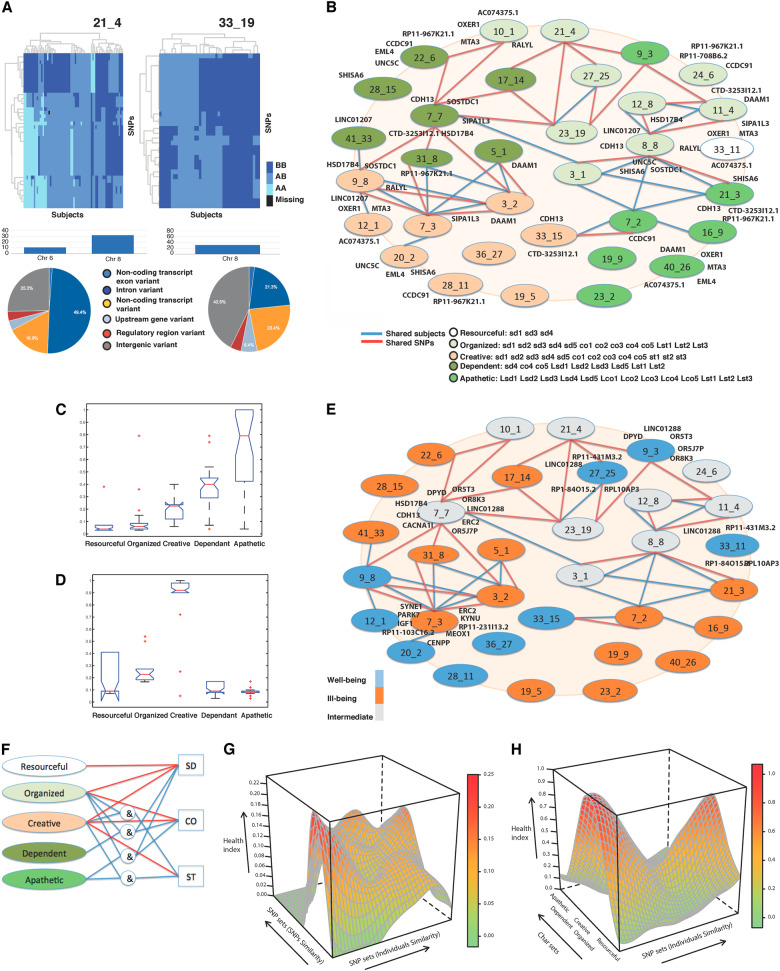
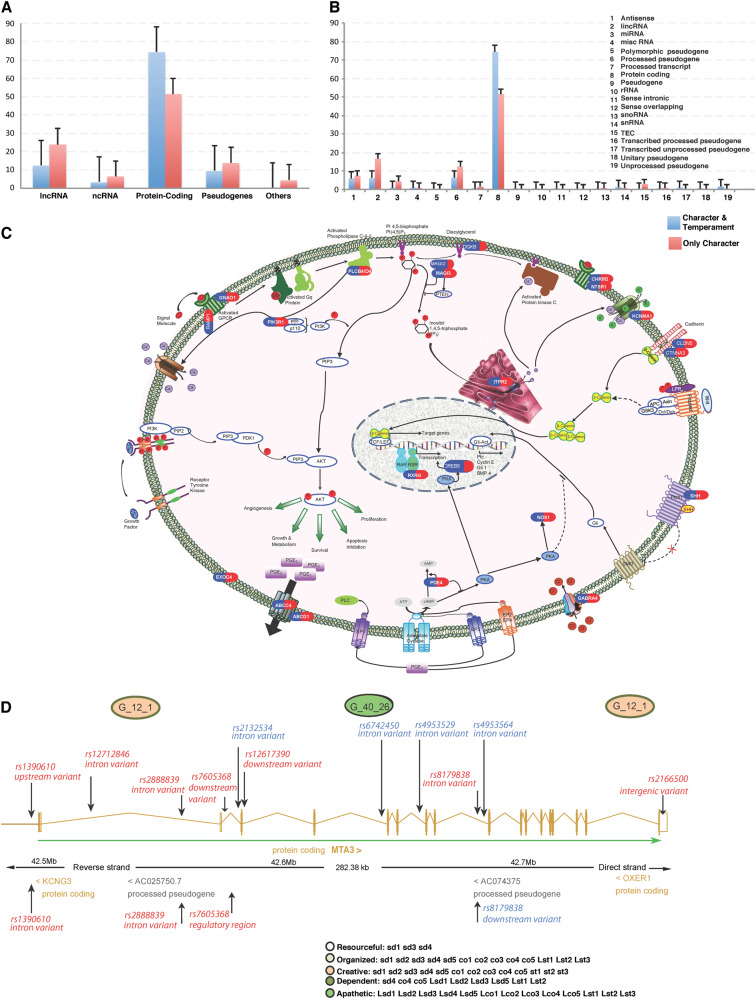
Human personality is 30-60% heritable according to twin and adoption studies. Hundreds of genetic variants are expected to influence its complex development, but few have been identified. We used a machine learning method for genome-wide association studies (GWAS) to uncover complex genotypic-phenotypic networks and environmental interactions. The Temperament and Character Inventory (TCI) measured the self-regulatory components of personality critical for health (i.e., the character traits of self-directedness, cooperativeness, and self-transcendence). In a discovery sample of 2149 healthy Finns, we identified sets of single-nucleotide polymorphisms (SNPs) that cluster within particular individuals (i.e., SNP sets) regardless of phenotype. Second, we identified five clusters of people with distinct profiles of character traits regardless of genotype. Third, we found 42 SNP sets that identified 727 gene loci and were significantly associated with one or more of the character profiles. Each character profile was related to different SNP sets with distinct molecular processes and neuronal functions. Environmental influences measured in childhood and adulthood had small but significant effects. We confirmed the replicability of 95% of the 42 SNP sets in healthy Korean and German samples, as well as their associations with character. The identified SNPs explained nearly all the heritability expected for character in each sample (50 to 58%). We conclude that self-regulatory personality traits are strongly influenced by organized interactions among more than 700 genes despite variable cultures and environments. These gene sets modulate specific molecular processes in brain for intentional goal-setting, self-reflection, empathy, and episodic learning and memory.
人格的可遗传性为 30-60%,这可通过对双胞胎和被收养者的研究得出。据预测,数以百计的遗传变异会影响其复杂的发展,但只有少数得到了确认。我们使用机器学习方法进行全基因组关联研究(GWAS),以揭示复杂的基因型-表型网络和环境相互作用。特质和性格问卷(TCI)衡量了对健康至关重要的自我调节成分(即自我导向、合作和自我超越的性格特征)。在一个由 2149 名健康芬兰人组成的发现样本中,我们确定了一组无论表型如何都在特定个体内聚类的单核苷酸多态性(SNP)。其次,我们确定了五个具有独特性格特征的人的特征聚类,无论基因型如何。第三,我们发现了 42 个 SNP 集,这些 SNP 集确定了 727 个基因座,与一个或多个性格特征显著相关。每个性格特征都与不同的 SNP 集相关,这些 SNP 集具有不同的分子过程和神经元功能。在儿童期和成年期测量的环境影响虽然很小,但具有显著影响。我们在健康的韩国和德国样本中证实了 42 个 SNP 集的可重复性,以及它们与性格的关联。确定的 SNP 解释了每个样本中性格特征可遗传的近 95%(50-58%)。我们得出的结论是,自我调节的性格特征受到 700 多个基因之间有组织的相互作用的强烈影响,尽管存在不同的文化和环境。这些基因集调节大脑中特定的分子过程,用于有目的的目标设定、自我反思、同理心和情景学习和记忆。