Sambodhi Research and Communications Pvt. Ltd., Noida, India.
Bill and Melinda Gates Foundation, Seattle, Washington, United States of America.
PLoS One. 2018 Oct 4;13(10):e0204810. doi: 10.1371/journal.pone.0204810. eCollection 2018.
To explore intersections of social determinants of maternal healthcare utilization using the Classification and Regression Trees (CART) algorithm which is a machine-learning method used to construct prediction models.
Institutional review board approval for this study was granted from Public Health Service-Ethical Review Board (PHS-ERB) and from the Health Ministry Screening Committee (HMSC) facilitated by Indian Council for Medical Research (ICMR). IRB review and approval for the current analyses was obtained from University of California, San Diego. Cross-sectional data were collected from women with children aged 0-11 months (n = 5,565) from rural households in 25 districts of Uttar Pradesh, India. Participants were surveyed on maternal healthcare utilization including registration of pregnancy (model-1), receipt of antenatal care (ANC) during pregnancy (model-2), and delivery at health facilities (model -3). Social determinants of health including wealth, social group, literacy, religion, and early age at marriage were captured during the survey. The Classification and Regression Tree (CART) algorithm was used to explore intersections of social determinants of healthcare utilization.
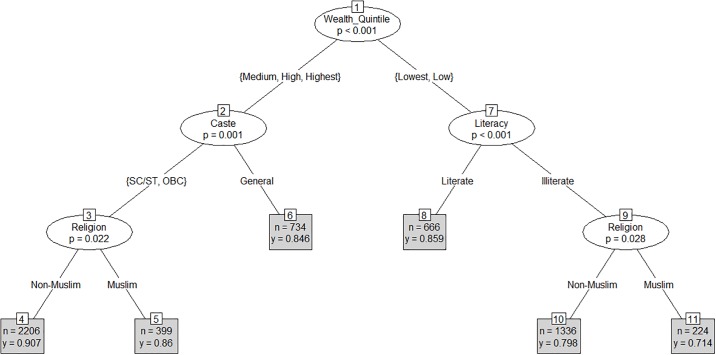
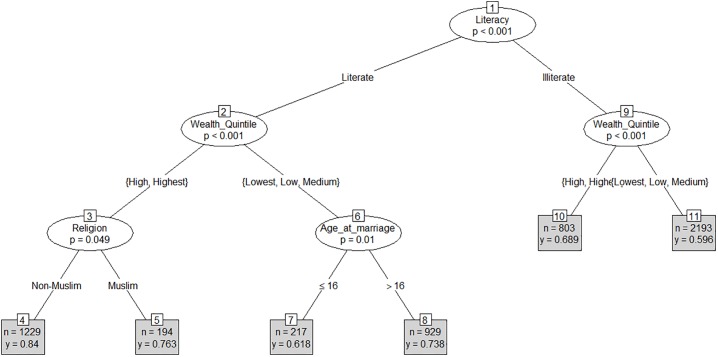
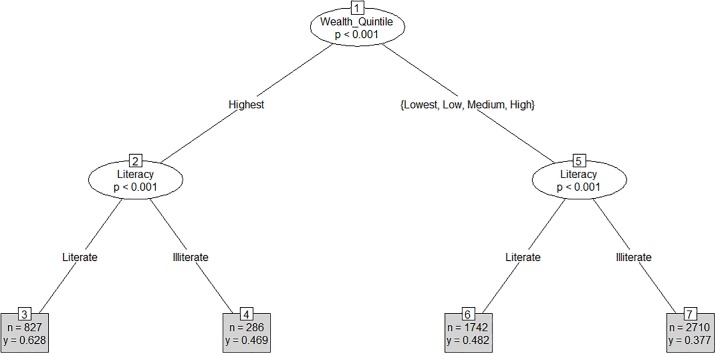
CART analyses highlight the intersections, particularly of wealth and literacy, in maternal healthcare utilization in Uttar Pradesh. Model-1 documents that women who are poorer, illiterate and Muslim are less likely to have their pregnancies registered (71.4% vs. 86.0% in the overall sample). Model-2 documents that poorer, illiterate women had the lowest ANC coverage (37.7% vs 45% in the overall sample). Model-3, developed for deliveries at health facilities, highlighted that illiterate and poor women have the lowest representation among facility deliveries (59.6% vs. 69% in the overall sample).
This paper explores the interactions between determinants of maternal healthcare utilization indicators. The findings in this paper highlights that the interaction of wealth and literacy can play a very strong role in accentuating or diminishing healthcare utilization among women. The study also reveals that religion and women's age at marriage also interact with wealth and literacy to create substantial disparities in utilization. The study provides insights into the effect of intersections of determinants, and highlights the importance of using a more nuanced understanding of the impact of co-occurring forms of marginalization to effectively tackle inequities in healthcare utilization.
使用分类回归树(CART)算法探索母婴保健利用的社会决定因素之间的交叉点,该算法是一种用于构建预测模型的机器学习方法。
本研究获得了公共卫生服务伦理审查委员会(PHS-ERB)和印度医学研究理事会(ICMR)促进的卫生部筛选委员会(HMSC)的机构审查委员会批准。加州大学圣地亚哥分校获得了对当前分析的 IRB 审查和批准。横断面数据来自印度北方邦 25 个地区农村家庭中 0-11 个月大儿童的母亲(n=5565)。调查了产妇保健利用情况,包括妊娠登记(模型 1)、妊娠期间接受产前护理(ANC)(模型 2)和在卫生设施分娩(模型 3)。在调查期间,还记录了健康的社会决定因素,包括财富、社会群体、文化程度、宗教和早婚。使用分类回归树(CART)算法来探索母婴保健利用的社会决定因素之间的交叉点。
CART 分析突出了社会决定因素在北方邦母婴保健利用方面的交叉点,特别是财富和文化程度之间的交叉点。模型 1 记录到,贫穷、文盲和穆斯林的女性更不可能登记怀孕(在总样本中为 71.4%,而不是 86.0%)。模型 2 记录到,贫穷、文盲的女性接受的 ANC 覆盖率最低(在总样本中为 37.7%,而不是 45%)。模型 3 是为在卫生机构分娩而制定的,突出显示了文盲和贫穷的女性在机构分娩中的代表性最低(在总样本中为 59.6%,而不是 69%)。
本文探讨了母婴保健利用指标的决定因素之间的相互作用。本文的研究结果表明,财富和文化程度的相互作用可能在强调或减少女性的保健利用方面发挥非常重要的作用。研究还表明,宗教和女性的初婚年龄也与财富和文化程度相互作用,造成利用方面的巨大差异。本研究提供了对决定因素相互作用的影响的深入了解,并强调了使用对同时存在的边缘化形式的影响的更细微的理解来有效解决保健利用方面的不平等现象的重要性。